
Locum Tenens and Physician Recruiter Contact Data
Locum tenens agencies and in-house physician recruiters are a distinct buying audience that most healthcare data vendors ignore. That's the opportunity.
2026-04-09
Locum Tenens Is a $7 Billion Market Hiding in Plain Sight
The locum tenens industry placed roughly $7 billion in physician staffing contracts in 2024, according to Staffing Industry Analysts. The market grew through the pandemic and hasn't slowed. Hospitals use locums to fill vacancies, cover leaves, staff new programs, and bridge to permanent hires. Group practices use locums for the same reasons. Telehealth platforms increasingly run on locum coverage.
For vendors selling into the staffing industry (credentialing software, scheduling tools, payment platforms, marketing services, data and lead generation), locum agencies and physician recruiters are a distinct buying audience with their own pain points. Most healthcare data vendors don't have a target list for them. That's the opportunity.
The Three Segments of Physician Staffing
Locum Tenens Agencies
Traditional locum tenens agencies match physicians with short-term assignments at hospitals and group practices. The largest agencies (Weatherby Healthcare, CompHealth, Locumsmart, Staff Care, Barton Associates, AMN Healthcare's locums division, and dozens of regional and specialty-focused agencies) collectively manage tens of thousands of active locum providers.
Buying decisions at locum agencies typically involve: the CEO or president, the VP of operations, the VP of sales, the recruiting director, the credentialing director, and the technology lead. They buy: physician contact databases for sourcing, credentialing software, applicant tracking systems, scheduling tools, payment platforms, marketing automation, and increasingly, AI-driven matching technology.
In-House Physician Recruiters
Hospitals and large group practices employ in-house physician recruiters who source permanent and locum physicians. According to the Association of American Medical Colleges, the US faces a projected physician shortage of 86,000-128,000 by 2036, which has accelerated in-house recruiting investment.
In-house physician recruiters work for: health systems, academic medical centers, large multispecialty groups, FQHCs, and increasingly, telehealth platforms. Their buying decisions involve: the CHRO or VP of talent acquisition, the physician recruitment director, and physician leaders involved in recruitment. They buy: physician contact databases, sourcing tools, applicant tracking systems, employer branding services, and recruitment marketing.
Locum Marketplaces and Tech Platforms
A newer category of marketplaces and platforms (Nomad Health, Trusted Health, Aya Healthcare's tech platform, Vivian Health for nursing, and several physician-specific platforms) has emerged in the last decade. These companies operate as tech-enabled marketplaces rather than traditional staffing agencies. They have engineering teams, product teams, and growth teams alongside their recruiting teams.
Marketplaces buy differently than traditional agencies. They look for: API-accessible data, programmatic enrichment, fraud and verification tools, clinical credentialing automation, and platform integrations. They're often more sophisticated tech buyers than traditional agencies.
What Each Segment Buys
| Need | Locum Agency | In-House Recruiter | Marketplace |
|---|---|---|---|
| Physician contact data | High | High | High (API) |
| Credentialing automation | High | Medium | High |
| ATS and CRM | High | High | Medium (built in-house) |
| Background check | High | High | High |
| License verification | High | High | High |
| Marketing automation | High | Medium | Low |
| Email outreach tools | High | Medium | Low |
| Scheduling tools | High | Low | Medium |
| Payment/billing platforms | High | Low | High |
| AI matching/sourcing | Growing | Growing | High |
The Decision-Maker Map
For locum agencies, the key contacts are:
- CEO or President: sets vendor strategy, approves large investments
- COO or VP Operations: manages recruiting and credentialing operations
- VP of Recruiting / Director of Recruiting: owns physician sourcing
- VP of Sales / Director of Sales: owns hospital and group client relationships
- Director of Credentialing: owns the credentialing process
- Director of IT or CTO: approves technology purchases
- Director of Marketing: owns physician acquisition and brand
For in-house physician recruiters, the key contacts are:
- CHRO or VP Talent Acquisition: approves vendor and budget decisions
- Director of Physician Recruitment: owns the function operationally
- Director of Provider Relations: bridges recruiting and physician leadership
- Chief Medical Officer: involved in physician leadership recruiting
- Service line leaders: drive recruiting needs by specialty
For marketplace platforms, the key contacts are:
- CEO and Founders: product and strategy decisions
- VP Product: integrates third-party tools into the platform
- VP Engineering: approves API integrations
- VP Operations: owns credentialing and verification workflows
- VP Growth: owns acquisition and marketing
Building a Locum Tenens and Physician Recruiter Target List
Step 1: Identify Locum Tenens Agencies
Start with the National Association of Locum Tenens Organizations (NALTO) member directory. Add: state-by-state locum agencies via Secretary of State filings, specialty-focused agencies (anesthesia locums, EM locums, hospitalist locums, psychiatry locums), and emerging tech-enabled platforms. The market has hundreds of agencies, not just the ten or twenty national names.
Step 2: Identify In-House Recruiting Functions
For each target health system, identify whether they have an in-house physician recruitment function. Most systems with 5+ hospitals do. Map: CHRO, VP Talent Acquisition, Director of Physician Recruitment, and any specialty-specific recruiters (often labeled "Provider Recruiter" or "Physician Liaison").
Step 3: Identify Marketplaces and Tech Platforms
Track new entrants in physician staffing tech. Funded platforms appear in Crunchbase and PitchBook. Many of them are still small enough to have founders directly involved in vendor decisions. The window for getting in front of founders is short before the company scales and adds layers of buying process.
Step 4: Layer Buyer Roles
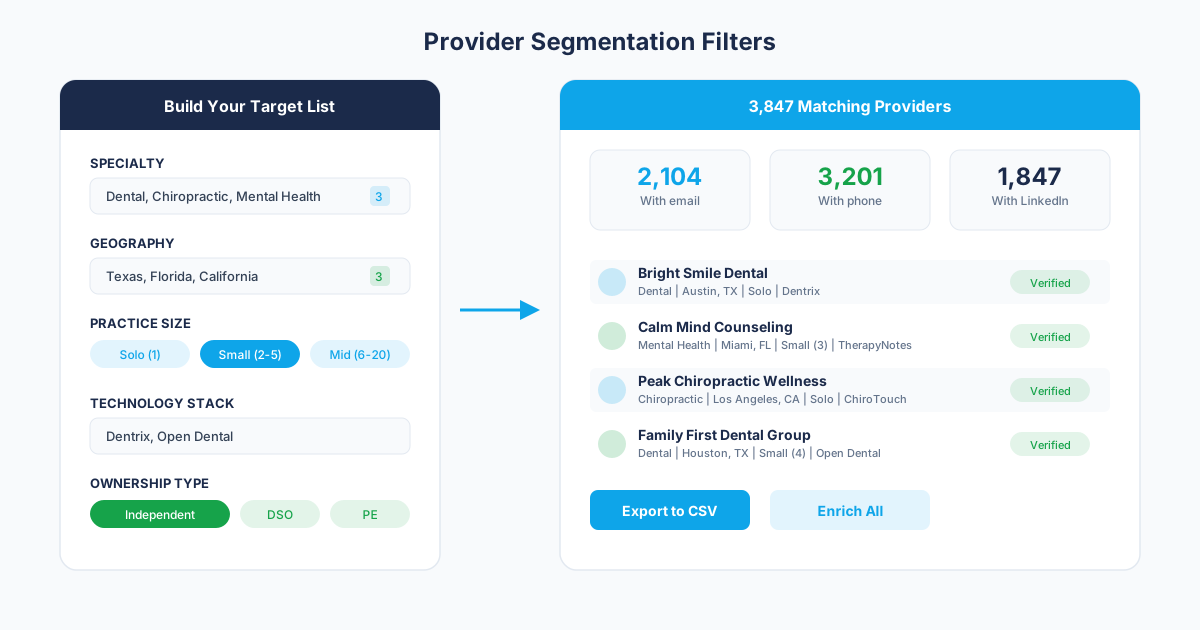
For each target organization, build the relevant buying committee from the role lists above. Direct contact information for each.
Step 5: Track Buying Triggers
Locum agencies have predictable buying triggers: new credentialing regulations, growth into new states, new specialty offerings, and ATS contract cycles. In-house recruiters have triggers tied to physician shortage announcements, new service line launches, and CHRO turnover. Marketplace platforms have triggers tied to funding rounds and product launches.
Mistakes Vendors Make Selling Into Physician Staffing
Mistake 1: Treating All Staffing Companies the Same
Locum tenens, allied health staffing, travel nursing, and per-diem nursing are different markets with different buyers. Allied health staffing companies (PT, OT, SLP) don't buy physician databases. Travel nursing agencies buy nursing data, not physician data. Don't waste outreach on the wrong segment.
Mistake 2: Pitching the Wrong Buying Committee
At a traditional locum agency, the recruiting director cares about physician contact data quality. The CTO cares about API access and integration. The CEO cares about ROI and competitive differentiation. Pitching the same message to all three wastes meetings.
Mistake 3: Ignoring Specialty Focus
An anesthesia-focused locum agency doesn't need broad physician data. They need anesthesia provider data with practice setting and case volume. Pitching general physician databases to specialty agencies signals you don't understand the market.
Mistake 4: Missing Marketplace Differences
Marketplace platforms operate like tech companies, not staffing agencies. They want APIs, not CSV downloads. They want enrichment that runs in workflow, not batch refreshes. Pitching them with traditional staffing language fails.
What Good Staffing Industry Data Looks Like
For each target organization, your database should include:
- Organization type: locum agency, in-house recruiter, marketplace platform, allied health staffing, travel nursing
- Specialty focus: if any (anesthesia, EM, psychiatry, hospitalist, etc.)
- Size indicators: employee count, revenue range, funding stage
- Geography: states served, primary office locations
- Buying committee: CEO, COO, recruiting director, IT, marketing director
- Tech stack indicators: ATS in use, credentialing platform in use
- Recent activity: funding rounds, new hires, new state expansions
- Contact data: direct email, phone, LinkedIn for each role
This is the dataset that turns a staffing industry sales motion into a repeatable pipeline. Get Provyx physician staffing industry data with full role and segment mapping.
Frequently Asked Questions
How big is the locum tenens market in the US?
The US locum tenens market is approximately $7 billion in annual physician staffing contracts and growing, according to Staffing Industry Analysts. The market includes traditional locum agencies, in-house physician recruiters at health systems, and emerging tech-enabled marketplaces. Demand has accelerated due to physician shortages and post-pandemic burnout-driven turnover.
Who are the largest locum tenens agencies?
The largest locum tenens agencies include CompHealth, Weatherby Healthcare, Locumsmart, Staff Care, Barton Associates, and AMN Healthcare's locums division. Beyond the national names, hundreds of regional and specialty-focused agencies compete for placements. Specialty-focused agencies often dominate their niche (anesthesia locums, EM locums, hospitalist locums, psychiatry locums).
How are physician recruitment marketplaces different from traditional locum agencies?
Marketplace platforms (Nomad Health, Trusted Health, Vivian Health, and similar) operate like tech companies with engineering, product, and growth teams alongside recruiting. They use APIs for data enrichment, build automated credentialing workflows, and integrate vendor tools into their platforms. Traditional locum agencies operate on relationship-based recruiting with CSV-style data and manual workflows. The buying processes are completely different.
Who buys vendor tools at a locum tenens agency?
The buying committee typically includes the CEO or president, COO or VP operations, VP recruiting, VP sales, director of credentialing, and director of IT. Larger agencies may have specialized vendor management. Smaller agencies often have CEO-driven decisions with input from operational leads. Sales motions should map all relevant roles, not just the recruiting director.
Why is in-house physician recruiting growing?
The US faces a projected physician shortage of 86,000-128,000 by 2036, according to the Association of American Medical Colleges. Health systems have responded by building in-house physician recruiting functions to reduce reliance on external agencies, control costs, and build employer brand. CHRO and VP talent acquisition leaders have growing budgets for physician recruitment technology and data.
What credentialing data do locum agencies need?
Locum agencies need: state medical license verification with expiration dates, DEA license, board certification status, malpractice history, sanction history, NPDB queries, hospital privileges, and CAQH ProView data. Credentialing automation is one of the highest-pain workflows in the industry, and vendors offering verified, structured credentialing data find strong product-market fit.
Sources and References
Related Resources
Get the Provider Data You Need
Tell us what you're looking for. We'll build a custom list matched to your target market.
Trusted by healthcare sales teams, medical device companies, and health IT vendors across the US.