
Healthcare CRM Data Enrichment: How to Fix Your Aging Provider Records
Your CRM data is aging faster than you think. Here's how to stop the decay and get your provider records back to campaign-ready.
2026-02-20
Your CRM Data Is Rotting Right Now
Here's a number that should make every healthcare sales leader uncomfortable: provider data decays at 4-6% per month. That's not a typo. Every month, 4-6% of the records in your CRM become less accurate. Phone numbers disconnect. Providers move practices. Office managers leave. Practices get acquired. Addresses change. Emails bounce.
Do the math. If you loaded a perfectly clean provider list into your CRM in January, by June roughly 25-30% of those records have at least one field that's wrong or outdated. By December, you're working with data where nearly half the records have degraded in some way.
Most teams don't notice the decay until the symptoms get painful. Rep connect rates drop. Email bounce rates creep up. Campaign response rates decline quarter over quarter. Marketing blames sales. Sales blames the data. Nobody fixes the root problem.
The root problem is that healthcare provider data has a shelf life, and most teams don't have an enrichment process to keep it fresh.
Why Healthcare Data Decays Faster Than Other B2B Data
B2B data decay is a universal problem. But healthcare provider data degrades faster than most other verticals. Here's why.
Provider Mobility
According to the AMA's Physician Practice Benchmark Survey, roughly 8% of physicians change practice locations in any given year. Among younger physicians (under 40), that rate is closer to 12%. That's just physicians. When you include dentists, therapists, nurse practitioners, and other provider types, the churn rate is even higher.
Every practice change means a new address, new phone number, new email, and often a new decision-making structure at the practice level. If your CRM record doesn't update, your rep is calling the wrong location and asking for someone who left.
Practice Consolidation
The healthcare industry is consolidating at an unprecedented rate. DSOs (Dental Service Organizations) have acquired over 10% of all US dental practices. Private equity firms are rolling up dermatology, ophthalmology, orthopedics, and primary care. Hospital systems acquire independent practices.
When a practice gets acquired, everything changes. The decision-maker is different. The purchasing process is different. The practice name and branding may change. Phone numbers and addresses can change. A record that said "Dr. Martinez, Owner, Smile Dental" now needs to say "Smile Dental, a Heartland Dental practice, managed by regional VP Sarah Kim." That's a completely different sales conversation, and most CRMs don't capture the transition.
Staff Turnover
The person your rep needs to reach often isn't the provider. It's the office manager, the practice administrator, or the operations director. These roles turn over at 25-30% per year in healthcare. If your CRM has a specific contact name and that person left 8 months ago, your rep is leaving voicemails for someone who doesn't work there anymore.
Multi-Location Complexity
Providers increasingly work across multiple locations. A psychiatrist might see patients at their main office on Monday through Wednesday, at a satellite clinic on Thursday, and via telehealth on Friday. Which address goes in your CRM? Which phone number? Multi-location practices create data ambiguity that simple CRM records can't handle well.
5 Signs Your Provider Data Needs Enrichment
You don't need a formal data audit to spot the warning signs. Here are the five indicators that your CRM data has decayed past the point of being useful.
1. Email Bounce Rate Above 5%
If more than 5% of your outbound emails are bouncing, your email data is stale. At 10%+, you're actively damaging your sender reputation with email providers, which means even your emails to valid addresses are more likely to land in spam. The industry benchmark for clean healthcare provider email data is 2-3% bounce rate.
2. Phone Connect Rate Below 15%
A connect rate measures how often a dial reaches a live person (not voicemail, not disconnected, not wrong number). For healthcare outbound calling with clean data and direct dials, you should see 20-25% connect rates. If you're below 15%, a significant chunk of your phone numbers are wrong, disconnected, or routing to the wrong person.
3. "Wrong Person" Rate Above 10%
Track how often your reps reach someone who says "they don't work here anymore" or "you have the wrong person." If that's happening on more than 1 in 10 calls, your contact-level data has decayed significantly. This is the most frustrating symptom for reps because it wastes their time and erodes their confidence in the data.
4. Returned Mail Above 3%
If you're doing direct mail (and many healthcare B2B teams still do, because it works), track your return-to-sender rate. Above 3% means your physical addresses are degrading. At 5%+, you're throwing money away on printing and postage for mail that will never arrive.
5. Declining Campaign Performance Quarter Over Quarter
If your outreach tactics haven't changed but your results are declining, data quality is almost always the culprit. The same email sequence that produced a 3% reply rate 6 months ago now produces 1.5%. The same calling cadence that booked 4 meetings per 100 dials now books 2. The play didn't break. The data under it did.
What Fields to Prioritize for Enrichment
You can't enrich everything at once. And not all fields decay at the same rate or have the same impact on sales outcomes. Here's the priority order.
Tier 1: Fix These First
- Email addresses: Highest impact on outbound campaigns. Verify existing emails and add missing ones. Target: 70%+ email coverage with sub-3% bounce rate.
- Direct phone numbers: Replace generic office numbers with direct dials or specific extensions. A direct dial is 3-5x more likely to reach the decision-maker than a main line.
- Contact name and role: Confirm that the named contact still works at the practice and still holds the title listed. Add new contacts where the previous one has left.
Tier 2: Fix These Next
- Practice address: Verify physical location against the current NPI registry and web presence. Standardize to USPS format. Flag practices that have moved.
- Practice status: Is the practice still open? Has it been acquired? Has it merged with another organization? Remove or update records for practices that no longer exist as independent entities.
- NPI verification: Cross-reference against the latest NPPES file. Flag deactivated NPIs. Confirm specialty classifications match your targeting criteria.
Tier 3: Add These for Segmentation
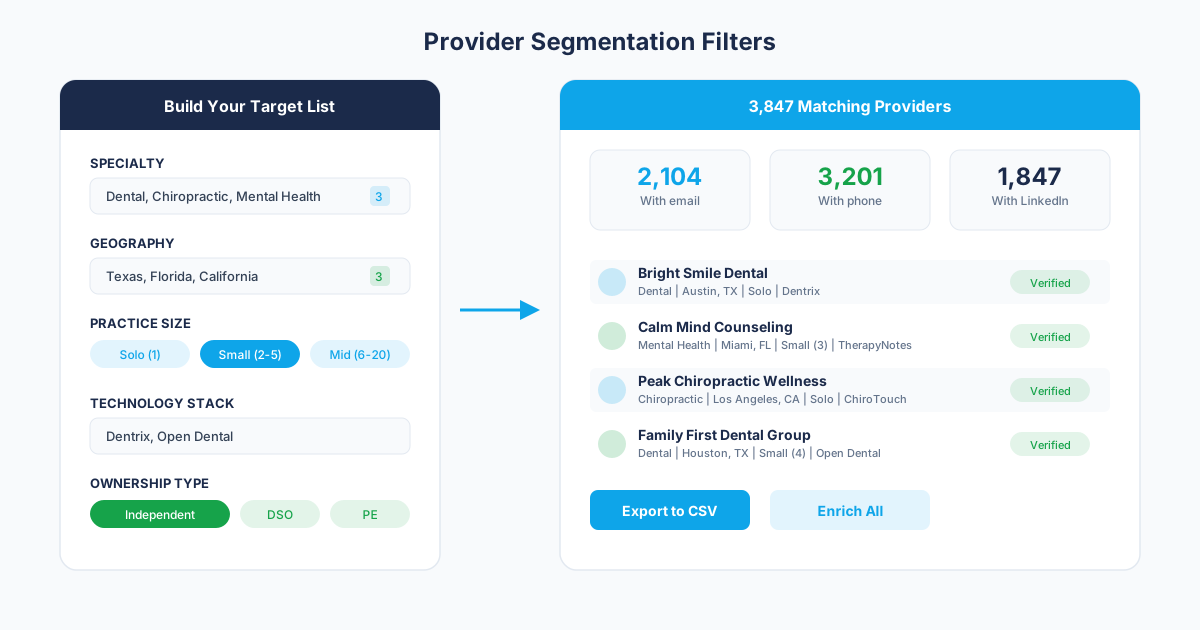
- Practice size: Number of providers, number of locations, estimated revenue. These fields enable tiered outreach strategies.
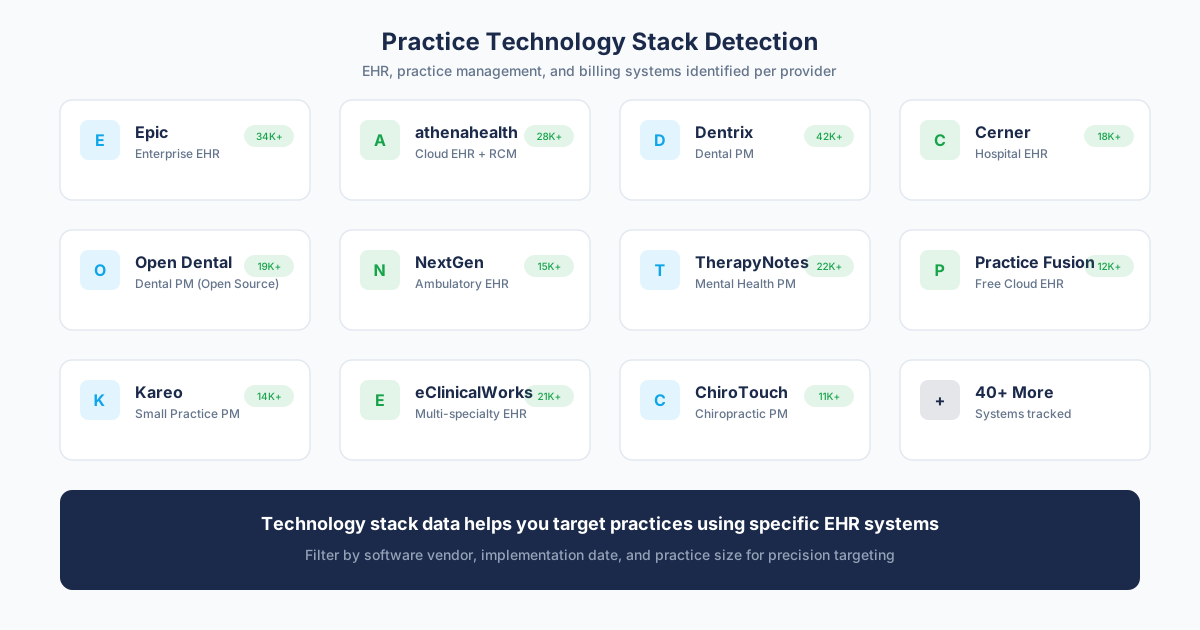
- Technology stack: EHR, practice management system, patient engagement platform. Critical for sales teams whose product integrates with or replaces existing software. See our technology detection service for how Provyx captures this data.
- Ownership and affiliation: Independent, DSO-affiliated, hospital-owned, PE-backed. Changes the sales conversation and the decision-making process entirely.
Enrichment Strategies That Work
There are several approaches to healthcare CRM data enrichment. Most teams need a combination.
Strategy 1: NPI Registry Matching
The simplest and cheapest enrichment step. Download the latest NPPES file and match your CRM records by NPI number. Update any fields where the registry has newer information: address, phone, classification, provider name, enumeration status.
Cost: Free. The NPPES file is public.
Limitations: NPI data doesn't include emails, direct dials, practice size, technology data, or ownership information. And as we've discussed, NPI addresses themselves can be outdated. But it's the right first step because it catches the easiest fixes at zero cost.
Strategy 2: Web Presence Verification
Scrape or manually check practice websites to verify addresses, phone numbers, provider rosters, and sometimes technology indicators. A practice website is often more current than the NPI registry because practices update their websites for patient acquisition purposes.
Cost: Varies. Manual verification costs $0.50-2.00 per record depending on the depth. Automated scraping costs less per record but requires engineering investment.
Limitations: Not all practices have websites. Among those that do, roughly 30% haven't updated their site in the past year. And web scraping at scale requires handling CAPTCHAs, rate limiting, and parsing thousands of different website formats.
Strategy 3: Third-Party Data Append
Purchase enrichment data from a commercial provider data vendor. Upload your CRM records (matched by NPI, name, or address), and get back filled-in fields: verified emails, direct phone numbers, practice size indicators, technology stack, and ownership data.
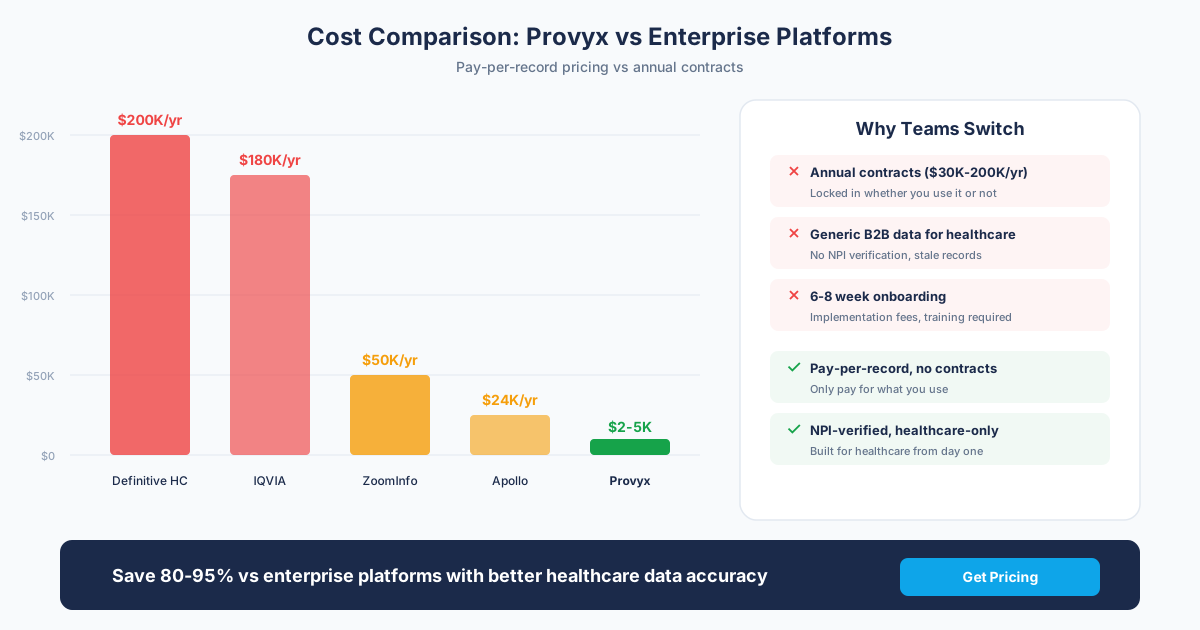
Cost: Typically $0.10-0.50 per record for basic enrichment (email + phone), $0.50-2.00 per record for full enrichment (email, phone, practice intelligence, technology).
Limitations: Data quality varies wildly between vendors. Some vendors resell the same stale data you already have. Ask for a match rate guarantee and a sample enrichment on your data before committing to a contract. If a vendor won't let you validate a sample at any price, that tells you something.
Provyx offers provider data enrichment with verified contacts, practice intelligence, and technology detection. Projects start at $2,500 and are scoped to the records, fields, and verification standards your team needs.
Strategy 4: Rep-Sourced Intelligence
Your sales reps talk to practices every day. They learn things: the office manager's name, what EHR the practice uses, whether the practice was recently acquired. Most of this intelligence never makes it back into the CRM because reps don't see the value in data entry.
Fix this with two changes. First, make the data entry easy. Add custom fields in your CRM for the 3-4 pieces of intelligence you most want reps to capture, and put them on the contact record screen where reps can't miss them. Second, make it matter. Show reps how updated data leads to better targeting, fewer wasted calls, and higher commission. Track and celebrate data contributions.
Cost: Time and process change. No direct cost.
Limitations: Only works for records your reps are already touching. Doesn't help with the 80% of your database that reps haven't contacted recently.
How to Measure Enrichment ROI
Data enrichment is an investment. Here's how to measure whether it's paying off.
Before/After Metrics
Measure these metrics before and after your enrichment project:
- Email bounce rate: Should drop to under 3% immediately after enrichment. If it doesn't, your enrichment source has a quality problem.
- Phone connect rate: Should increase by 30-50% if you're adding direct dials. Going from 12% to 18% connect rate means your reps are having 50% more conversations per day without making more calls.
- Email reply rate: Should increase 20-40% when you're reaching the right person with a verified email. Reaching the decision-maker instead of a generic inbox changes the entire conversion funnel.
- Meetings booked per 100 touches: The metric that matters most. If enrichment doesn't move this number within 60 days, something is wrong with either the data quality or the outreach strategy.
The ROI Calculation
Here's a simplified ROI framework. Assume your team has 10,000 provider records in the CRM.
Cost of enrichment: 10,000 records x $0.30/record = $3,000.
If enrichment increases your meeting booking rate from 2% to 3% (a conservative improvement), and your team touches 2,000 records per quarter, that's 20 additional meetings per quarter. If your average deal size is $5,000 and your close rate is 20%, those 20 meetings produce 4 additional deals worth $20,000 in revenue.
$20,000 in revenue from a $3,000 enrichment investment. That's 6.7x ROI in one quarter. And the enriched data keeps producing results for multiple quarters until it decays again.
The math gets even better when you factor in rep time savings. If bad data wastes 30 minutes per rep per day on wrong numbers, bounced emails, and wrong-person calls, and you have 10 reps, that's 50 hours per week of wasted selling time. At a fully loaded rep cost of $50/hour, that's $2,500/week in lost productivity. Clean data pays for itself in rep efficiency alone.
Building an Ongoing Enrichment Process
One-time enrichment projects are common. They're also a mistake. You clean your data in Q1, and by Q3 it's degraded again. You need a recurring process.
Monthly: NPI Cross-Reference
Every month, download the latest NPPES file and run a match against your CRM. Flag deactivated NPIs, address changes, and classification changes. This is free and takes minimal effort once you've set up the process.
Quarterly: Contact Verification
Every quarter, run your email list through a verification service (ZeroBounce, NeverBounce, or similar). Remove or flag addresses that bounce. Run your phone numbers through a line-type and connectivity check. Update any numbers that have been disconnected or reassigned.
Budget: $500-1,500 per quarter for a 10,000-record database, depending on the verification services you use.
Semi-Annually: Full Enrichment Refresh
Twice a year, do a full data append. Send your CRM records to your enrichment vendor and get back updated fields: new emails for contacts that have left, updated phone numbers, refreshed practice size and ownership data. This is where you recapture the records that have decayed since your last enrichment.
Budget: $2,000-5,000 per refresh for a 10,000-record database, depending on the enrichment depth and vendor pricing.
Ongoing: Rep-Sourced Updates
Between scheduled enrichment cycles, capture intelligence from your reps' daily interactions. Build this into your CRM workflow so it's automatic, not optional. Every call disposition should include a data quality flag: was the contact correct? Was the phone number right? Has anything changed?
Common Enrichment Mistakes
We've helped dozens of healthcare sales teams fix their data. Here are the mistakes we see most often.
Mistake 1: Enriching Without Deduplication First
If your CRM has duplicate records (and it does, almost every CRM does), enriching before deduplicating means you're paying to enrich the same entity multiple times. And after enrichment, the duplicates are harder to detect because they now have slightly different enriched data. Always dedupe first. Match on NPI number as the primary key.
Mistake 2: Overwriting Good Data with Bad Data
Not every enrichment source is better than what you already have. If a rep manually verified a phone number last week and your enrichment vendor returns a different (older) number, the rep's data is more current. Build merge rules that protect recently verified data from being overwritten by batch enrichment.
Mistake 3: Enriching Records You'll Never Use
If 40% of your CRM records are outside your ICP (wrong specialty, wrong geography, wrong practice size), don't pay to enrich them. Filter your database down to target records before running enrichment. This sounds obvious, but we've seen teams enrich their entire database of 50,000 records when only 12,000 match their ICP.
Mistake 4: No Enrichment Cadence
The most common mistake of all. A team does one big enrichment project, celebrates the improved data quality, and then doesn't enrich again for 12+ months. By the time they do, the data has degraded to pre-enrichment levels. Treat enrichment like a recurring subscription, not a one-time purchase.
For a full data quality framework, check our medical practice data quality checklist.
What Provyx Does Differently
Most data vendors sell you a list and wish you luck. Provyx approaches enrichment as a continuous process.
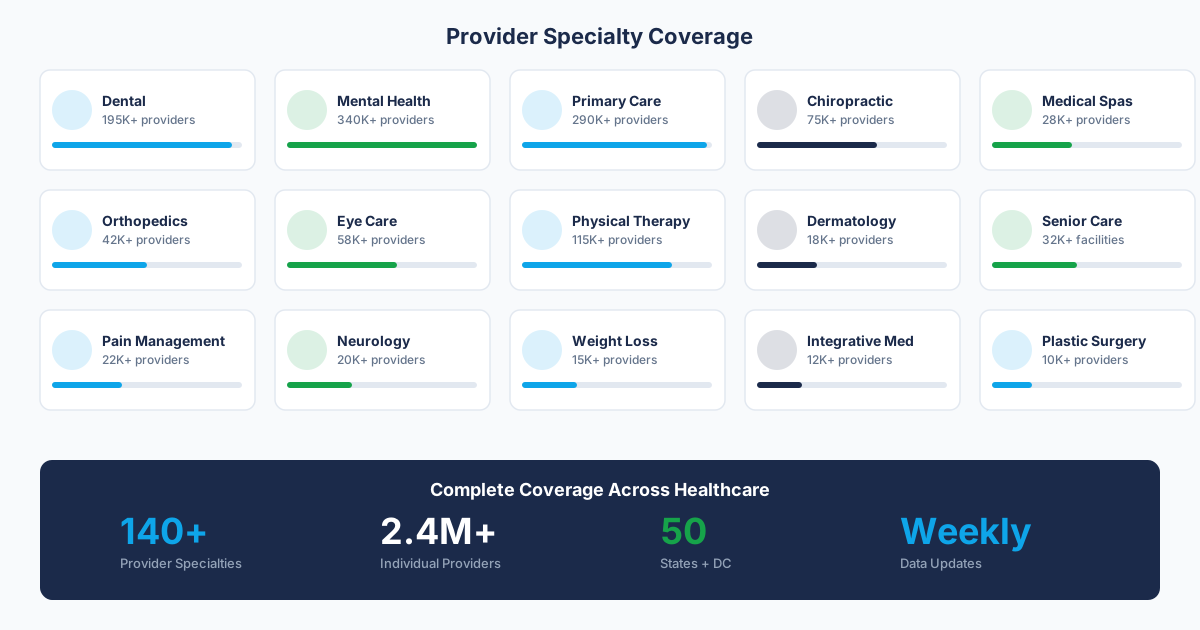
We start with the NPI registry as our base layer, then add verified contact information, practice intelligence, and technology detection data from multiple sources. Every record is cross-referenced and verified before delivery. We don't just append data from another database. We confirm it.
Our enrichment includes:
- Verified email addresses: for practice decision-makers, not just generic office emails.
- Direct phone numbers: with line-type verification (mobile, landline, VoIP).
- Practice intelligence: including provider count, location count, and ownership structure.
- Technology detection: for EHR, practice management, and key software platforms.
- Monthly refresh cycles: so your data stays current, not just clean at the point of purchase.
Want to see how much of your CRM data is stale? Send us a sample and we'll run a free data quality assessment. We'll tell you exactly which records need enrichment and what the expected improvement will be.
Frequently Asked Questions
How fast does healthcare CRM data decay?
Healthcare provider data decays at approximately 4-6% per month. That means a perfectly clean database will have roughly 25-30% of records with at least one outdated field within 6 months. Provider mobility, practice acquisitions, staff turnover, and multi-location changes all contribute to faster decay than most other B2B verticals.
What's the most cost-effective way to enrich provider data?
Start with the free option: download the latest NPI registry file and match it against your CRM to update addresses, phone numbers, and flag deactivated providers. Then invest in commercial enrichment for email addresses and direct phone numbers, which have the highest impact on sales outreach. Budget $0.10-0.50 per record for basic enrichment.
How often should I enrich my healthcare CRM data?
Monthly NPI cross-referencing (free), quarterly contact verification via email and phone validation services ($500-1,500 per quarter for 10,000 records), and semi-annual full enrichment refreshes ($2,000-5,000 per refresh). This cadence keeps decay from accumulating to the point where it impacts sales results.
What's the ROI of healthcare data enrichment?
A conservative estimate for a 10,000-record database: $3,000 in enrichment cost produces 20+ additional meetings per quarter through improved connect and reply rates. At a $5,000 average deal size and 20% close rate, that's $20,000 in incremental revenue, or roughly 6-7x ROI. Rep time savings from fewer wrong numbers and bounced emails add further value.
Related Resources
Get the Provider Data You Need
Tell us what you're looking for. We'll build a custom list matched to your target market.
Trusted by healthcare sales teams, medical device companies, and health IT vendors across the US.