
7 Healthcare Sales Prospecting Mistakes That Kill Your Pipeline
After working with dozens of healthcare sales teams, we see the same mistakes on repeat. Here's how to stop making them.
2026-02-15
The Problem Isn't Your Reps. It's Your Process.
Healthcare B2B sales is hard. Long sales cycles. Multiple stakeholders. Compliance gatekeepers. Providers who are busy seeing patients and don't want to talk to vendors. That's the nature of the market.
But when we dig into pipeline data with struggling healthcare sales teams, the biggest problems aren't market-driven. They're self-inflicted. The same seven mistakes come up over and over, across companies of every size and stage. Fix these, and your pipeline numbers improve. Keep making them, and no amount of rep hiring or tool spending will save you.
Mistake #1: Treating All Providers as the Same Buyer
This is the most common and most expensive mistake. A team gets a list of 20,000 providers in their target specialty and runs the same outreach sequence to all of them. Same email. Same call script. Same value proposition.
The problem: a solo dermatologist in rural Texas and a dermatologist employed by a 40-location PE-backed group in Miami have almost nothing in common from a buying perspective. The solo doc is the decision-maker, the check-signer, and the end user. The employed derm has zero purchasing authority and probably doesn't care about your product's ROI because it's not their money.
The Fix
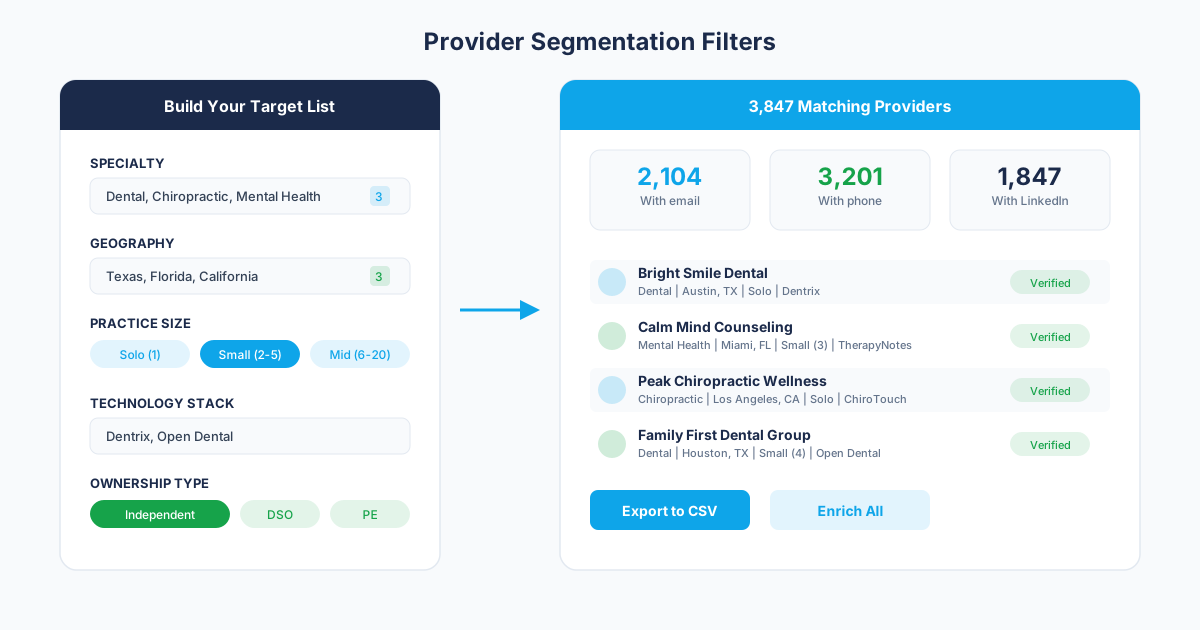
Segment before you prospect. At minimum, split your list by:
- Practice size: (solo, small group, large group, health system)
- Ownership type: (independent, hospital-owned, PE-backed)
- Decision-maker role: (physician owner, office manager, regional VP)
Each segment gets its own messaging, its own value prop, and its own cadence. Yes, this is more work upfront. But a targeted email to the right person at the right type of practice will outperform a generic blast by 5-10x on response rate.
If your data doesn't support this level of segmentation, that's your first problem to solve. See our prospecting framework for details on building segmented outreach.
Mistake #2: Using Stale Data and Pretending It's Fine
We've audited provider lists that were two, three, even five years old and still actively being used for outreach. The team knows the data is old. The reps complain about bad numbers and bounced emails. But nobody wants to spend the money or time to refresh it.
Here's what stale data costs you. CMS NPI data shows roughly 4-6% of records change monthly. After one year without a refresh, 40-55% of your list has some form of degradation. Bad phone numbers, wrong addresses, providers who've left the practice, practices that have closed or been acquired.
But the cost goes beyond wasted outreach. Stale data destroys rep trust. Once a rep has three or four bad calls in a row, they stop trusting the list. They start doing their own research for every single call. Your reps are now spending 30-40% of their time as amateur data researchers instead of selling.
The Fix
Commit to a refresh cadence. Monthly email and phone re-validation. Quarterly full re-enrichment. Budget for it annually and treat it as a cost of doing business, like paying for your CRM. The math always works out in favor of spending on data maintenance vs. Absorbing the productivity loss from stale records.
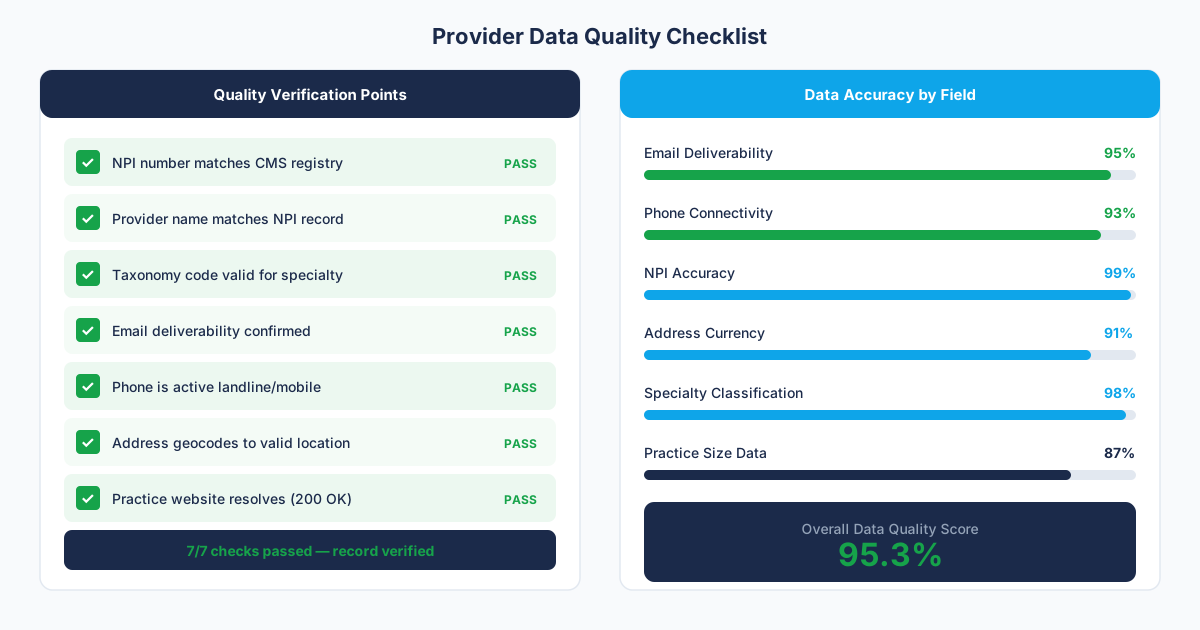
Use our data quality checklist to assess where your current list stands.
Mistake #3: Calling the Main Office Line and Expecting to Reach the Decision-Maker
The front desk at a medical practice is a fortress. It's designed to keep people out, not let them in. The staff are trained to take messages, redirect calls, and protect the providers' time. This isn't going to change.
Yet most healthcare sales teams are still relying on main office phone numbers as their primary outreach channel. They call the number on file, get the front desk, ask for the office manager, and get sent to voicemail. Or they get told "we're not interested" by someone who has no idea what the product even does.
Connect rates on main office lines typically run 2-5% for reaching an actual decision-maker. On direct dials, that number jumps to 15-25%. That's a 5-10x improvement from a single data point.
The Fix
Invest in direct contact data. Direct dials and validated business email addresses for the specific people you need to reach. Yes, this data costs more. Yes, it's harder to source. But the math is overwhelming. If a rep makes 60 calls a day on main office lines and reaches 2 decision-makers, versus 60 calls on direct dials and reaching 10-15, the productivity difference is staggering.
Multi-channel helps too. A direct email followed by a LinkedIn connection request followed by a direct dial call is far more effective than three attempts through the front desk.
Mistake #4: Ignoring the Non-Clinical Decision-Makers
Healthcare sales teams have a natural bias toward targeting providers. Doctors, dentists, therapists. It makes sense. These are the people your product serves. But in most practices with more than 2-3 providers, clinical professionals don't make purchasing decisions. Or at least not alone.
The office manager handles vendor relationships. The practice administrator manages the budget. The IT coordinator evaluates technical integrations. In larger groups, there might be a COO, a VP of Operations, or a procurement team.
If your entire outreach is aimed at providers, you're missing the people who control the purchase. Even worse, you might get a provider excited about your product, only to have the deal die because you never engaged the person who writes the checks.
The Fix
Map the buying committee for each practice size tier:
- Solo/small practices (1-3 providers):: The provider is often the decision-maker, but the office manager usually gatekeeps and influences
- Mid-size practices (4-15 providers):: Practice administrator or managing partner makes decisions, with input from key providers and the office manager
- Large groups (15+ providers):: Operations leadership, sometimes with a formal procurement process. Provider influence varies.
- Health systems and PE groups:: Centralized decision-making at the corporate level. Individual practice contacts are useful for building clinical champions but won't close the deal.
Your data needs to reflect this reality. Single-contact records aren't enough. You need multi-stakeholder coverage at each practice.
Mistake #5: Prospecting by Volume Instead of Fit
There's a persistent belief in sales that more activity equals more pipeline. If 100 calls a day isn't working, do 150. If 500 emails aren't getting responses, send 1,000.
In healthcare sales, this approach backfires spectacularly. The total addressable market for most healthcare B2B products is finite and relatively small. There are roughly 250,000 physician practices in the US. In any given specialty, you might be looking at 15,000-40,000 practices. That's not a market you can afford to burn through with spray-and-pray outreach.
Every bad touchpoint costs you. Irrelevant emails get you marked as spam. Untargeted calls waste the prospect's time and create a negative first impression. In a market where providers talk to each other at conferences and in professional networks, your reputation travels.
The Fix
Flip the equation. Instead of maximizing volume, maximize fit. Build a tightly defined ICP (ideal customer profile). Score your list against it. Concentrate your outreach on the highest-scoring accounts and put serious effort into each one.
A rep who makes 40 highly researched calls to perfect-fit practices will outperform a rep who makes 100 generic calls every single time. The data consistently shows this across every healthcare sales team we've worked with.
The Volume Trap in Numbers
Consider this scenario. Team A sends 10,000 emails to a broadly targeted provider list. They get a 0.5% response rate: 50 responses, of which 15 turn into meetings. Team B sends 2,000 emails to a tightly targeted list with personalized messaging. They get a 3% response rate: 60 responses, of which 30 turn into meetings.
Team B sent 80% fewer emails and got twice the meetings. They also didn't burn 8,000 prospects with irrelevant outreach. Those 8,000 providers that Team A spammed? Good luck getting them to open your next email. Your domain reputation took a hit too.
In healthcare, where your total addressable market is measured in tens of thousands, not millions, every wasted touchpoint narrows your future opportunity. With a market that small, quality over volume is the math.
Mistake #6: Not Tracking Data Quality Metrics
Most sales teams track activity metrics (calls made, emails sent) and outcome metrics (meetings booked, pipeline created). Almost none of them track data quality metrics.
What should you be tracking?
- Email bounce rate: If it's above 5%, your data has a freshness problem
- Phone connect rate: Below 3%? Your numbers are probably wrong, not just going unanswered
- Wrong person rate: How often do reps reach someone who's no longer at the practice or was never the right contact?
- Address return rate: If direct mail is part of your mix, what percentage comes back undeliverable?
- Data completeness: What percentage of records have email? Direct phone? Decision-maker name? Role?
These metrics tell you whether your data is helping or hurting your team. If you aren't tracking them, you can't diagnose why your outreach is underperforming.
The Fix
Add data quality metrics to your weekly sales review. Build a simple dashboard that tracks bounce rates, connect rates, and wrong-contact rates by data source. When you see a source degrading, address it immediately. Don't wait for the quarterly review.
Here's a template for a minimum viable data quality dashboard:
- Email bounce rate by data source (updated after every campaign)
- Phone connect rate by number type (direct vs. Main line, updated weekly)
- Wrong-contact rate (rep-reported, tracked in CRM disposition codes)
- Records with missing email, missing direct phone, missing decision-maker name (updated monthly)
- Average record age (days since last verification, updated monthly)
Five metrics. Updated regularly. That's all it takes to shift from guessing about data quality to knowing. Most CRMs can generate these reports natively. If yours can't, a simple spreadsheet pulling from your CRM and email platform will work.
Mistake #7: Not Having a Re-Engagement Strategy for Dormant Contacts
Healthcare sales cycles are long. A provider who said "not now" six months ago might be ready today. A practice that was mid-contract with a competitor might be coming up for renewal. But most teams treat a "no" as permanent and move on.
The result: after 12-18 months of outbound, your team has burned through most of the addressable market and has nowhere to go. They've contacted everyone once, gotten rejected or ignored, and now they're either re-prospecting the same stale list or asking for more budget to buy a new one.
The Fix
Build a structured re-engagement cadence for every contact that didn't convert. Not "call them again in six months." A deliberate sequence triggered by specific events or time intervals:
- 90-day nurture:: Educational content (not a sales pitch) sent every 30 days to stay top of mind
- Event-based triggers:: When a practice changes ownership, opens a new location, or appears in relevant news, that's a re-engagement signal
- Contract cycle alignment:: If you know typical contract lengths in your space, time your re-engagement to coincide with renewal windows
- New stakeholder triggers:: When a new office manager or practice administrator is identified at a previously contacted practice, that's a fresh entry point
This requires good data maintenance. You need to know when contacts change, when practices evolve, and when new stakeholders arrive. Static data can't power a dynamic re-engagement strategy. This is another reason why ongoing data verification and enrichment is critical.
The Common Thread
Look at all seven mistakes. The underlying cause is the same in every case: insufficient or poorly maintained provider data leading to undisciplined prospecting.
Better data doesn't guarantee better results. You still need good reps, strong messaging, and a product that solves a real problem. But bad data guarantees bad results. It's the foundation everything else is built on.
Start by auditing your current data against the issues in this post. Count your bounces. Measure your connect rates. Look at how many records have direct contact info vs. Just a main office number. The gaps will tell you exactly where to invest.
If you'd like help running that audit, we're happy to take a look. No pitch required. Sometimes the most useful thing we can do is show you what you're working with.
Frequently Asked Questions
What's the biggest prospecting mistake healthcare sales teams make?
Treating all providers as the same buyer. A solo physician, a mid-size group practice, and a PE-backed multi-location organization all have completely different decision-making structures, buying processes, and pain points. Segmentation by practice size, ownership type, and decision-maker role is essential.
How much time do reps waste on bad provider data?
Industry data suggests reps using unverified provider lists spend 30-40% of their selling time researching and validating contact information. For a team of 10 reps, that can translate to $150,000-$200,000 per year in lost productivity.
What's a good connect rate for healthcare sales calls?
On main office lines, 2-5% connect rates to decision-makers are typical. With verified direct dial numbers, that jumps to 15-25%. The difference comes from bypassing the front desk entirely and reaching the right person directly.
Sources and References
Related Resources
Get the Provider Data You Need
Tell us what you're looking for. We'll build a custom list matched to your target market.
Trusted by healthcare sales teams, medical device companies, and health IT vendors across the US.