
How to Build a Healthcare Provider Contact List That Converts
Most provider lists are dead on arrival. Here's how to build one that gives your sales team an unfair advantage.
2026-02-15
Why Most Provider Lists Fail Before the First Call
Let's get this out of the way: building a healthcare provider contact list isn't hard. Building one that produces meetings and revenue? That's a different problem entirely.
We've audited hundreds of provider lists from sales teams across the healthcare B2B space. The pattern is consistent. Teams start with a data dump from a vendor or a scrape of the NPI registry, load it into their CRM, assign it to reps, and watch the pipeline go nowhere. Connect rates hover around 2-3%. Email bounce rates hit 15-20%. Reps lose confidence in the data within weeks and start building their own lists manually.
The issue isn't usually the volume of records. It's the quality, structure, and completeness of each record. A list of 50,000 providers with bad phone numbers and no decision-maker names is worth less than a list of 5,000 verified contacts with direct dials and role information.
Here's how to build the second kind of list.
Step 1: Define Your Ideal Practice Profile
Before you touch any data, get specific about who you're selling to. Not "doctors." Not even "orthopedic surgeons." You need a practice-level profile that accounts for:
- Specialty and sub-specialty: What specific clinical focus? A pain management practice and a sports medicine practice are both "orthopedic" but they have different needs.
- Practice size: Solo practitioner vs. 5-provider group vs. 50-provider multi-location? Your pricing, sales cycle, and pitch all change.
- Ownership structure: Independent, hospital-owned, PE-backed, or part of a management group? This determines who makes purchasing decisions.
- Geography: National, regional, or local? Urban, suburban, or rural? Reimbursement rates and competitive landscapes vary dramatically by market.
- Technology indicators: What EHR do they use? Do they have an existing solution in your category? This is harder to get but valuable for targeting.
Write this down. Make it specific. "Independently owned dental practices with 3-10 providers in the Southeast that use Dentrix or Eaglesoft" is a targetable profile. "Dental practices" is not.
If you need help thinking through your ideal practice profile, our prospecting guide walks through the framework in more detail.
Common Profile Mistakes
Two mistakes we see constantly at this stage:
First, defining the ICP too broadly because leadership wants a large TAM number. "All dentists in the US" isn't an ICP. It's a census count. Your ICP should be narrow enough that you can write a specific email to everyone in it. If you can't, it's too broad.
Second, skipping the ownership structure entirely. This is the number one predictor of whether your outreach will reach a decision-maker. An independently owned 5-provider orthopedic group buys completely differently from a hospital-employed orthopedic department. Same specialty, same size, completely different buyer journey. If you lump them together, your messaging will resonate with neither.
Step 2: Start with the NPI Registry (But Don't Stop There)
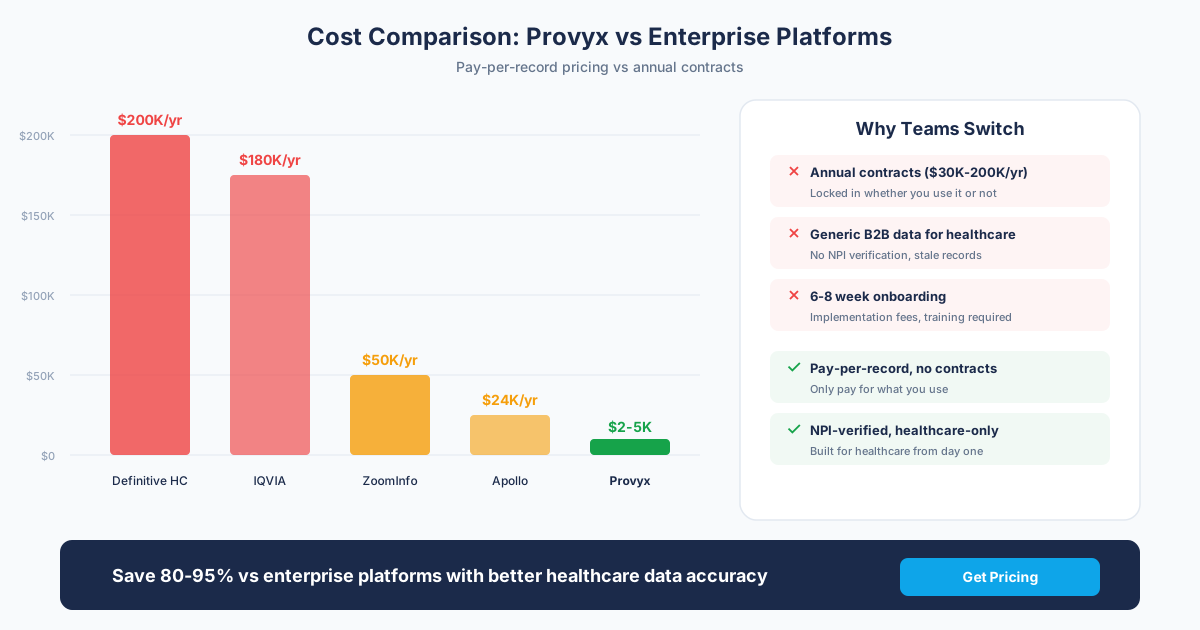
The NPI registry is your foundation. It's free, complete, and updated monthly. Every healthcare provider in the US who bills Medicare or Medicaid has an NPI number. That's roughly 2.2 million Type 1 (individual) and 900,000 Type 2 (organizational) NPIs.
What you'll get from the NPI registry:
- Provider name
- specialty classifications (specialty classification)
- Practice address (mailing and/or practice location)
- Phone number (usually the main office line)
- Enumeration date
What you won't get:
- Email addresses
- Direct phone numbers
- Decision-maker names and roles
- Practice size or revenue indicators
- Ownership information
- Whether the provider is still active at that location
The NPI registry is a starting point, not an end point. Teams that treat it as a finished product end up with the 2-3% connect rates I mentioned earlier. You need enrichment layers on top of it.
For a deeper dive on NPI data vs. Commercial alternatives, check out our comparison guide.
Step 3: Enrich with Verified Contact Data
This is where the real work begins. Enrichment means adding the information that turns a registry record into a sellable contact. There are three approaches, and most teams use a combination.
Option A: Manual Research
Have your team (or a VA/research assistant) look up each practice online. Visit the website, find the About page, identify the owners and key staff, search LinkedIn for direct contact info.
Pros: High accuracy when done well. You can capture nuanced information that automated tools miss.
Cons: slow. A good researcher can enrich maybe 20-30 records per hour. For a list of 10,000 practices, that's 330-500 hours of work. At $20/hour, you're looking at $6,600-$10,000 just for the research.
This approach makes sense for high-value enterprise accounts. It doesn't scale for broad outreach.
Option B: DIY Enrichment Tools
Combine multiple data sources yourself. Pull NPI data, cross-reference with state licensing boards, append email addresses from a tool like Hunter or Apollo, add LinkedIn profiles from Sales Navigator. Layer in Google Places data for practice details.
Pros: Cheaper per record than manual research. You control the process.
Cons: Significant technical effort to build and maintain the pipeline. Each data source has different formats, update frequencies, and accuracy levels. You'll spend a lot of time on data engineering instead of selling. And the match rates between sources are often lower than vendors claim. Expect 40-60% match rates on email, and 30-50% of those will be generic addresses like info@ or front.desk@.
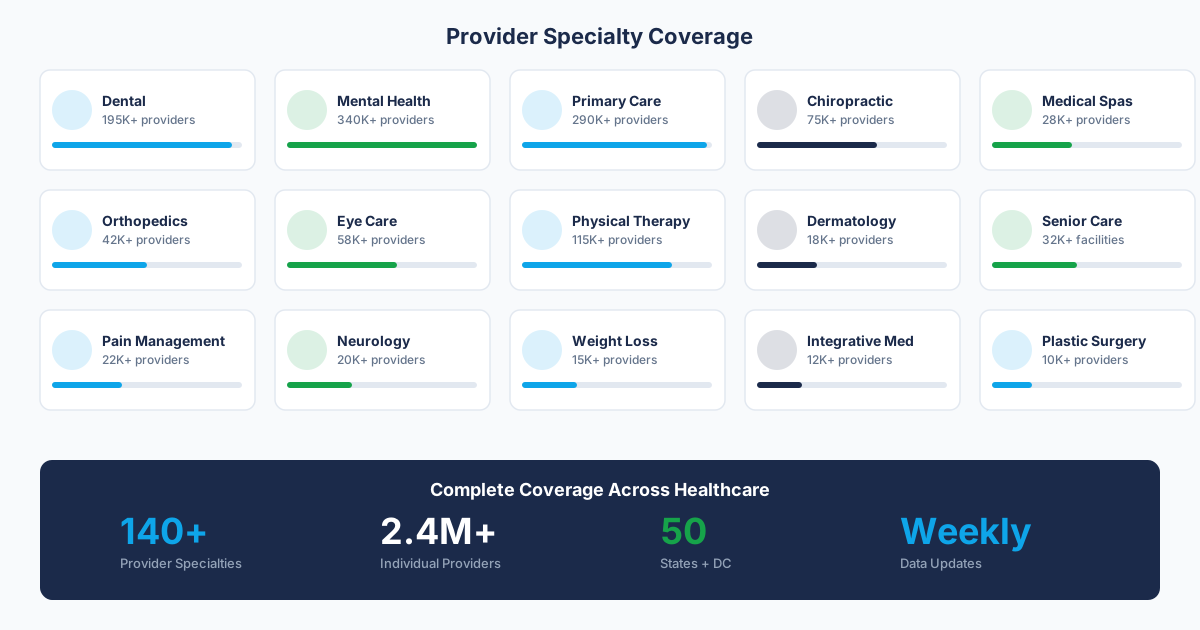
Option C: Healthcare-Specific Data Vendors
Buy pre-enriched provider data from a vendor that specializes in healthcare. The best ones combine NPI data with web scraping, phone verification, email validation, and ownership research into a single deliverable.
Pros: Fastest path to a usable list. Healthcare-specific vendors understand the nuances that general B2B data providers miss (like the difference between a billing address and a practice location, or why specialty classifications alone don't define a specialty).
Cons: Varies by vendor. Some are expensive. Some deliver stale data. Some have great practice-level records but weak contact-level data. You need to evaluate carefully.
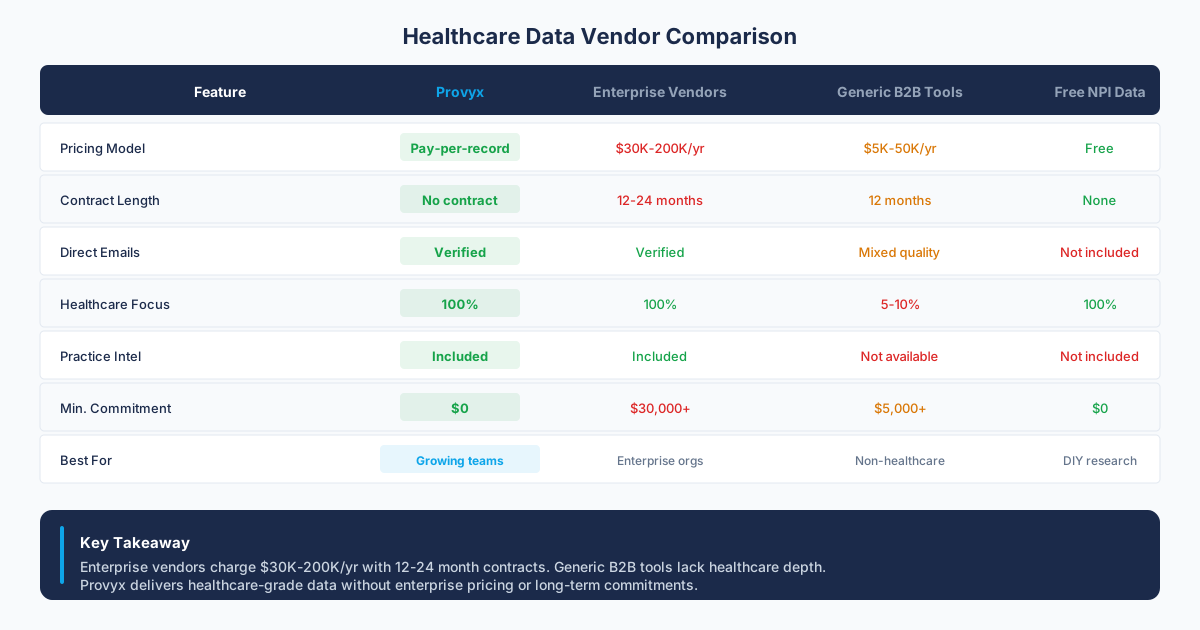
Provyx sits in Option C, with an emphasis on verified contact-level data. But regardless of which vendor you evaluate, the key questions are the same: How fresh is the data? What's the verification methodology? How many contacts per practice? What's the bounce/error rate guarantee?
Step 4: Validate Before You Load
This step gets skipped constantly, and it's one of the most expensive mistakes in the process. Before you load any list into your CRM or outreach tool, validate it.
Validation means:
- Email verification: Run every email through a verification service (ZeroBounce, NeverBounce, or similar). Remove hard bounces. Flag catch-all domains for lower-priority outreach. You want a verified deliverability rate above 95%.
- Phone validation: Check that phone numbers are properly formatted, currently in service, and classified correctly (mobile vs. Landline vs. VoIP). Disconnected numbers waste rep time and tank your dialer metrics.
- Deduplication: Providers who work at multiple locations will appear multiple times. Decide your strategy: deduplicate to primary location, or keep all locations but flag the primary? Either way, don't send duplicate outreach.
- Address standardization: USPS standardize all addresses. This catches formatting inconsistencies and identifies addresses that don't exist. It also enables proper territory assignment.
If you're working with a vendor like Provyx, much of this validation happens before delivery. But always verify independently. Trust but verify applies to data management as much as anywhere else.
The Hidden Cost of Skipping Validation
Teams skip validation because it feels like an extra step that slows down time-to-outreach. That's short-term thinking. Here's what happens when you load unvalidated data into your outreach tools:
- Email sender reputation damage.: If your bounce rate exceeds 5-8%, email service providers start throttling your deliverability. This doesn't just affect the bad list. It affects every email you send from that domain, including to existing customers and inbound leads.
- Dialer efficiency collapse.: Disconnected numbers and fax lines waste dialer minutes and inflate your cost per connect. We've seen teams with 20% bad phone numbers where every successful connection was costing them 3x what it should have.
- CRM pollution.: Duplicate records create attribution nightmares. Two reps working the same account because the data came in with slightly different practice names or addresses. Territory conflicts. Confused pipeline reporting.
A few hours of validation before loading saves weeks of cleanup and reputation repair after. Every time.
Step 5: Segment for Outreach
You've got a clean, enriched, validated list. Now segment it so your reps aren't treating every record the same way.
Effective segmentation for healthcare provider lists:
By Decision-Maker Role
Different roles need different messaging. The physician owner cares about clinical outcomes and patient volume. The office manager cares about workflow efficiency and vendor management overhead. The CFO or practice administrator cares about ROI and contract terms.
If your data includes role information, build separate sequences for each persona. If it doesn't, that's a gap in your data you should fill.
By Practice Size
Solo practices and large groups don't buy the same way. Solos make fast decisions but have smaller budgets. Large groups have longer sales cycles but higher contract values. Your outreach cadence, messaging, and even channel strategy should differ.
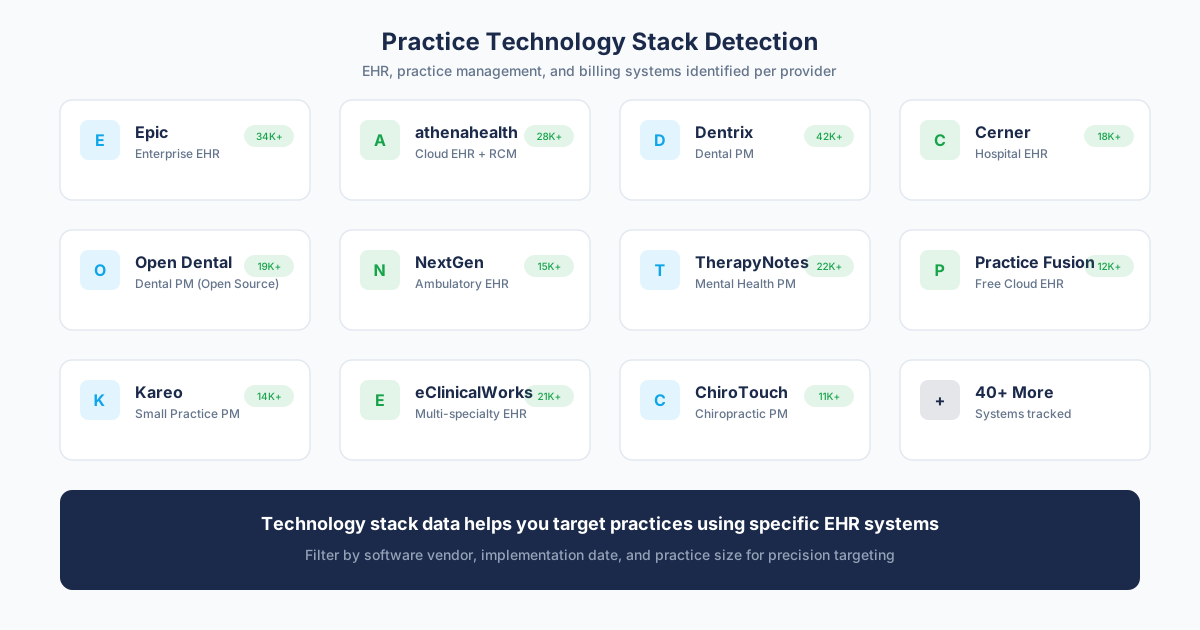
By Technology Stack
If you can identify what EHR, practice management system, or competing solutions a practice uses, you can tailor your pitch to address specific integration points or competitive weaknesses. This is advanced but effective.
By Engagement Likelihood
If you have historical data on which segments respond best, use it. Weight your list toward the profiles that have converted in the past. This sounds obvious, but most teams distribute leads evenly instead of concentrating effort where it's most likely to pay off.
By Geography and Market Density
This gets overlooked. Practices in dense urban markets behave differently from practices in rural areas. Urban practices face more vendor competition, meaning your outreach needs to stand out more. Rural practices have fewer vendor options, which can mean faster decisions but also smaller budgets and different priorities. Reimbursement rates vary by region too, affecting a practice's willingness to invest in new tools and services.
If your product has different value propositions for urban vs. Rural practices, segment accordingly. Don't send the same email to a Manhattan dermatologist and a sole practitioner in rural Montana.
Step 6: Maintain the List (The Part Everyone Forgets)
A provider list starts decaying the moment you build it. The CMS NPI data shows thousands of records changing every month. Providers move. Practices close. Phone numbers change. New practices open.
Build a maintenance cadence:
- Monthly:: Re-validate email addresses and phone numbers. Remove bounces and disconnects.
- Quarterly:: Re-enrich the list with updated contact data. Add new providers who've entered your target segments.
- Ongoing:: Feed rep-reported data changes back into the system. When a rep learns that Dr. Garcia moved to a new practice, that update should flow into your master database, not just live in a CRM note.
If you're using a managed data solution, your vendor should handle the refresh cycle. If you're managing it yourself, calendar the maintenance tasks and treat them as non-negotiable.
What This Means for Your Outreach
Building a healthcare provider contact list that converts isn't about finding a magic data source. It's about a disciplined process: define your target precisely, start with authoritative foundation data, enrich with verified contacts, validate everything before it touches your CRM, segment for personalized outreach, and maintain it relentlessly.
Skip any of these steps and you'll end up with the same 2-3% connect rates that plague most healthcare sales teams. Follow all of them and you'll have a data asset that compounds in value over time.
What Good Looks Like: A Quick Benchmark
After working with dozens of healthcare sales teams on their provider data, here are the benchmarks that separate high-performing lists from mediocre ones:
- Email deliverability:: 95%+ verified deliverable
- Phone connectivity:: 15%+ connect rate on direct dials, 3%+ on main lines
- Contact depth:: 2.5+ named contacts per practice on average
- Decision-maker coverage:: 80%+ of records include at least one identified decision-maker or purchasing influencer
- Data freshness:: All records verified within 90 days
- Bounce rate:: Below 3% on email campaigns
If your current list hits all six of these benchmarks, you're in great shape. Focus on segmentation and messaging optimization. If it misses on two or more, fixing the data will produce bigger gains than any other sales investment you can make.
For a more detailed assessment framework, walk through our 15-point data quality checklist.
Need help building or cleaning up your provider list? Reach out to our team. We do this every day.
Frequently Asked Questions
How many contacts should I have per healthcare practice?
Aim for at least 2-3 verified contacts per practice: the primary decision-maker (often a physician owner or practice administrator), a clinical stakeholder, and an operations or office management contact. Practices with 3+ contacts in your database convert at roughly 2.5x the rate of single-contact records.
Is the NPI registry enough to build a sales contact list?
No. The NPI registry provides foundational data (provider name, classification, address, main phone) but lacks email addresses, direct phone numbers, decision-maker roles, and ownership information. You need enrichment layers on top of NPI data to build a list that's usable for outbound sales.
How quickly does a healthcare provider list go stale?
CMS data shows 4-6% of provider records change every month. Over a quarter, that means 12-18% of your list has degraded. Without monthly re-validation and quarterly re-enrichment, your list quality drops to the point where reps lose trust in the data and start doing their own research.
What's a good email bounce rate for a healthcare provider list?
You should target a verified deliverability rate above 95%, which means a bounce rate below 5%. If your list is bouncing at 10%+ on email, it hasn't been properly validated and you risk damaging your sender reputation. Run every email through a verification service before loading it into your outreach tools.
Sources and References
Related Resources
Get the Provider Data You Need
Tell us what you're looking for. We'll build a custom list matched to your target market.
Trusted by healthcare sales teams, medical device companies, and health IT vendors across the US.