
NPI Database vs. Commercial Provider Data: What You Get (and What You Don't)
The NPI database is powerful and free. But if you're using it as your primary sales data source, here's what you're missing.
2026-02-15
The NPI Database: What It Is and Why It Exists
The National Provider Identifier (NPI) database is a federal registry maintained by CMS. Every healthcare provider who bills Medicare or Medicaid must have an NPI number. It's the backbone of healthcare provider identification in the United States, and it's completely free to access.
The September 2026 NPPES monthly file (retrieved 13 September 2026) contains 7,471,371 active Type 1 (individual provider) records and 1,972,058 active Type 2 (organizational) records, plus 355,329 deactivated NPIs, according to Provyx's count of the file. CMS releases updated data files monthly through their NPPES data dissemination page.
For healthcare B2B sales teams, the NPI database is often the first stop when building a provider list. And it should be. It's authoritative, complete, and free. But it was built for billing and administrative purposes, not for sales prospecting. That distinction matters enormously.
What the NPI Database Gives You
Let's be specific about what's in the NPI file. Each record contains:
- NPI number: The unique 10-digit identifier
- Provider name: For individuals, first and last name. For organizations, the legal business name.
- specialty classifications: One or more healthcare provider specialty classifications indicating specialty
- Mailing address: Often a billing address, which may or may not be the practice location
- Practice location address: When provided (not always populated)
- Phone number: Usually the main office line
- Authorized official: For Type 2 (organizational) NPIs, the name of the authorized official
- Enumeration date: When the NPI was assigned
- Deactivation information: If the NPI has been deactivated, the date and reason
This is solid foundational data. If all you need is a list of providers by specialty in a given geography with a main office phone number, the NPI database will get you there for free.
What the NPI Database Doesn't Give You
Here's where it gets interesting. The NPI database was designed for administrative simplification in healthcare billing. It was not designed to help you sell things. As a result, several categories of information that are critical for B2B sales are either missing entirely or unreliable.
Email Addresses: Nonexistent
The NPI database contains zero email addresses. Not one. If email is part of your outreach strategy (and it should be), the NPI registry gives you nothing to work with. You'll need a separate source entirely.
Direct Phone Numbers: Rare
The phone numbers in the NPI database are almost exclusively main office lines. No direct dials. No cell phones. No extension numbers. When your rep calls the number on file, they're reaching a receptionist or a phone tree, not the decision-maker. For high-volume outbound, this is a significant friction point.
Decision-Maker Identification: Absent
Who at this practice makes purchasing decisions? The NPI database won't tell you. For Type 1 NPIs, you get the provider's name. For Type 2 NPIs, you get the authorized official, who is often the provider who signed the NPI application and may not be the current decision-maker.
In a 10-provider practice, knowing the names of the individual NPI holders tells you who practices there. It doesn't tell you who runs the business, manages the office, or controls the budget.
Practice Size and Revenue: Not Available
The NPI database doesn't include any financial information. You can't determine practice revenue, number of patients, number of employees, or any other sizing metric. You can sometimes infer size by counting the number of individual NPIs associated with a practice location, but this is imprecise and labor-intensive.
Ownership Information: Minimal
Who owns this practice? Is it physician-owned, hospital-owned, PE-backed, or part of a larger management group? The NPI database doesn't track this. The authorized official field for Type 2 NPIs gives you a name, but not the ownership structure. Given that the AMA reports less than 47% of physicians are now in physician-owned practices, this is a massive blind spot.
Address Accuracy: Inconsistent
Here's a subtlety that trips up a lot of teams. The NPI database has two address fields: mailing address and practice location. Many providers list their billing company's address or a PO box as the mailing address. The practice location field is supposed to be the physical office, but it's self-reported and not verified by CMS.
We've found that roughly 8-12% of NPI practice location addresses are out of date at any given time. Providers move offices and don't update their NPI records promptly. Some never update them at all.
This creates a real problem for territory assignment and geographic targeting. If you're building a list of practices within a 50-mile radius of your rep's territory, 10% of those records might be in the wrong location. Some will be across the state. Others will be at a billing company in a different city entirely. Your reps waste time planning visits to addresses where the practice doesn't exist.
Active Status: Delayed
When a provider retires, moves out of state, or stops practicing, their NPI should be deactivated. But deactivation is voluntary, and there's no enforcement mechanism. We routinely find NPIs that have been inactive for years but are still listed as active in the registry. Conversely, some active providers have accidentally deactivated NPIs that they haven't bothered to reactivate.
What Commercial Provider Data Adds
Commercial provider data vendors exist to fill exactly these gaps. The best ones start with NPI data as their foundation and then layer on additional data through various collection methods. Here's what a good commercial dataset adds:
Verified Email Addresses
Commercial vendors source email addresses through web scraping, partnership data, public filings, and direct verification. A strong vendor will provide individual email addresses (not just generic info@ or office@ addresses) with deliverability verification. Expect match rates of 50-70% for individual provider emails and 80-90% for practice-level emails.
Direct Phone Numbers
Direct dials, cell phones, and direct extension numbers for key contacts. This is one of the highest-value additions because it bypasses the front desk entirely. Match rates vary by vendor, but 30-50% coverage for direct dials is typical in healthcare.
Named Contacts with Roles
Beyond the NPI-registered providers, commercial data includes office managers, practice administrators, CFOs, marketing directors, IT managers, and other non-clinical staff who influence or make purchasing decisions. This is the data that turns a practice record into a multi-threaded sales opportunity.
Practice Intelligence
Practice size (provider count, estimated revenue), ownership structure, EHR system, payer mix indicators, and procedure focus. This contextual data enables precise segmentation and personalized outreach.
Verified and Standardized Addresses
USPS-standardized addresses with regular verification against postal databases. Commercial vendors catch address changes faster than the NPI registry because they're actively monitoring, not waiting for providers to self-report.
Update Frequency and Verification Methodology
Perhaps the most important difference between NPI data and commercial data is the verification approach. The NPI registry is passively updated. Providers submit changes when they remember to (or when they're required to for billing). Commercial vendors actively verify their data through a combination of automated web monitoring, phone verification campaigns, email deliverability testing, and cross-referencing with state licensing databases.
The result is that commercial data tends to catch changes 30-90 days faster than the NPI registry. A provider who moved to a new practice in January might not update their NPI until March or April. A good commercial vendor will catch the change in February by detecting the new website listing, the updated Google Business profile, and the state licensing board address update.
For time-sensitive sales motions, that 30-90 day advantage matters. If you're trying to reach providers who just opened a new practice (a prime buying moment for many healthcare products), the NPI registry will tell you about them months after the commercial data already did.
The Real Comparison: Cost vs. Value
The NPI database is free. Commercial data costs money. So when does it make sense to pay?
When Free NPI Data Is Enough
If you're doing light research, building a rough TAM estimate, or supplementing data you already have, the NPI database is fine. It's also a reasonable starting point if you have an internal team that can do manual enrichment on a small, targeted list (under 500 practices).
When You Need Commercial Data
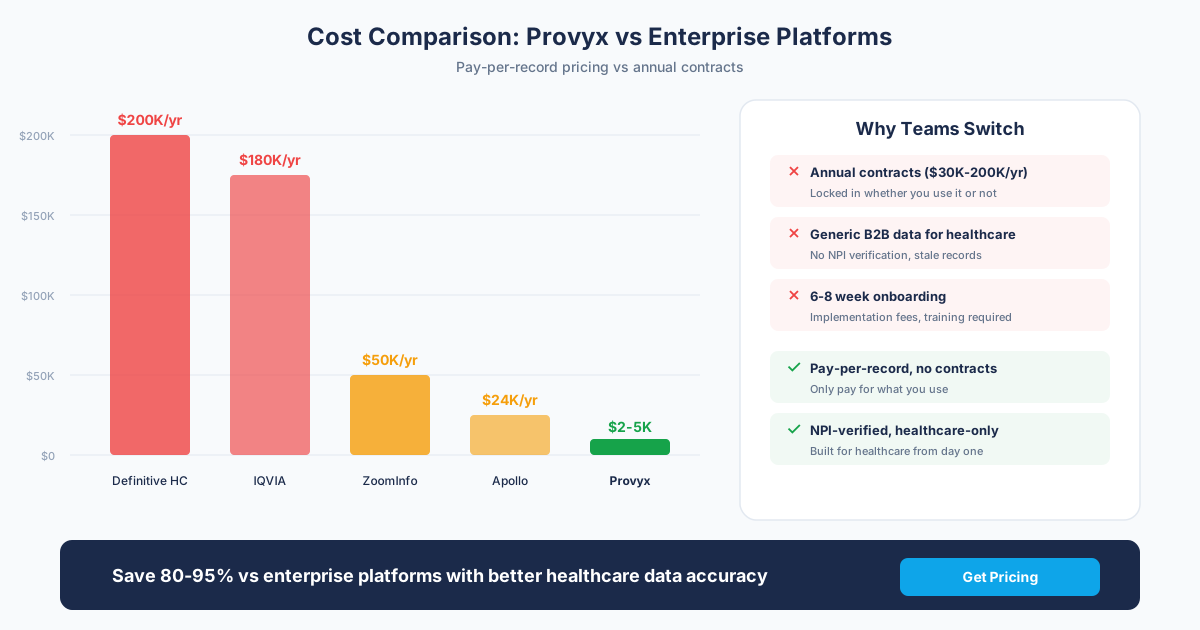
If you're running outbound at any kind of scale (1,000+ practices), you need commercial data. The math is straightforward. Let's say you're paying reps $30/hour fully loaded. If they spend 30% of their time researching contacts instead of selling (which is the industry average for teams using NPI data alone), that's $9/hour per rep in wasted productivity.
For a team of 10 reps working 2,000 hours/year, that's $180,000/year in lost selling time. Commercial provider data that saves even half of that research time pays for itself many times over.
The other factor is opportunity cost. Every hour a rep spends looking up a phone number is an hour they're not having conversations. The revenue impact of that lost selling time dwarfs the cost of buying better data.
The Hidden Third Cost: Data Engineering
Teams that go the DIY route often underestimate the engineering cost. You don't just download the NPI file once. You need to build a pipeline that downloads the monthly updates, parses the CSV (which is 7+ GB and requires special handling), reconciles changes against your existing records, deduplicates against your CRM, and flags records that need re-enrichment.
Then you need to maintain that pipeline. CMS occasionally changes file formats or field definitions. Your enrichment API providers change their rate limits or pricing. The email verification service you rely on gets acquired and sunsets its API. Each of these breaks your pipeline, and someone needs to fix it.
For a team with strong data engineering resources, this can work. For a sales team that just wants a clean list, it's a distraction from the core business. We've worked with companies that spent six months and $100,000+ building internal provider data pipelines that still couldn't match the coverage and accuracy of a specialized commercial vendor. The build-vs-buy analysis almost always favors buying for provider data, unless your core product is provider data.
How Provyx Bridges the Gap
We built Provyx specifically for this use case. Our process starts with the NPI foundation, then adds multiple enrichment layers:
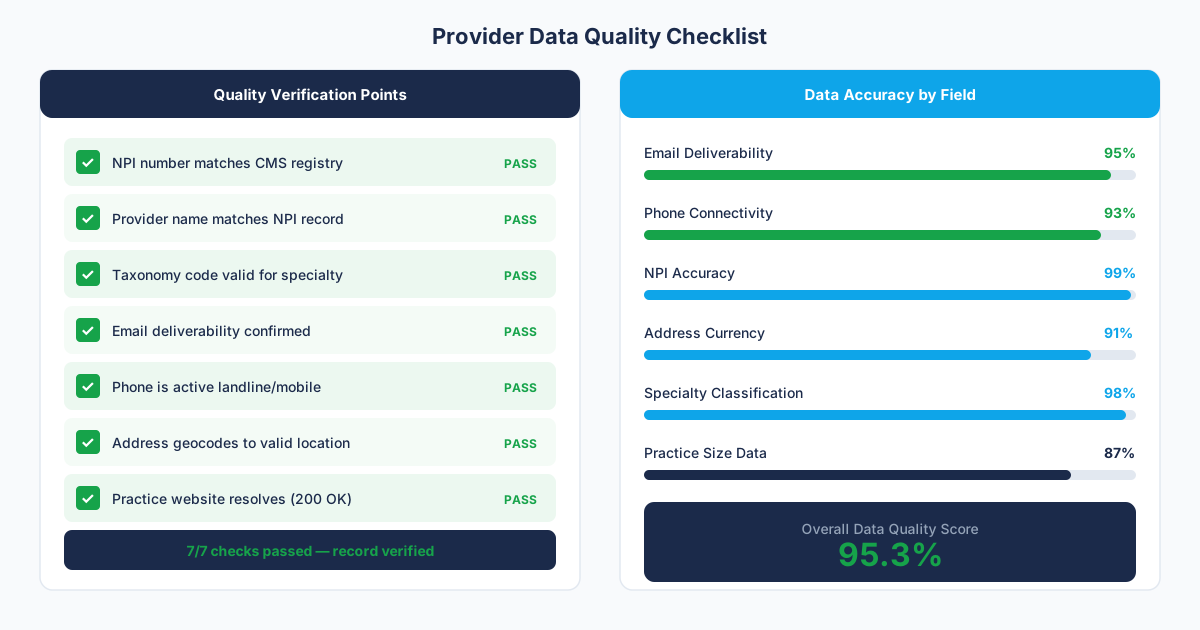
- Web verification: We confirm each practice's current address, phone, and website against live web data
- Contact discovery: We identify and verify multiple contacts per practice, including non-clinical decision-makers
- Email and phone validation: Every email is deliverability-tested, every phone number is checked for active status
- Ownership and practice intelligence: We research ownership structure, provider count, and specialty focus
The result is a dataset that gives your sales team everything they need to prospect effectively, without the manual research burden. Learn more about our verification process or see our data quality standards.
Making the Decision
The NPI database is an incredible public resource. Use it. But recognize its limitations for sales purposes. If you're building a high-performance outbound motion targeting healthcare providers, you'll need to supplement it with verified, enriched contact data.
The question isn't whether you need more than NPI data. It's whether you build that enrichment layer yourself or buy it from someone who does it at scale. For most teams, the economics strongly favor buying. The ones who try to build it internally usually end up spending more in engineering time and lost sales productivity than they would have spent on a commercial solution.
Want to see how your current data compares? Get a list matched against your target market and see the difference for yourself.
Side-by-Side Summary
Here's the comparison in plain terms:
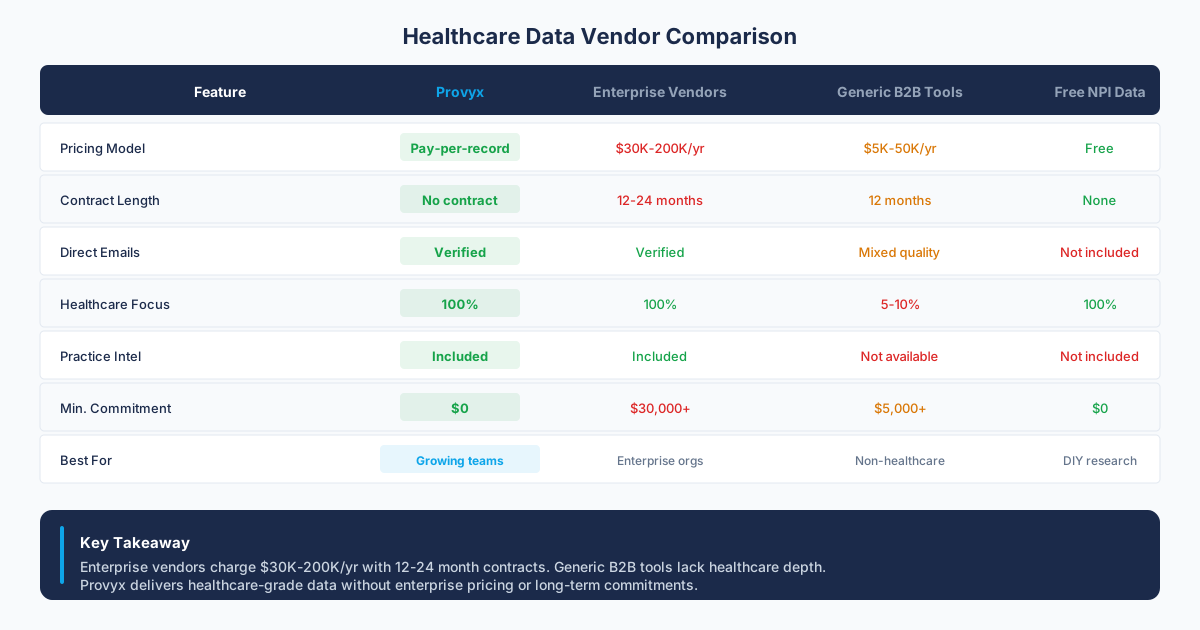
- NPI database:: Free, complete provider registry. Great for foundation data, TAM analysis, and small-scale research. Lacks emails, direct phones, decision-maker identification, ownership data, and verified addresses. Requires significant enrichment for sales use.
- Commercial provider data:: Costs money, but fills every gap that matters for outbound sales. Delivers verified emails, direct phone numbers, named contacts with roles, practice intelligence, and standardized addresses. Saves 30-40% of rep time that would otherwise go to manual research.
The NPI database is the starting line. Commercial data is the race. If you're serious about healthcare sales performance, you need both: NPI as your authoritative foundation, commercial enrichment as your competitive edge.
Frequently Asked Questions
Is NPI data free to use for commercial purposes?
Yes. The NPI database is public information maintained by CMS and is free to download and use. There are no licensing fees or commercial use restrictions on the NPI data itself. However, how you use the data for outreach may be subject to state privacy laws depending on what additional personal information you collect or append.
How often is the NPI database updated?
CMS releases updated NPI data files monthly through their NPPES data dissemination page. However, the underlying data depends on providers self-reporting changes, so there's often a lag between when a change occurs (like an address update) and when it appears in the registry.
Can I get email addresses from the NPI database?
No. The NPI database does not contain email addresses for any provider or organization. Email data must be sourced separately through web scraping, data partnerships, direct verification, or commercial data vendors.
What's the biggest limitation of NPI data for sales teams?
The absence of decision-maker contact information. NPI data tells you which providers practice at a location, but it doesn't identify office managers, practice administrators, or other non-clinical staff who influence purchasing decisions. It also lacks direct phone numbers and email addresses, forcing reps to call main office lines and navigate phone trees.
Sources and References
Related Resources
Get the Provider Data You Need
Tell us what you're looking for. We'll build a custom list matched to your target market.
Trusted by healthcare sales teams, medical device companies, and health IT vendors across the US.