
Healthcare Provider Database Accuracy: What to Expect
Every data vendor claims high accuracy. Here's what the numbers actually look like when you test them.
2026-03-29
Accuracy Claims vs. Accuracy Reality
Open the website of any healthcare data vendor and you'll see accuracy claims. "97% accurate." "Verified monthly." "The most complete healthcare database available." These claims are almost never testable because the vendors define accuracy differently, measure it differently, and report it differently.
Here's what accuracy actually means in healthcare provider data, how to measure it yourself, and what benchmarks are realistic for different data fields.
The Five Dimensions of Provider Data Accuracy
Accuracy isn't a single number. It's at least five separate measurements, and a database can score well on one while failing on another.
1. Record Completeness
What percentage of records have values in key fields? A record with a name, NPI, and address but no email, no phone, and no owner name is "accurate" in the fields it contains but useless for outreach. Completeness measures how many of the fields you need are actually populated.
Realistic benchmarks for a well-maintained healthcare provider database:
- NPI + name + address:: 95%+ (this comes directly from the NPPES registry)
- Phone number:: 80-90%
- Email address:: 40-60% (verified business email, not generic)
- Practice owner or decision-maker name:: 30-50%
- Website URL:: 60-75%
Any vendor claiming 90%+ email completeness across all specialties is either counting generic addresses (info@, frontdesk@) or hasn't been honest about their methodology.
2. Field-Level Correctness
When a field has a value, is that value correct? This is what most people think of when they hear "accuracy." A phone number that connects to the practice. An email that doesn't bounce. An address where the practice actually operates.
Field-level correctness varies dramatically by data type:
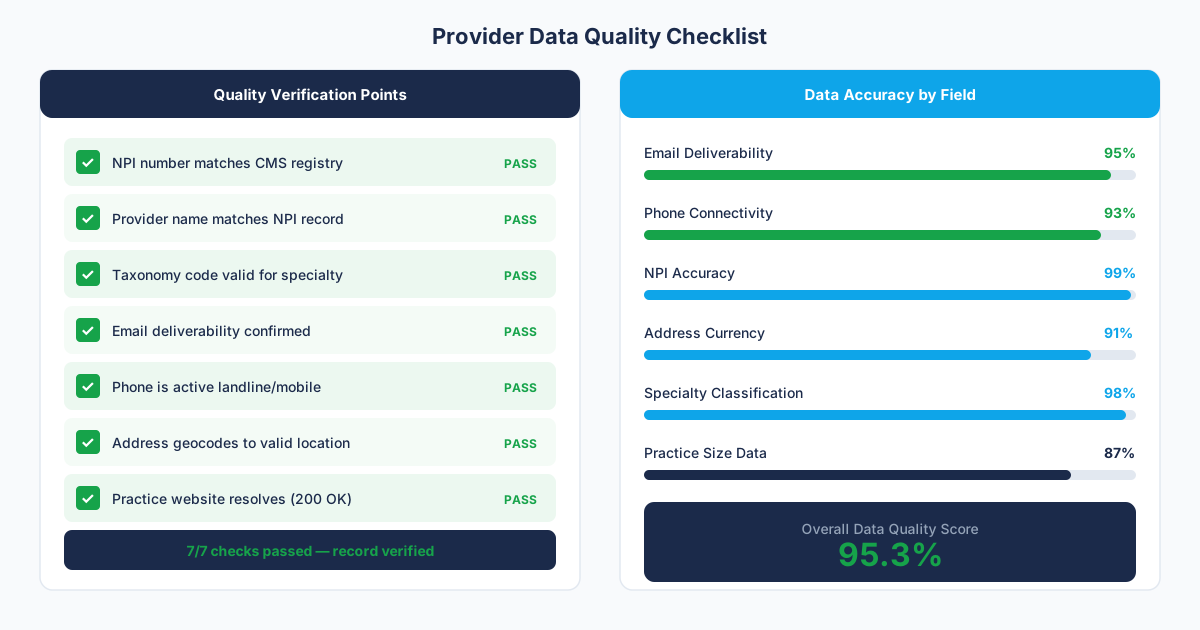
- NPI number:: 99%+ (NPI numbers don't change and can be validated against the NPPES registry)
- Practice name:: 90-95% (practices rebrand, merge, and change names)
- Address:: 85-92% (providers move, and NPI addresses lag behind actual relocations)
- Phone:: 80-90% (numbers change, get disconnected, or route to automated systems)
- Email:: 85-95% (deliverable at time of verification, but decays 2-4% per month)
- Specialty classification:: 88-94% (NPI classification is broad; sub-specialty accuracy is lower)
3. Freshness
How recently was each record verified? A record that was correct 18 months ago has a meaningful probability of being wrong today. CMS data dissemination reports show roughly 4-6% of provider records change every month. Over 12 months, that compounds to 40-50% of records having at least one changed field.
This is why "we update our database quarterly" is an inadequate answer. Quarterly updates mean every record is 0-3 months old, with an average age of 6 weeks. Monthly updates are the minimum standard. Weekly or continuous verification is where the best vendors operate.
4. Deduplication Quality
A database with 2 million records that contains 300,000 duplicates isn't a 2 million record database. It's a 1.7 million record database with a deduplication problem. Duplicates waste outreach volume, create confusion in CRM systems, and cause reps to contact the same provider multiple times through different records.
Duplicates in provider data come from several sources:
- Multi-location providers.: A dermatologist working at 3 clinic locations appears as 3 NPI address records. That's not a duplicate in the NPI system, but it's a duplicate for outreach purposes.
- Name variations.: Robert Smith, Rob Smith, R. Smith, Robert J. Smith. Same person, four potential records.
- Source merging.: Combining NPI data with a state licensing board and a web-scraped directory creates duplicates unless identity resolution is applied.
Good databases achieve 95%+ deduplication accuracy. The remaining 5% are edge cases where two different people have similar names and practice in similar geographies. Over-deduplication (merging two different people into one record) is worse than under-deduplication, so the best vendors err on the side of keeping separate records when identity is ambiguous.
5. Coverage Accuracy
What percentage of the actual provider population is represented in the database? A database can have perfect field-level accuracy on every record it contains and still be useless if it only covers 40% of the providers in your target segment.
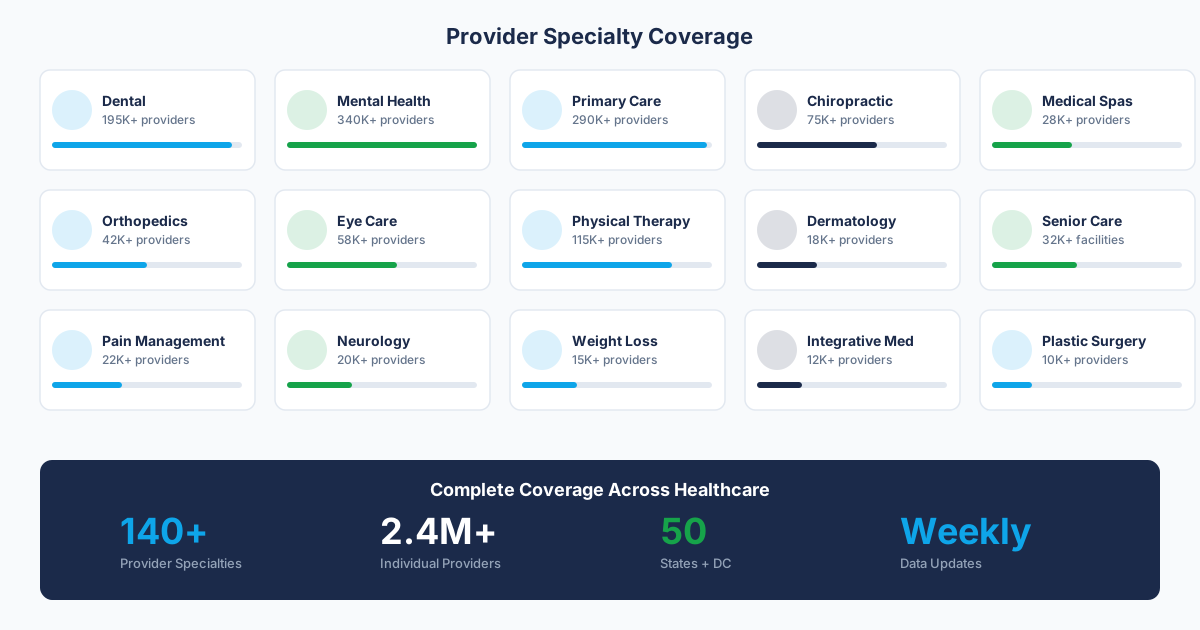
Coverage accuracy is the hardest to measure because you need a ground truth to compare against. The NPPES registry is the closest thing to a provider census, with roughly 2.4 million active Type 1 (individual) NPIs and 1.2 million active Type 2 (organizational) NPIs. A good commercial database should cover 90%+ of active NPIs for mainstream specialties.
Where coverage gaps appear: new practices (takes 2-6 months to appear in most databases), recently relocated practices, providers in rural areas, and niche specialties like integrative medicine or ketamine clinics that are underrepresented in traditional data sources.
Why Healthcare Provider Data Decays Faster Than You Think
Provider data decays faster than general B2B data. The reasons are structural:
Practice Consolidation
Private equity acquisitions, DSO rollups, and hospital system expansions are changing practice ownership at an unprecedented rate. The AMA's 2025 benchmark survey found less than 47% of physicians own their practices, down from 53% five years earlier. When ownership changes, email domains change, phone systems change, decision-makers change, and sometimes the practice address changes.
Provider Mobility
Physicians change practice affiliations more frequently than professionals in most other industries. Early-career physicians especially move between practices as they complete fellowship training, join group practices, and eventually establish or acquire their own practices. Each move invalidates multiple data fields simultaneously.
Technology Transitions
Practices that switch EHR systems, phone systems, or email providers invalidate contact data en masse. A practice migrating from an on-premise email server to Google Workspace or Microsoft 365 changes every email address at the organization overnight.
Retirement and Deactivation
The physician workforce is aging. According to BLS projections, physician retirements are accelerating as baby boomer doctors exit the workforce. Retired providers whose NPI records remain active create ghost records that look valid in databases but correspond to non-practicing individuals.
How to Test a Vendor's Accuracy Claims
Don't take anyone's word for it. Here's how to independently verify the accuracy of any healthcare provider database.
Step 1: Start With Your Target Segment
Test records that match your target criteria (specialty, geography, practice size), whether they come from a first order or a vendor's existing export.
Step 2: Validate Emails
Run every email address through a third-party email verification service (NeverBounce, ZeroBounce, or similar). Count hard bounces, soft bounces, and catch-all domains separately. Hard bounce rate above 5% on a sample is a red flag.
Step 3: Spot-Check Phones
Call 15-20 phone numbers at random. Does the practice answer? Is the practice name correct? Is the provider still there? This takes an hour and tells you more about data quality than any vendor pitch deck.
Step 4: Verify Addresses
Cross-reference 20 addresses against Google Maps and the practice's own website. Check whether the address is the actual practice location or a billing address, PO box, or registered agent. NPI addresses are notoriously inaccurate for location purposes.
Step 5: Check Decision-Maker Data
For 10 records that include owner or decision-maker names, visit the practice website and verify. Is that person actually at the practice? Are they in the role described? This is where most databases have the highest error rates because personnel changes happen frequently and are hard to detect programmatically.
Accuracy Expectations by Use Case
The accuracy you need depends on what you're doing with the data. Not every use case demands the same standard.
Email Outreach
You need high email correctness (95%+) and current verification. A 10% bounce rate doesn't just waste 10% of your sends. It triggers spam filters that reduce deliverability across your entire campaign. For email, verified contact data isn't optional.
Direct Mail
Address accuracy matters most. You can tolerate slightly outdated email data if your addresses are current. USPS address standardization catches most formatting issues, but it won't tell you if the practice has moved to a new building three blocks away. Run addresses through USPS validation before any mail campaign.
Territory Planning
You need accurate addresses, specialty classifications, and practice size indicators. Individual contact accuracy matters less than geographic and specialty accuracy. A territory plan built on NPI data that places 10% of practices at billing addresses instead of practice locations creates territory overlap and coverage gaps. See our territory planning guide for more detail.
Market Sizing
Coverage accuracy is the priority. You need to know that your database represents the full universe of providers in your target segment. Field-level accuracy matters less when you're counting practices than when you're contacting them. But missing 20% of the market gives you a market size estimate that's 20% too low, which affects everything from pricing to headcount planning.
CRM Enrichment
Deduplication quality is critical. Enriching your CRM with a database that creates duplicates makes your data worse, not better. Before enriching, establish matching rules between your CRM records and the vendor's records, and run a dedup pass after the merge. More on this in our CRM data enrichment guide.
The Accuracy Tax
Low-accuracy data doesn't just fail to help you. It actively costs you money in ways that don't show up on the invoice:
- Wasted rep time.: Reps spending 30 minutes per day validating contact information before making calls. Over a year, that's 130 hours per rep spent on data hygiene instead of selling.
- Lost sender reputation.: High bounce rates from bad email data reduce deliverability to your entire database, including known-good contacts.
- CRM pollution.: Bad data that enters your CRM creates cascading problems: wrong territories, wrong segments, wrong lead scores, wrong reports to leadership.
- Missed pipeline.: Every call to a wrong number, every email to a bounced address, every mailer to a closed practice is a touchpoint that should have reached a real prospect.
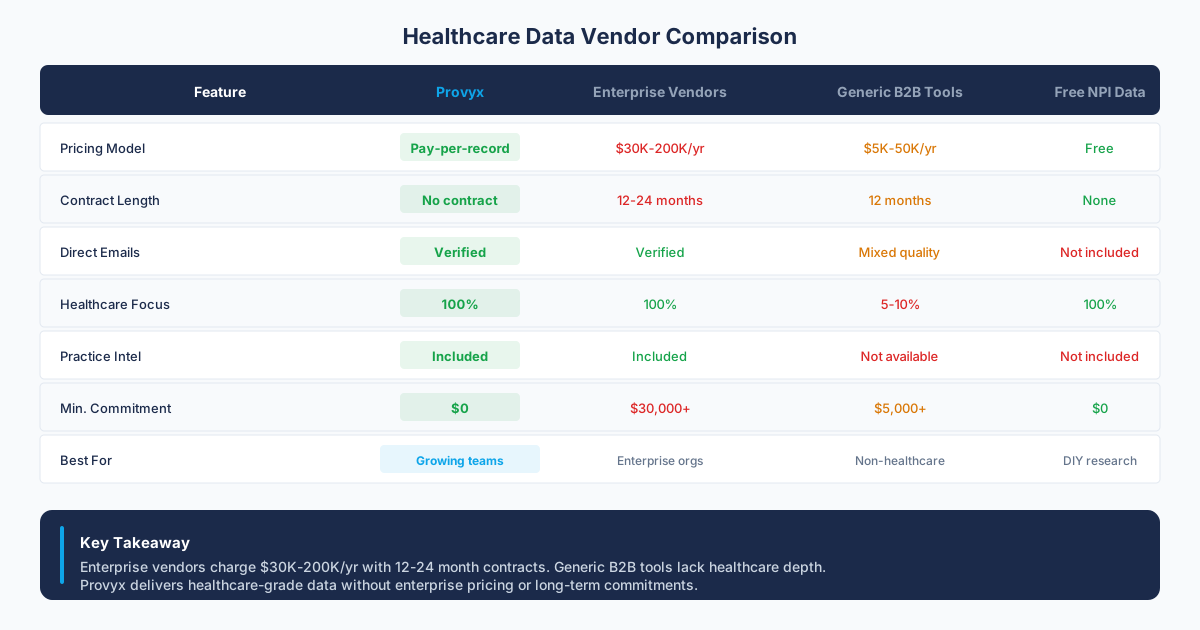
The vendors with the lowest per-record cost rarely deliver the lowest cost per qualified conversation. That's the metric that matters, and it correlates with accuracy far more than it correlates with list price.
Frequently Asked Questions
What accuracy rate should I expect from a healthcare provider database?
Accuracy varies by field. NPI numbers: 99%+. Addresses: 85-92%. Phone numbers: 80-90%. Verified email: 85-95% at time of verification, decaying 2-4% per month. Practice owner names: 70-85%. Any vendor claiming 97%+ across all fields is likely using a narrow definition of accuracy or not measuring it rigorously.
How fast does healthcare provider data decay?
Roughly 4-6% of provider records change every month according to CMS data. Over 12 months, that compounds to 40-50% of records having at least one changed field. Email addresses, phone numbers, and practice affiliations are the fastest-decaying fields. NPI numbers and specialty classifications are the most stable.
How can I independently test a healthcare data vendor's accuracy?
Test 50-100 records that match your criteria, then verify them yourself. Run emails through a third-party verification service (NeverBounce, ZeroBounce). Call 15-20 phone numbers. Cross-reference 20 addresses against Google Maps and practice websites. Check 10 decision-maker names against practice websites. This takes 2-3 hours and gives you more signal than any vendor demo.
Why is healthcare provider data less accurate than general B2B data?
Three structural reasons: practice consolidation (PE acquisitions, DSO rollups, and health system mergers change contact data en masse), provider mobility (physicians change affiliations more frequently than most professionals), and technology transitions (practices switching email systems or phone providers invalidate contact data overnight). These factors create decay rates roughly 1.5-2x higher than general B2B contact data.
Sources and References
Related Resources
Get the Provider Data You Need
Tell us what you're looking for. We'll build a custom list matched to your target market.
Trusted by healthcare sales teams, medical device companies, and health IT vendors across the US.