
Urgent Care Center Decision Makers: A Sales Guide
Urgent care is booming, but the ownership maze makes it hard to find the person who signs the check. Here is how to identify and reach decision makers across independent, chain, and hospital-affiliated urgent care centers.
2026-04-02
Urgent Care Is a $30+ Billion Market with a Complicated Org Chart
The urgent care industry has exploded. The Urgent Care Association estimates there are over 14,000 urgent care centers in the United States, up from roughly 9,000 a decade ago. Annual patient visits exceed 160 million. The market generates over $30 billion in revenue and continues growing at 5-6% per year.
For anyone selling into urgent care (medical supplies, diagnostic equipment, software, staffing, revenue cycle management), this growth means more prospects every quarter. But it also means more complexity. The urgent care market includes tiny independent clinics, massive private equity-backed chains with 500+ locations, hospital system-owned satellite centers, and everything in between.
Each ownership model has a completely different decision-making structure. The person who buys your product at an independent urgent care is not the same person (or even the same type of person) who buys it at a CityMD location. If your sales team uses a single playbook for all urgent care centers, you're wasting most of your outreach.
The Urgent Care Ownership Landscape
Before you can find decision makers, you need to understand the ownership types and how they differ. There are four primary categories.
1. Independent Owner-Operated Centers
Roughly 35-40% of urgent care centers are independently owned, typically by one or more physicians. These range from single-location operations to small groups with 2-5 centers. The owner is usually an emergency medicine or family medicine physician who saw an opportunity outside the hospital system.
Decision-making structure: Simple. The physician-owner controls everything. Clinical decisions, vendor selection, budget allocation, technology adoption. For purchases under $25,000-$50,000, the owner typically decides alone. For larger investments, they might consult a practice administrator or accountant, but final authority stays with the owner.
Who to contact: The physician-owner directly. Secondary contacts include the office manager or practice administrator, who handles vendor logistics and scheduling. At independent centers, the office manager often has significant influence over day-to-day purchasing (supplies, smaller equipment) even if the owner signs off on capital expenditures.
Sales cycle: 2-6 weeks for most products. Independent owners make decisions fast because they feel the pain points directly. If your product solves a problem they experience every day, the conversation moves quickly.
2. Private Equity-Backed Chains
PE firms have poured billions into urgent care over the past decade. Major chains include:
- CityMD/Summit Health (VillageMD):: 370+ locations, primarily in the Northeast. Merged with Summit Health in 2023, now part of VillageMD.
- GoHealth Urgent Care:: 200+ locations across multiple states, operating under joint venture partnerships with health systems.
- MedExpress (Optum/UnitedHealth):: 200+ locations, owned by UnitedHealth Group through Optum.
- American Family Care (AFC):: 300+ locations, franchise model with corporate ownership of many units.
- Carbon Health:: 100+ locations, tech-forward model with proprietary EHR.
Decision-making structure: Centralized. Individual center managers have minimal purchasing authority. Equipment, software, and service vendor decisions are made at headquarters by category. A VP of Operations might handle facility equipment. A VP of Clinical Services handles clinical tools and protocols. A CTO or VP of IT handles software and technology. Procurement departments manage vendor contracts and negotiations.
Who to contact: Corporate-level executives. The center manager can tell you what they need, but they cannot authorize a purchase. Reaching the right VP or director at HQ is essential. For chains with 100+ locations, a single deal can be worth more than 50 independent center deals combined.
Sales cycle: 3-12 months. Multiple stakeholders, budget approval processes, pilot requirements, and legal review. Enterprise sales motion required.
3. Hospital System-Affiliated Centers
Many health systems have expanded into urgent care as a patient acquisition channel. These centers carry the hospital brand (e.g., "Duke Urgent Care," "Northwell GoHealth Urgent Care") and feed patients into the broader health system.
Some are fully owned and operated by the health system. Others are joint ventures with urgent care operators (GoHealth's model, for example, partners with local health systems). The ownership structure determines the purchasing path.
Decision-making structure: Purchasing flows through the health system's procurement department. The urgent care center director manages daily operations but has limited vendor authority. Decisions are made at the system level, often through value analysis committees that evaluate new products and services.
Who to contact: The urgent care service line director at the system level (oversees all urgent care locations), plus the relevant procurement or value analysis committee members. The individual center's medical director can serve as a clinical champion but won't be the buyer.
Sales cycle: 6-18 months. Health system procurement moves slowly. Budget cycles are annual. Pilot programs are common before system-wide rollout. But a system-wide contract can cover 10-30 urgent care locations at once.
4. Franchise Models
Some urgent care brands operate on a franchise model, where individual franchisees own and operate locations under a corporate brand. American Family Care (AFC) and Patient First are examples, though the models differ.
Decision-making structure: Hybrid. The franchisee owns the location and makes most purchasing decisions, but the franchisor may have approved vendor lists or required equipment standards. For some product categories, the franchisee has full autonomy. For others, corporate approval is required.
Who to contact: The franchisee (local owner) for direct purchasing authority. Corporate headquarters for approved vendor status or system-wide deals. Getting on the franchisor's approved vendor list can open the door to every franchisee in the network.
Sales cycle: Varies. Franchisee-level deals move like independent centers (2-8 weeks). Corporate vendor approval takes 3-6 months but unlocks the entire franchise network.
Finding the Right Person: Data Strategies by Ownership Type
Now that you understand the ownership landscape, here's how to build a contact strategy for each segment.
For Independent Centers
Your data needs are straightforward: physician-owner name, direct email, direct phone, and the office manager's name and email. The CMS provider enrollment data can help identify the authorized official on the practice's Medicare enrollment, which is often the owner.
Additional signals that improve targeting:
- Year established:: Centers open more than 5 years are stable businesses making upgrade purchases. Newer centers may still be working off startup equipment budgets.
- Services offered:: Centers offering occupational medicine, employer health services, or on-site X-ray indicate higher revenue and equipment investment levels.
- Patient volume indicators:: Google review count is a rough proxy. A center with 500+ Google reviews likely sees 40-60+ patients per day and has budget for operational improvements.
- Provider count:: A center with 4-6 providers is a busier, better-funded operation than one with a single part-time physician.
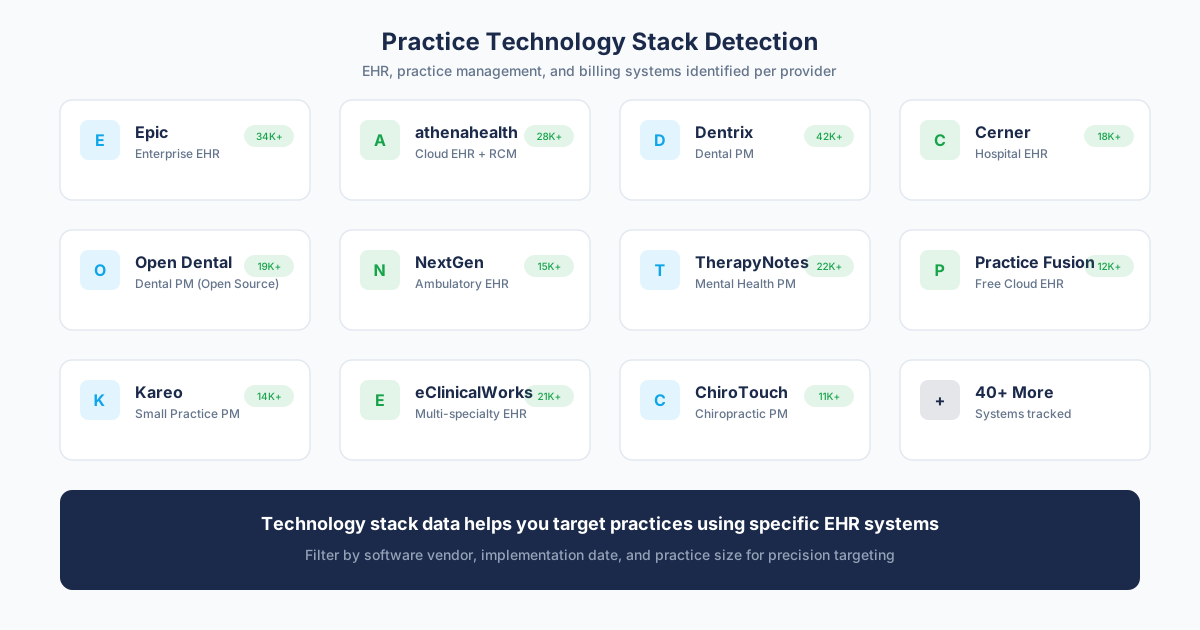
Provyx tracks primary care and urgent care practice data with ownership indicators and decision-maker contacts that let you focus on independent centers where the owner is reachable directly.
For PE-Backed Chains
Individual location data is useful for understanding the chain's footprint, but your contact strategy should focus on headquarters. You need:
- Corporate parent identification:: Which chain operates this location? Many PE-backed centers operate under local brand names that don't obviously connect to the parent company.
- HQ contacts by function:: VP/Director of Operations, VP/Director of Clinical Services, CTO, Head of Procurement. These are the decision makers.
- Location count:: Helps you size the opportunity. A chain with 50 locations is a mid-market deal. A chain with 300+ locations is enterprise.
- Geographic footprint:: Some chains are regional (CityMD is primarily NYC/NJ). Others are national. Your sales approach changes accordingly.
Learn more about selling to consolidated healthcare groups in our health system sales guide.
For Hospital-Affiliated Centers
Your primary data need is parent system identification. Which health system owns or operates this urgent care center? Once you know that, you need the system-level contacts:
- Urgent care service line director:: Oversees all urgent care locations for the system.
- VP of ambulatory services:: Urgent care often falls under ambulatory/outpatient services at the system level.
- Procurement/value analysis:: The committee that evaluates and approves new vendors and products.
Hospital system sales is its own discipline. Your urgent care center data should connect individual locations to their parent systems so your enterprise reps can work the system-level relationship rather than approaching centers one by one.
For Franchise Models
You need both levels: the franchisee (local owner) and the franchisor (corporate). Your data should include:
- Franchise brand:: Which franchise network is this location part of?
- Franchisee name and contact:: The local owner who can make purchasing decisions within their authority.
- Corporate vendor contacts:: The franchisor's operations or procurement team for approved vendor list inclusion.
Data Fields That Matter for Urgent Care Sales
When building or evaluating an urgent care dataset for sales, here are the fields that drive results:
- Center name and NPI:: Business identity and unique identifier.
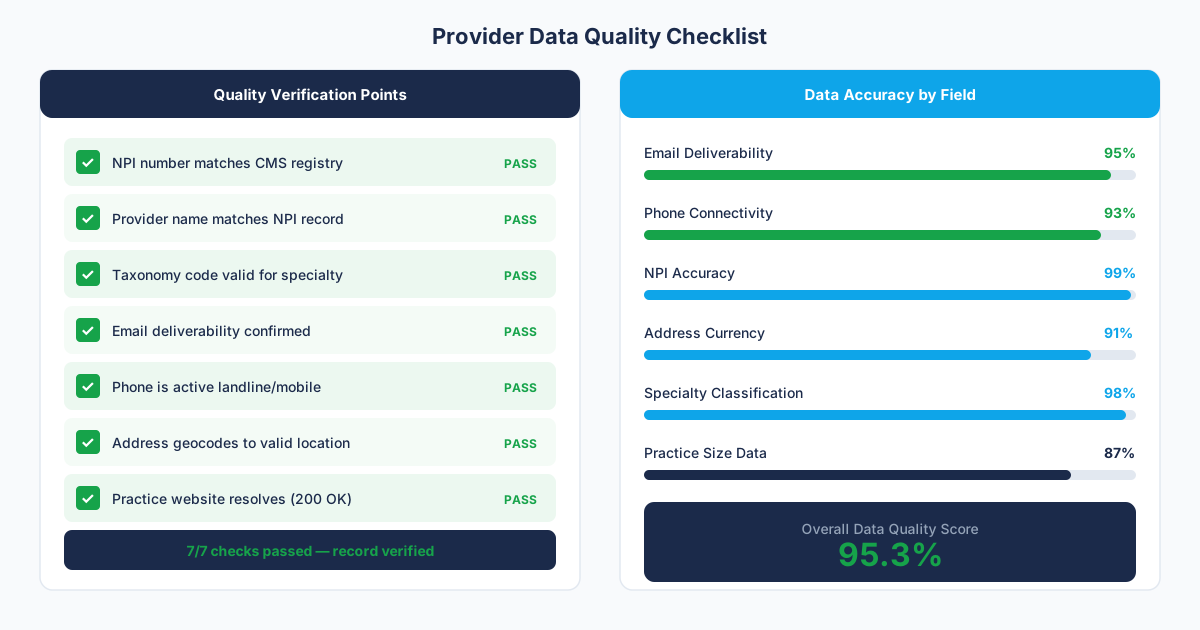
- Verified physical address:: The actual clinic location. NPI mailing addresses for urgent care centers are frequently billing company addresses.
- Ownership type:: Independent, PE-backed chain, hospital-affiliated, or franchise. This single field determines your entire sales approach.
- Corporate parent name:: For chain, system-affiliated, and franchise locations. Maps individual centers to their parent organization.
- Decision-maker name, title, email, phone:: The person who can approve purchases. Varies by ownership type as described above.
- Secondary contacts:: Office manager, clinical director, or center manager. Useful for scheduling demos and gathering requirements even if they don't hold budget authority.
- Provider count:: Number of physicians and advanced practice providers at the location. Indicates volume and budget capacity.
- Services offered:: On-site X-ray, occupational medicine, behavioral health, IV therapy, and other services that indicate equipment needs and revenue sophistication.
- Hours of operation:: Extended-hour and 7-day-a-week centers are higher-volume operations with more revenue.
- Year established:: Useful for equipment replacement cycle targeting.
Navigating the Ownership Maze: A Practical Example
Let's say you sell a patient check-in kiosk system to urgent care centers. Here's how the same product requires four different sales approaches based on ownership:
Independent center (Dr. Patel's Urgent Care, single location in Austin, TX): Email Dr. Patel directly. Mention your kiosk reduces front desk workload by 30%. Offer a 15-minute demo. Dr. Patel decides in a week.
PE-backed chain (CityMD location in Manhattan): Don't contact the Manhattan location. Find CityMD's VP of Operations at headquarters. Build a business case showing ROI across 370 locations. Prepare for a 3-month pilot at 5 locations followed by a 6-month rollout discussion.
Hospital-affiliated center (Duke Urgent Care in Durham, NC): Contact the Director of Ambulatory Services at Duke Health. Submit through their vendor evaluation process. Expect a value analysis committee review. Timeline: 9-15 months from first contact to purchase order.
Franchise location (AFC Urgent Care in suburban Chicago): Contact the local franchisee owner for their location. Simultaneously reach AFC corporate about approved vendor status. If corporate approves, your sales team gains access to 300+ franchise locations.
Same product. Four completely different paths to revenue. Without ownership data, your reps cannot execute the right approach.
Common Mistakes Selling to Urgent Care
Mistake 1: Treating All Centers as Independent
Roughly 60% of urgent care centers are part of chains, health systems, or franchise networks. If your reps approach every center as if it were independent, they're wasting time on locations where the local contact cannot buy. Worse, they may alienate the corporate buyer by approaching individual locations without coordination.
Mistake 2: Using Physician Directories as Contact Lists
Many urgent care physicians are employed (not owners) and rotate between locations. The physician working today may not be there tomorrow. And employed physicians at chain locations have zero purchasing authority. Your contacts need to be role-based (owner, center manager, operations director), not just the providers listed on the NPI.
Mistake 3: Ignoring the Joint Venture Structure
GoHealth operates through joint ventures with health systems. A "GoHealth Urgent Care" location may be jointly owned by GoHealth and Northwell, or GoHealth and Providence. The purchasing authority depends on the JV agreement. Your data should capture these relationships so reps understand the true decision-making path.
Mistake 4: Skipping the Office Manager
At independent centers, the office manager or center director handles vendor logistics, scheduling, supply ordering, and day-to-day operations. Even when the physician-owner makes final decisions, the office manager is the gatekeeper and influencer. Including them in your outreach multi-threading strategy significantly improves response rates.
Mistake 5: Not Tracking Ownership Changes
Urgent care ownership changes frequently. Independent centers get acquired by PE firms. Health systems sell off underperforming centers. Franchise locations change hands. A center that was independently owned 6 months ago may now be part of a 50-location chain with centralized purchasing. Your data needs regular refresh cycles to capture these transitions.
Building Your Urgent Care Sales Strategy
A data-driven urgent care sales strategy follows this sequence:
- Segment your total market by ownership type.: Use ownership data to divide your prospect list into the four categories. This determines your sales motion for each segment.
- Prioritize by deal size and cycle length.: Independent centers close fast but are smaller deals. PE chains and health systems are larger deals with longer cycles. Balance your pipeline with a mix.
- Map corporate parents.: For chain and system-affiliated centers, group individual locations under their parent organization. One corporate relationship can unlock dozens or hundreds of locations.
- Build contact strategies by segment.: Direct outreach to independent owners. Enterprise sales to PE chain headquarters. Health system procurement engagement for affiliated centers.
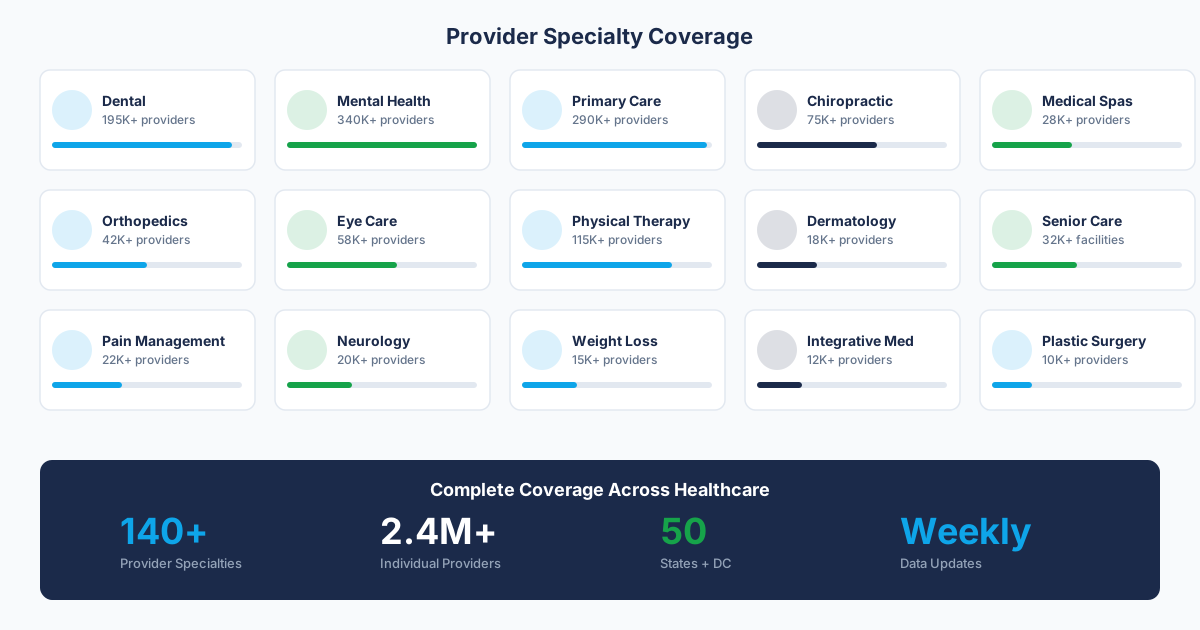
- Track ownership changes.: Set up regular data refreshes to catch acquisitions, closures, and ownership transitions. An independent center you couldn't close last quarter might now be part of a chain where you have a corporate relationship.
For urgent care ownership data with decision-maker contacts, check our practice owner data guide or reach out to our team to discuss your specific targeting needs.
Frequently Asked Questions
How many urgent care centers are there in the United States?
The Urgent Care Association estimates over 14,000 urgent care centers in the US as of 2025, up from roughly 9,000 a decade ago. The industry serves over 160 million patient visits annually and generates more than $30 billion in revenue. Growth continues at 5-6% per year as more patients choose urgent care over emergency departments for non-life-threatening conditions.
Who makes purchasing decisions at urgent care chains like CityMD or GoHealth?
At PE-backed chains, purchasing decisions are centralized at corporate headquarters. Individual center managers have minimal authority. Depending on the product category, the buyer may be a VP of Operations, VP of Clinical Services, CTO, or Head of Procurement. Contacting individual locations is ineffective for sales. You need corporate-level contacts to move deals forward.
What percentage of urgent care centers are independently owned?
Approximately 35-40% of urgent care centers are independently owned by physicians. The remaining 60-65% are part of PE-backed chains, hospital health systems, franchise networks, or joint ventures. This split matters because ownership type determines the decision-making structure, sales cycle length, and the right contact strategy for sales teams.
How do I tell if an urgent care center is hospital-affiliated?
Look for the health system brand in the center name (e.g., 'Duke Urgent Care' or 'Northwell GoHealth Urgent Care'). However, some affiliated centers operate under different brand names. Commercial provider data that includes corporate parent identification is the most reliable way to connect individual locations to their parent health systems.
What data fields do I need for urgent care sales prospecting?
The critical fields are: ownership type (independent, chain, hospital-affiliated, franchise), corporate parent name, decision-maker name and title with direct email and phone, verified physical address, provider count, services offered, and year established. Ownership type alone determines your entire sales approach, making it the single most important field.
How often does urgent care ownership data change?
Frequently. PE acquisitions of independent centers happen every quarter. Health systems open new urgent care satellites and occasionally divest underperforming ones. Franchise locations change hands. Data should be refreshed at least quarterly to capture ownership transitions that fundamentally change who you need to contact and how.
Sources and References
Related Resources
Get the Provider Data You Need
Tell us what you're looking for. We'll build a custom list matched to your target market.
Trusted by healthcare sales teams, medical device companies, and health IT vendors across the US.