
How a Benefits Company Built Its Network Recruitment List
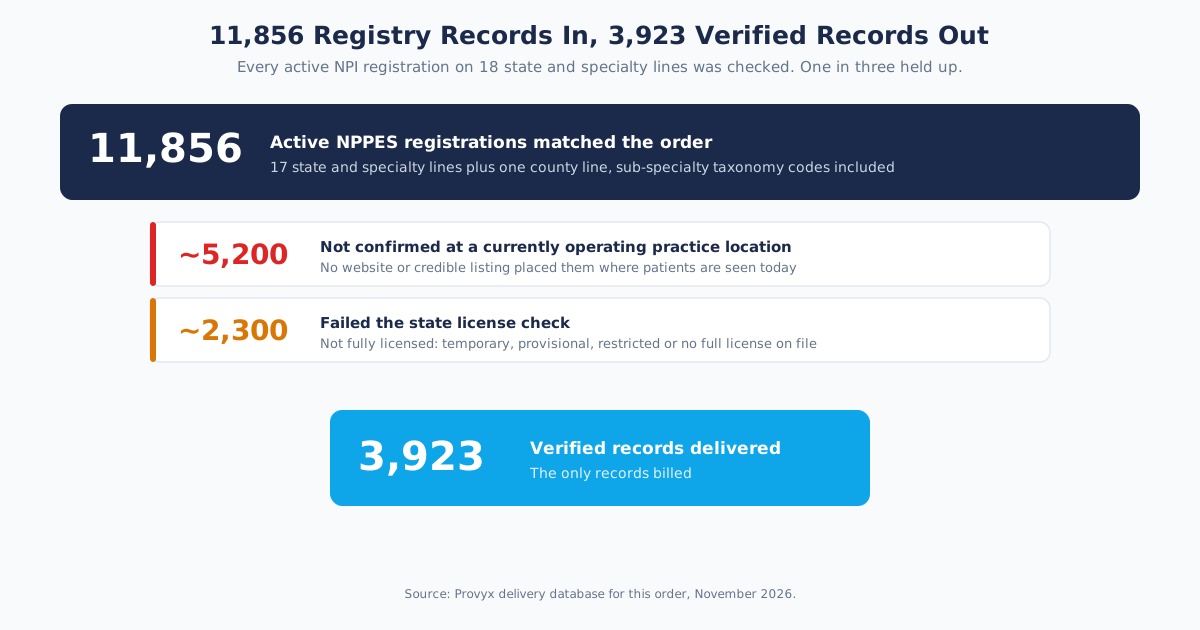
A national specialty health benefits company needed active, fully licensed practitioners and clinics in eight states plus one county, at the address where each one sees patients. Provyx checked all 11,856 matching registry records and delivered the 3,923 that held up.
Published November 2026
The Results at a Glance
“I have reviewed the lists you sent, and have found them to be accurate, and what we need.”
Reports coordinator, practitioner network team, national specialty health benefits company
The Client: A Specialty Benefits Company Growing Its Networks
The client is a national specialty health benefits company that builds and manages practitioner networks for chiropractic, acupuncture, massage, physical and occupational therapy, dietitians and related care. It has more than $500 million in annual revenue and more than 1,000 employees.
The request came from a reports coordinator on the practitioner network team on September 23, 2026. The team wanted lists of “active, in-state practitioners and clinics” for 17 state and specialty lines, defined by NPI taxonomy. A county-only line was added later, for 18 lines across eight states plus one county in the South, Northeast, Mid-Atlantic and West.
The specialties were massage therapists, chiropractors, acupuncturists, dietitians, naturopathic doctors, occupational therapists, podiatrists, physical therapists, speech-language pathologists, and outpatient PT and OT clinics.
The Challenge: Registry Addresses and License Status
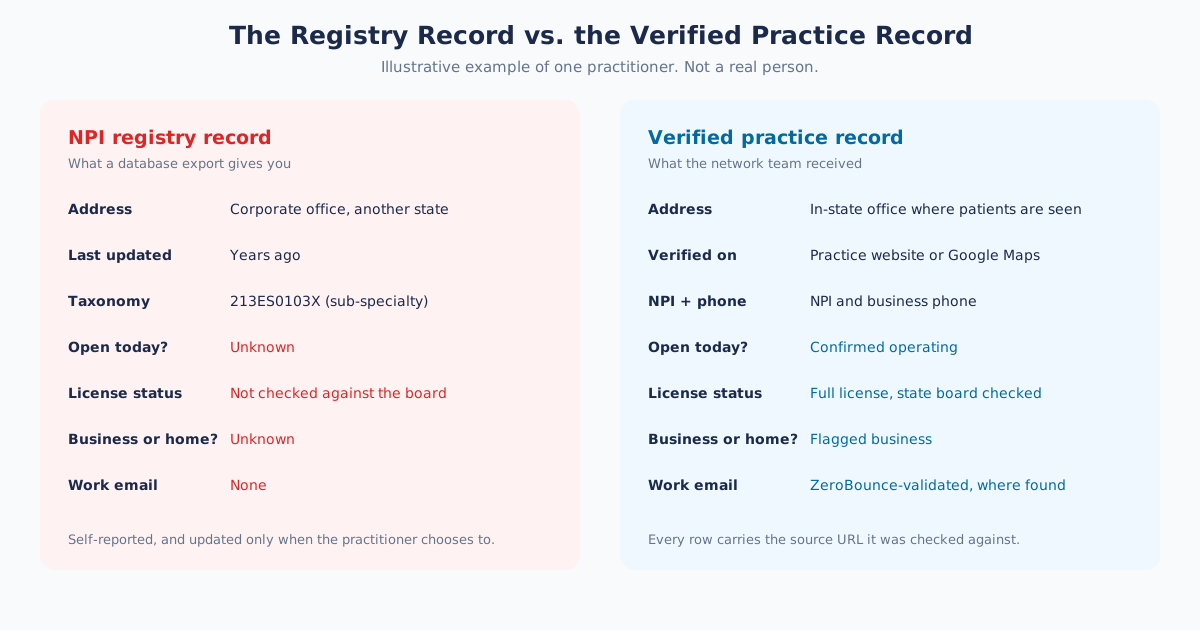
The team had two requirements that a registry export cannot meet. The first was the address. In the team’s words: “The addresses where the clinical providers practice is needed, not the corporate office, as the provider may not be in the same state as the corporate office.”
The NPI registry holds whatever address the practitioner entered, and records are rarely maintained. More than half of active NPI records have not been updated in five years, and more than half of those have not been updated in ten. For chiropractors, 75% of records are five or more years old (NPI staleness report).
The second requirement was the license. “We do not want those that are temporary, provisional, conditional, permitted, or restricted, and no assistants or techs.” The registry does not record whether a license is full, provisional or restricted. Only the state board does.
The buying terms were fixed too. Company policy allows no subscriptions, only a one-time purchase against an approved quote, paid by card or check.
A Taxonomy Detail That Changed the Count
Provyx flagged early that most practitioners register under sub-specialty taxonomy codes. Most podiatrists use 213ES0103X, for example, not the general 213E00000X. A list built on the general codes alone would miss most of the market. The customer chose to include the sub-specialty codes, which you can look up in the NUCC taxonomy code set.
How Provyx Built the List
Provyx does not sell stored licensure lists. It built this one live, record by record, starting from the 11,856 active NPPES registrations that matched the 18 lines.
- Find where each practitioner sees patients. Each record was resolved to a practice location and verified against the practice’s own website or a credible listing such as Google Maps.
- Confirm the location. Each address was flagged as a business or a residence, and the practice was confirmed as currently operating.
- Check the license. Practitioners were checked against the state licensing board. One state does not license dietitians, so those were checked in the national registered dietitian registry kept by the Commission on Dietetic Registration. One state’s board blocks automated checks, so its lines shipped without a board check. Clinic lines are facilities and need no license check.
- Add contact fields. Each record carries the NPI and business phone, with a ZeroBounce-validated email as an option.
- Show the source. Every row names the source it was checked against, so the network team can open it.
One Last Check Before the File Shipped
A final email-affiliation check ran before delivery. It caught 39 professional emails that belonged to a practitioner’s other or prior employer. Provyx removed them, sent a corrected file within the hour, and lowered the invoice to match.
What the Network Team Received
| Measure | Count |
|---|---|
| Active registry records checked | 11,856 |
| Verified practitioner and clinic records delivered | 3,923 |
| Named contacts | 3,058 |
| Contacts with a validated email | 2,058 |
| Practitioners license-verified against the state board | 2,662 |
| Not confirmed at an operating practice location | About 5,200 |
| Failed the state license check | About 2,300 |
The customer was billed only for the 3,923 delivered records. The records left out were never invoiced.
Where the 988 Hours Come From
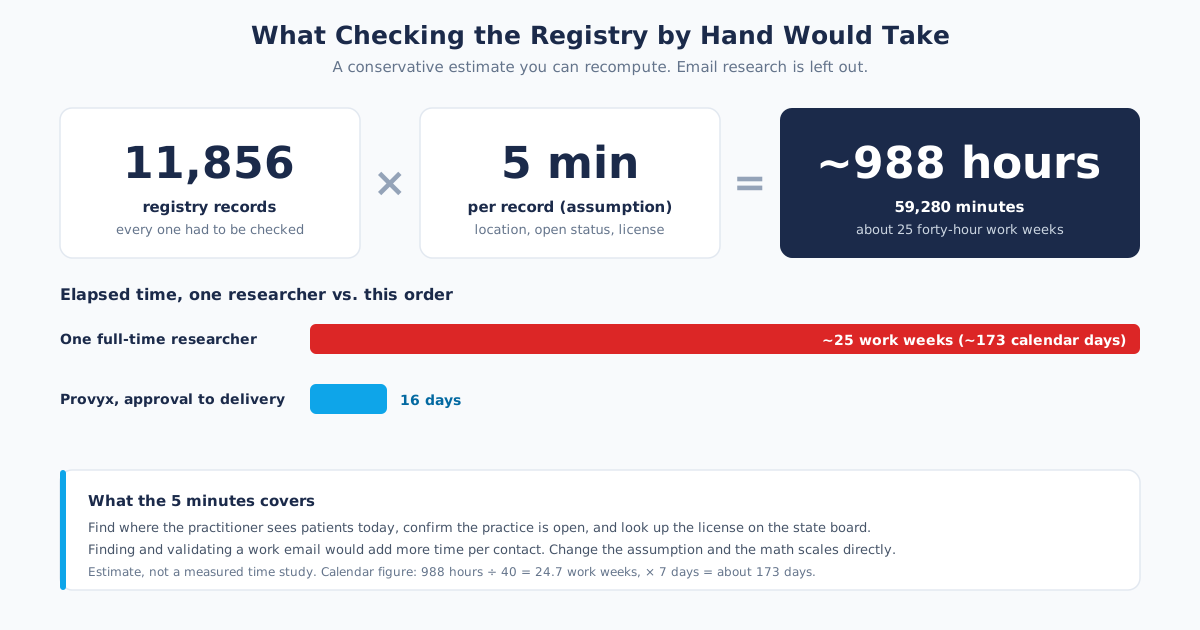
The estimate is simple so you can check it. Checking one registry record by hand means finding where the practitioner practices today, confirming the practice is open, and looking up the license on the state board. We assume 5 minutes per record. That is conservative for a record with an out-of-state address or a board that is slow to search.
11,856 records × 5 minutes = 59,280 minutes, or about 988 hours. At 40 hours a week, that is about 25 work weeks for one researcher. Finding and validating a work email for the 3,058 named contacts would add more. Provyx returned the lists 16 days after the order was approved.
Timeline and Terms
The order was approved on October 27, after the customer’s internal management and purchasing review. Provyx delivered on November 12, 16 days later. The customer reviewed the full file within its 14-day review window and paid on November 19. The final price came in under the estimate and under the approved quote.
The terms matched the company’s no-subscription policy:
- Nothing owed before delivery.
- 14 days to review and flag any record outside the scope, which Provyx fixes or removes.
- Billed only on what is validated and delivered.
- A one-time purchase, paid by card or check.
“I appreciate all your time and assistance with this order and will reach out to you again when needed.”
Reports coordinator, practitioner network team, national specialty health benefits company
The county-only line showed that lists can be cut finer than a state. The coordinator noted it for later work:
“Thank you for confirming purchase by County, as this may be used for future projects.”
Reports coordinator, practitioner network team, national specialty health benefits company
When This Approach Fits a Network Team
A list built this way fits when you recruit practitioners into a network by state, county or specialty and need the office where they treat patients. It also fits when license status decides eligibility. Expect the delivered count to be well below the registry count. Here it was one third, because records that cannot be confirmed are left out instead of passed along.
Two limits apply. A state board that blocks automated checks means those lines ship without a board check, and Provyx says so in the file. Practitioners with no website or credible listing cannot be placed at a practice, so they are not delivered. For coverage and adequacy questions on a network you already have, see provider network analysis. For onboarding checks after recruitment, see provider credentialing data.
Related Resources
Recruiting Practitioners Into a Network?
Tell us the states, counties, specialties and license rules. We’ll check every registry record against the practice and the state board, and you pay only for the records that hold up.
One-time purchase. Nothing owed before delivery. 14-day review.