
What is Healthcare Taxonomy Code?
A healthcare taxonomy code is a 10-character alphanumeric code from the NUCC Health Care Provider Taxonomy that classifies a provider's specialty, subspecialty, or service type. Source: CMS NPPES files.
Updated April 2026
Healthcare Taxonomy Code Explained
Taxonomy codes were created by the National Uniform Claim Committee (NUCC) to standardize how healthcare providers are classified across the US. Providers select one or more taxonomy codes when applying for their NPI, and these codes are stored in the NPPES database alongside their NPI number.
The taxonomy system is hierarchical: broad categories (e.g., "Allopathic & Osteopathic Physicians") break down into specialties (e.g., "Orthopedic Surgery") and subspecialties (e.g., "Sports Medicine"). There are over 800 active taxonomy codes covering every clinical and non-clinical healthcare role. Source: CMS NPPES files.
For data buyers, taxonomy codes are the primary filter for building targeted provider lists. If you need a list of dermatologists, you filter by taxonomy code 207N00000X. If you need pain management specialists, you filter by 208VP0014X. Taxonomy codes are more reliable than keyword-based filtering because they use a standardized classification system. Source: CMS NPPES files.
Provyx product note: This glossary entry is educational. Provyx does not license or distribute NUCC taxonomy code values. Customer files use plain-language specialty and subspecialty labels instead.
Why Healthcare Taxonomy Code Matters for Healthcare Data
Taxonomy codes are how you filter the 8 million+ providers in NPPES down to the specific specialty you're targeting. Without taxonomy filtering, you're stuck with name-based searches that miss providers and include false matches. Every serious provider data product supports taxonomy code filtering. Source: CMS NPPES files.
Real-World Example
A dental supply company wants to target oral surgeons specifically rather than general dentists. By filtering for taxonomy code 1223S0112X (Oral and Maxillofacial Surgery), they get a precise list of 5,800 oral surgeons. A keyword search for "oral surgeon" would miss providers listed as "maxillofacial surgeon" and include non-surgeon dentists who mention surgery on their profiles. Source: CMS NPPES files.
How should a data team use Healthcare Taxonomy Code?
Store the reported classification code, plain-language label, primary indicator, and source date separately. Use the code to narrow a candidate set, then confirm current clinical focus when the campaign depends on a subspecialty or procedure. That keeps a self-reported classification useful without presenting it as proof of present-day practice.
For Healthcare Taxonomy Code, a sales list needs a different standard from a research extract. Research can retain ambiguous records for later study. Outreach requires a named entity, a current business relationship, and a contact route checked close to delivery. Store uncertainty as a field instead of hiding it inside one "verified" label. That gives campaign owners a way to exclude weak matches while preserving them for analysts who may have more context.
Which Healthcare Taxonomy Code fields deserve manual review?
Review primary and secondary specialty labels first. Those fields carry the most weight in a match and create the most damage when stale. Compare the source value with the current practice website or official record, record the date of the check, and keep conflicting evidence visible. A clean-looking row can still connect the right name to the wrong location, organization, or specialty. Identity, affiliation, and contactability should each have their own result.
Manual review of Healthcare Taxonomy Code belongs at the boundary between sources. Name differences, mergers, shared addresses, and organization aliases often create valid records that deterministic rules cannot resolve safely. Give the reviewer the source links and the reason the row was flagged. A reviewer who sees only the final spreadsheet has to repeat the research and may reach a different conclusion without knowing which conflict triggered the review.
Where do Healthcare Taxonomy Code errors enter the workflow?
A frequent error is treating a self-reported classification as proof of current clinical focus. The mistake usually appears during normalization or joining, after the source file has been collected but before the final record is assembled. Preserve source-specific identifiers through each step, compare entity type before joining, and reject matches that depend on name similarity alone. Shared surnames, brand names, and building addresses create false confidence when a pipeline collapses several signals into one score.
Staleness creates a second failure path for Healthcare Taxonomy Code. A correct historical record may be wrong for a campaign sent today. Save both the source's update date and your own check date. Those dates answer different questions: when the publisher changed the record and when your team confirmed the evidence. Refresh high-change fields such as role, practice affiliation, email, and phone more often than durable identifiers.
How can buyers test Healthcare Taxonomy Code data before purchase?
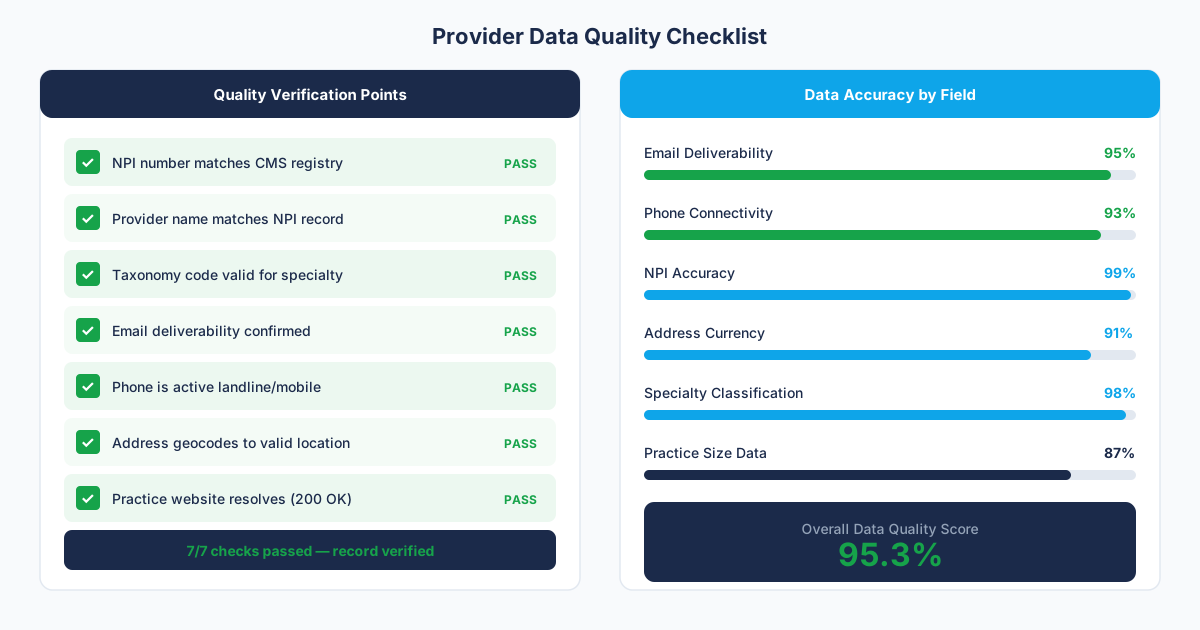
When testing Healthcare Taxonomy Code, ask for a sample drawn from the same specialty, geography, and organization mix as the planned order. A broad national sample can hide the exact edge cases your team will encounter. Check the sample against authoritative sources, call a small set of business numbers, and review ambiguous matches with the people who know the territory. Record pass, fail, and unresolved counts by field rather than reducing the whole sample to one accuracy percentage. Source: CMS NPPES files.
A vendor supplying Healthcare Taxonomy Code should explain source coverage, matching rules, refresh timing, and what happens when sources disagree. Request field-level definitions too. Terms such as current, direct, active, and verified can refer to several different checks. A written acceptance rule makes the project testable: the delivered file either satisfies the agreed condition or it does not. Keep the sample and acceptance rule with the final delivery for later QA.
What should happen before Healthcare Taxonomy Code data reaches a CRM?
Before Healthcare Taxonomy Code reaches a CRM, normalize names and addresses, preserve stable identifiers, separate individuals from organizations, and keep the relevant source URL or source label available for audit. Deduplicate only after entity type and affiliation have been checked. Then map the accepted fields to the CRM without overwriting a newer first-party value. Conflicts should route to review, especially when the incoming record would change an account owner, practice location, suppression status, or clinical specialty.
Finish with a dated QA summary that states the requested population, delivered record count, field coverage, excluded rows, and unresolved exceptions. That summary gives sales operations a usable handoff and makes later refreshes comparable. When campaign results arrive, feed bounces, wrong-party calls, and corrected affiliations back into the next build. Healthcare Taxonomy Code becomes more valuable when source evidence and field outcomes remain connected after delivery.
Frequently Asked Questions
Where can I look up taxonomy codes?
The NUCC maintains the official taxonomy code list at nucc.org. You can also find taxonomy codes in NPPES records and through CMS documentation. The codes are updated twice yearly.
Can a provider have multiple taxonomy codes?
Yes. Providers can list multiple taxonomy codes in NPPES to reflect different specialties or roles. For example, a physician who practices both internal medicine and cardiology would have taxonomy codes for each. One code is designated as the primary taxonomy.
How are taxonomy codes different from CPT codes?
Taxonomy codes classify who the provider is (their specialty and type). CPT codes classify what procedures the provider performs. A cardiologist (taxonomy) might perform an echocardiogram (CPT). They serve different purposes in healthcare data.
How should a primary classification be used?
Treat the primary classification as one reported field, not a complete description of current practice. Check additional classifications and the provider's current practice evidence before segmenting.
Why do classification labels need normalization?
Source systems may use different labels or levels of detail. Keep the original code and label, then map them to a controlled campaign category without discarding the source value.
Sources and References
Related Resources
Get the Provider Data You Need
Tell us what you're looking for. We'll build a custom list matched to your target market.
Trusted by healthcare sales teams, medical device companies, and health IT vendors across the US.