
How a Maternal Health Company Built Its OB-GYN Practice List
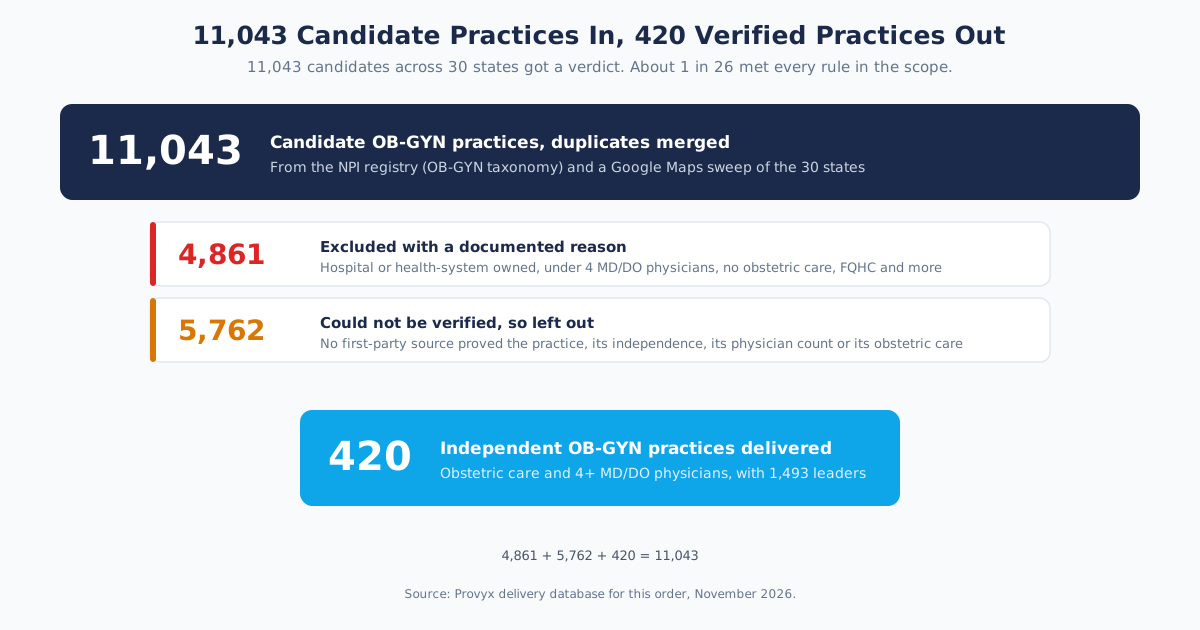
A digital maternal health company wanted every independent OB-GYN practice that still delivers obstetric care and has enough physicians to buy its platform, with the leaders who make that decision. Provyx judged 11,043 candidate practices across 30 states and delivered the 420 that met every rule.
Published November 2026
The Results at a Glance
“Thank you for your work on this. This looks great...”
Provider sales executive, digital maternal health company, on receiving the file
The Client: A Maternity Care Platform Selling to OB-GYN Practices
The client is a digital maternal health company. It sells a maternity care platform to OB-GYN practices and was leading its practice sales with remote patient monitoring. Its sales team needed to know which practices could actually buy: independent groups that still deliver babies and are big enough to use the platform.
The first priority was a validated list of independent OB-GYN practices that still provide obstetric care and have at least four MD or DO physicians.
The team also needed to reach the people who make the decision: medical directors, owning physicians, practice administrators and, at larger groups, the executive team.
The Challenge: Three Facts the Registry Does Not Record
OB-GYN physicians register in the NPI Registry, filed under one of the 207V NUCC taxonomy codes for obstetrics and gynecology. The registry was the starting point, but the scope turned on three facts it does not hold.
- Independence. The registry does not say whether a practice belongs to a hospital, health system or university. Private-equity-backed groups were in scope; system-owned practices were out.
- Obstetric care. The general OB-GYN taxonomy code does not say whether a practice still delivers babies. GYN-only practices were out.
- Physician count. Only MDs and DOs counted toward the floor. Nurse practitioners, physician assistants, midwives and medical assistants did not.
And the team wanted its highest-priority states covered completely, with no practice left on the table, before moving on to the next. That rules out a registry export: our NPI staleness report shows how far registry addresses drift from where practices operate today.
How Provyx Built the List
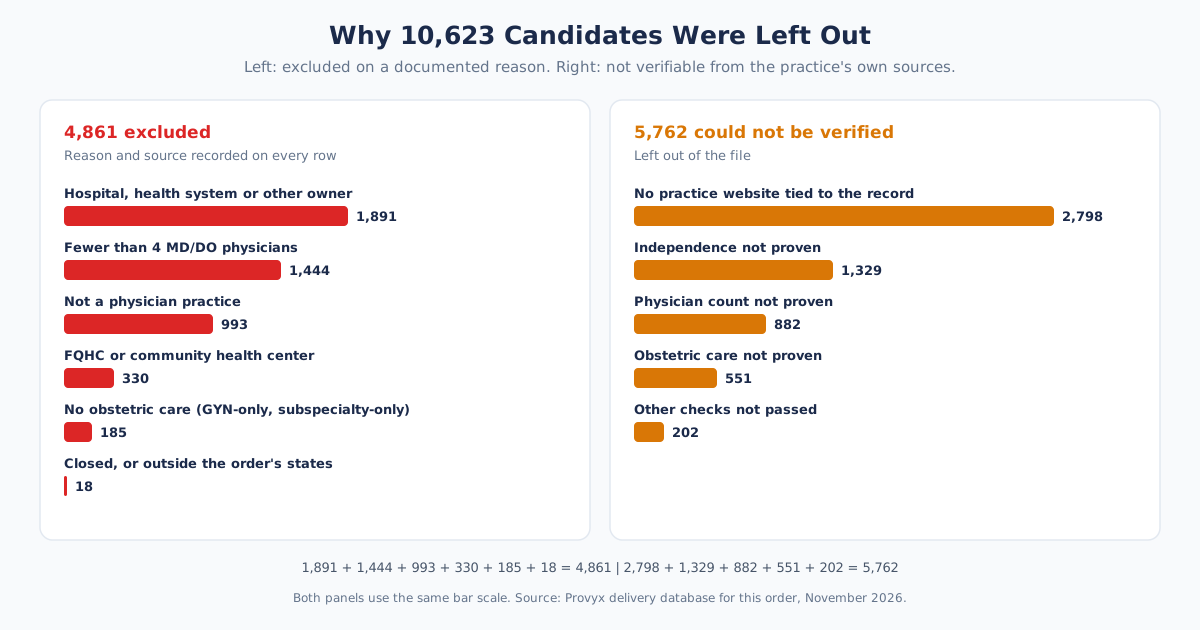
Provyx built the list live for this order. Candidates came from the NPI registry and from a Google Maps category sweep of the 30 states, which finds practices the registry search misses. After duplicates were merged, 11,043 candidate practices went through the same checks.
- Find the practice's own website. Each candidate was tied to the practice's own site. A directory listing or a hospital page did not count as the practice.
- Check ownership. A practice was excluded as hospital or health-system owned only on a quoted statement from a source, such as “a division of” wording or a health system named in the site's copyright line. Without proof either way, the practice was held and left out of the file.
- Confirm obstetric care. Every delivered practice carries the service label or sentence from its website that shows obstetric, prenatal or pregnancy care, with the link.
- Count the physicians. MDs and DOs were counted from the practice's own roster. At multispecialty groups, only the OB-GYN department counted. 418 of the 420 counts come from the practice website.
- Find the leaders. Leaders came from the practice website, LinkedIn, the NPI registry's authorized official, state business filings and similar public records. Every contact row names its source.
- Find and validate emails. Each professional email was validated with ZeroBounce and checked to make sure the mail domain belongs to the practice or an affiliated entity. Personal emails were left out, as the scope asked.
Before delivery, independent reviewers checked rows against the practices' live websites. Problems they found were fixed in the underlying data and the file was rebuilt, never edited by hand.
What the Sales Team Received
One workbook with two tables. The practice table carries name, address, phone, website, published practice email, number of locations, MD/DO count, total providers including NPs and midwives, ownership, EHR where a source showed it, and source links beside the key facts. The contact table carries name, title, credentials, NPI for physicians, LinkedIn where found, professional email, mobile and the source of the role.
| Measure | Count |
|---|---|
| Candidate practices judged | 11,043 |
| Independent OB-GYN practices delivered | 420 |
| States with a delivered practice | 29 of 30 |
| MD/DO physicians at the delivered practices | 5,038 |
| Median MD/DO count per practice | 6 |
| Leadership contacts | 1,493 |
| Contacts with a LinkedIn profile | 780 |
| Validated professional emails | 1,108 |
| Mobile numbers | 751 |
Texas (79 practices), New York (45) and California (37) produced the most. North Dakota was the one state with no qualifying practice.
Where the 920 Hours Come From
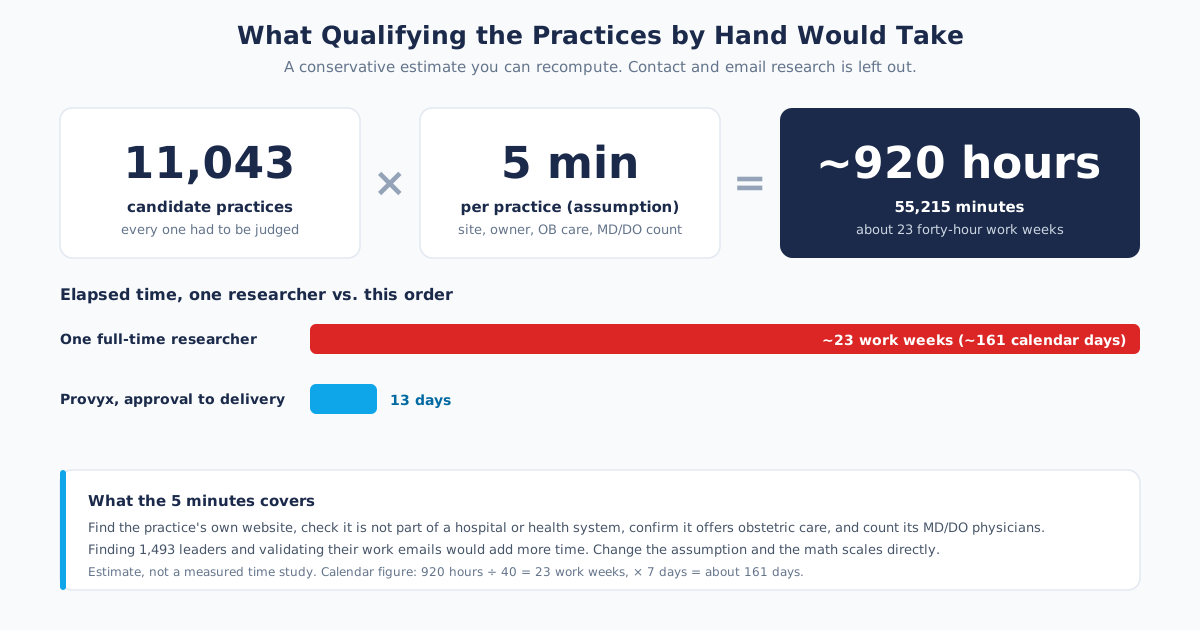
The estimate is simple so you can check it. Qualifying one candidate by hand means finding the practice's own website, checking it is not part of a hospital or health system, confirming it offers obstetric care, and counting its MDs and DOs. We assume 5 minutes per candidate. That is conservative for a group with a dozen locations or a roster spread across bio pages.
11,043 candidates × 5 minutes = 55,215 minutes, or about 920 hours. At 40 hours a week, that is about 23 work weeks for one researcher. Finding 1,493 leaders and validating their work emails would add more. Provyx delivered in 13 days, and the sales team approved the file the same day.
When This Approach Fits a Practice Sales Team
A list built this way fits when your buyer is defined by facts a database export cannot filter on: who owns the practice, which services it still offers, and how many physicians of a given type it employs. It also fits when you sell to the people who run the practice, such as owners, administrators and medical directors. Expect the delivered count to be far below the candidate count. Here it was about 1 in 26, because practices that cannot be proven are left out.
For more on reaching practice leaders, see healthcare decision-maker data. If you sell software to practices, see provider data for healthcare SaaS companies.
Related Resources
Selling to Independent Physician Practices?
Tell us the specialty, ownership, size floor, services and roles. We'll judge every candidate practice against them and deliver only the practices that hold up, with the leaders who decide.