
Provider Data Enrichment: NPI to Sales-Ready Contacts
Raw NPI data is a phone book for people who don't answer phones. Here's how enrichment turns it into pipeline.
2026-03-29
The Gap Between NPI Data and a Usable Sales List
Every healthcare B2B team starts in the same place. Someone downloads the NPPES data file, filters to the target specialty, loads it into a spreadsheet, and realizes they can't do anything with it.
No email addresses. Phone numbers that ring to a billing department in another state. Addresses that might be a PO Box. No idea whether the provider is a solo practitioner or part of a 200-location health system. No decision-maker names. No way to tell if the practice is even still open.
The NPI record for a family medicine practice in Dallas looks like this: a name, an address, a specialty classifications, and a phone number. What a sales rep needs looks like this: the practice owner's name, a verified business email, a direct phone number, the office manager's contact info, the practice size (3 providers, 1 location), the EHR they use (Athena), and the fact that they're independently owned and actively evaluating new vendors because their current data platform contract expires in Q3.
Bridging that gap is provider data enrichment. It's the single highest-leverage investment a healthcare sales team can make, and it's where most teams either underinvest or invest badly.
What Enrichment Adds to an NPI Record
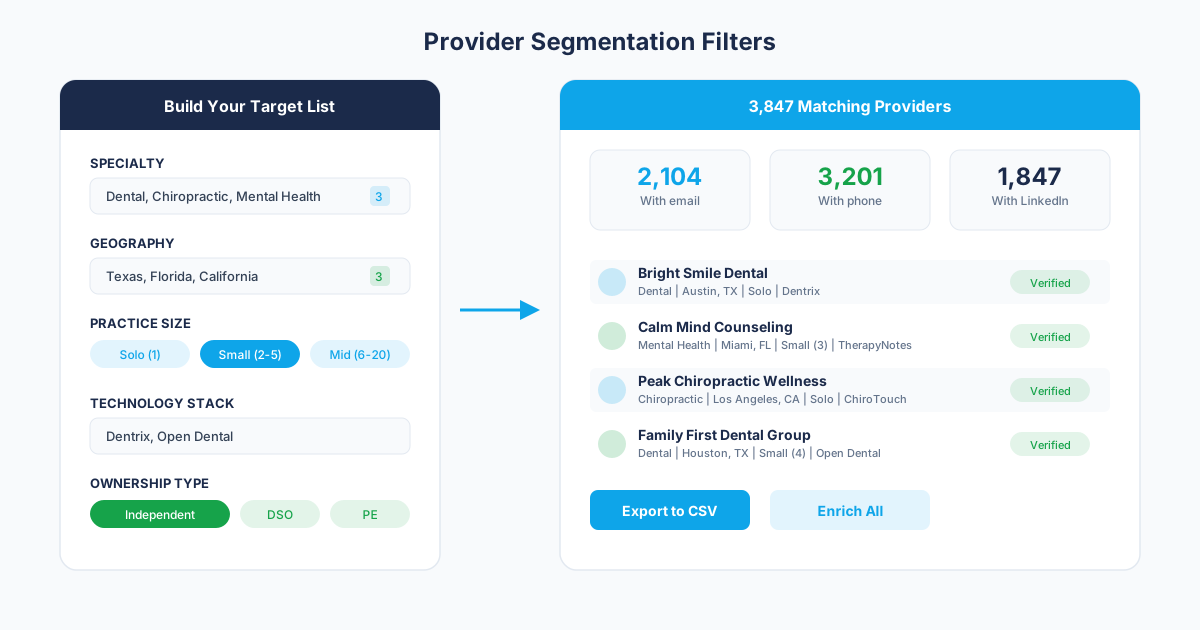
Enrichment is the process of appending additional data fields to a base record. For healthcare providers, the base record is usually an NPI record or a combination of NPI and state licensing data. The enrichment layers that matter for sales and marketing:
Contact Data
- Business email addresses: The most requested enrichment field. Match rates from NPI records to verified business emails typically range from 40-60%, depending on specialty. Dental practices tend to have higher email match rates because dental offices maintain websites more consistently. Mental health providers have lower match rates because many solo therapists use personal email or don't list contact info publicly.
- Direct phone numbers: Beyond the main office line. Direct dials for practice owners and key staff. Match rates are typically 20-35% for verified direct numbers.
- Cell/mobile numbers: Available for a smaller subset. Match rates typically 10-20%. Useful for text-based outreach but requires careful compliance consideration.
- LinkedIn profile URLs: Match rates for healthcare providers range from 30-50%. Higher for physicians in institutional settings, lower for allied health professionals in private practice.
Practice Intelligence
- Practice size: Number of providers, number of locations, approximate annual revenue. Derived from NPI affiliation analysis, web scraping, and commercial databases.
- Ownership structure: Independent, hospital-owned, PE-backed, or part of a management group. This field alone changes the entire sales approach.
- Services and procedures offered: What the practice does, beyond what the NPI specialty classifications implies. Scraped from practice websites and verified against claims indicators.
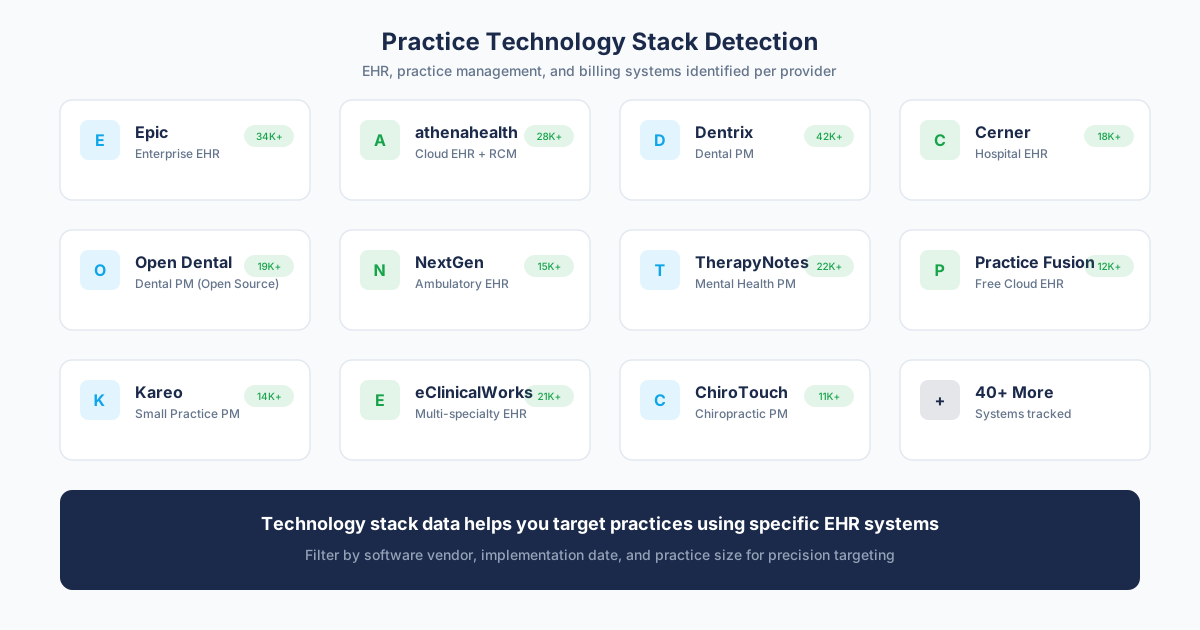
- Technology stack: EHR system, practice management software, billing platform. Identifies competitive displacement opportunities and integration requirements. Our technology detection service covers this layer.
Quality and Freshness Signals
- Last verified date: When was this record last confirmed accurate? Any field more than 90 days old should be treated as potentially stale.
- Source attribution: Where did each data point come from? Practice website, state directory, LinkedIn, phone verification? Source quality varies.
- Confidence scores: How certain is the match between the NPI record and the appended data? A 95% confidence email match from a practice website is more reliable than a 60% confidence match from a general business database.
Enrichment Sources: Where the Data Comes From
Not all enrichment data is created equal. The source matters because it determines accuracy, coverage, and compliance characteristics. Here's the hierarchy we've found most reliable after processing millions of provider records.
Tier 1: Practice Websites (Highest Accuracy)
The provider's own website is the single most reliable source for contact information, staff names, services offered, and location details. If the practice website lists an email address, phone number, or staff bio, that information was placed there intentionally by the practice.
The downside: not every practice has a website. Coverage varies by specialty. About 85% of dermatology practices have websites. For solo mental health practitioners, it drops to around 50-60%. And scraping practice websites at scale requires building and maintaining a web crawling infrastructure.
Tier 2: State Professional Directories and Licensing Boards
State licensing boards maintain provider directories that include license status, practice addresses, and sometimes ownership information. These are government-maintained data sources with mandatory reporting requirements, making them more reliable than most commercial sources.
Coverage varies wildly by state. Some states publish complete online directories with multiple contact fields. Others publish a PDF list once a year. The data engineering effort to normalize across 50 states is substantial.
Tier 3: Professional Associations and Directories
Specialty associations like the American Dental Association, the American Psychiatric Association, and similar organizations maintain member directories. These are useful for verifying that a provider is active in their specialty and for finding additional practice details. Coverage is limited to association members, which is typically 40-70% of providers in any given specialty.
Tier 4: LinkedIn and Professional Networks
LinkedIn is the primary source for non-clinical contacts (administrators, office managers, operations directors) and for verifying clinical contacts' current affiliations. The data is self-reported, which means it's usually current but occasionally aspirational or outdated.
For healthcare providers, LinkedIn coverage varies. Physicians in academic or institutional settings have higher LinkedIn adoption than those in private practice. Administrative and executive contacts have very high LinkedIn coverage.
Tier 5: Commercial Data Aggregators
Services like data.com remnants, general B2B databases, and business listing aggregators. Coverage is broad but accuracy is inconsistent. These are best used as supplementary sources, not primary ones. Always cross-validate commercial aggregator data against a higher-tier source before using it for outreach.
Match Rates: What to Expect
Vendors love to quote match rates without context. Here's what realistic match rates look like when enriching NPI records across different specialties and data fields.
| Data Field | Typical Match Rate | Notes |
|---|---|---|
| Business email (verified) | 40-60% | Higher for dental, lower for behavioral health |
| Direct phone | 20-35% | Higher in independent practices |
| LinkedIn URL | 30-50% | Higher for physicians in institutional settings |
| Practice owner name | 50-70% | Higher for solo/small practices |
| Ownership structure | 60-80% | Binary independent/affiliated easier than detailed classification |
| EHR/technology | 25-40% | Varies heavily by detection method |
Any vendor claiming 90%+ match rates on verified business emails across all healthcare specialties is either redefining "verified" or including generic addresses (info@, contact@) in their counts. Dig into the methodology.
Build vs. Buy: The Honest Math
Should you build an enrichment pipeline in-house or buy enriched data from a vendor? This is the question we get asked most often, and the answer depends on your team size, technical capability, and data volume needs.
Building In-House
What you need:
- A data engineer to build and maintain the pipeline (0.5-1.0 FTE)
- NPI data download and parsing infrastructure
- Web scraping capability for practice websites (not trivial at scale)
- Email verification API subscriptions ($0.003-0.01 per verification)
- Phone validation service ($0.01-0.05 per lookup)
- LinkedIn scraping or Sales Navigator seats
- Address standardization API (USPS or commercial)
Estimated annual cost for a pipeline processing 50,000 provider records: $80,000-$150,000 including engineer time, API costs, and infrastructure. That works out to $1.60-$3.00 per enriched record.
The advantage: full control over data quality, enrichment depth, and update frequency. If you have a strong data engineering team and plan to make provider data a core competency, this can make sense.
The disadvantage: it takes 3-6 months to build, and maintaining it is an ongoing commitment. When the engineer who built it leaves, you're in trouble. When a web scraping target changes their site structure, your pipeline breaks at 2 AM.
Buying from a Healthcare Data Vendor
What you get:
- Pre-enriched provider records with the fields listed above
- Regular refresh cycles (monthly to quarterly, depending on vendor and tier)
- Delivery in CRM-ready format (CSV, API, or direct integration)
- Vendor handles all the scraping, verification, and maintenance
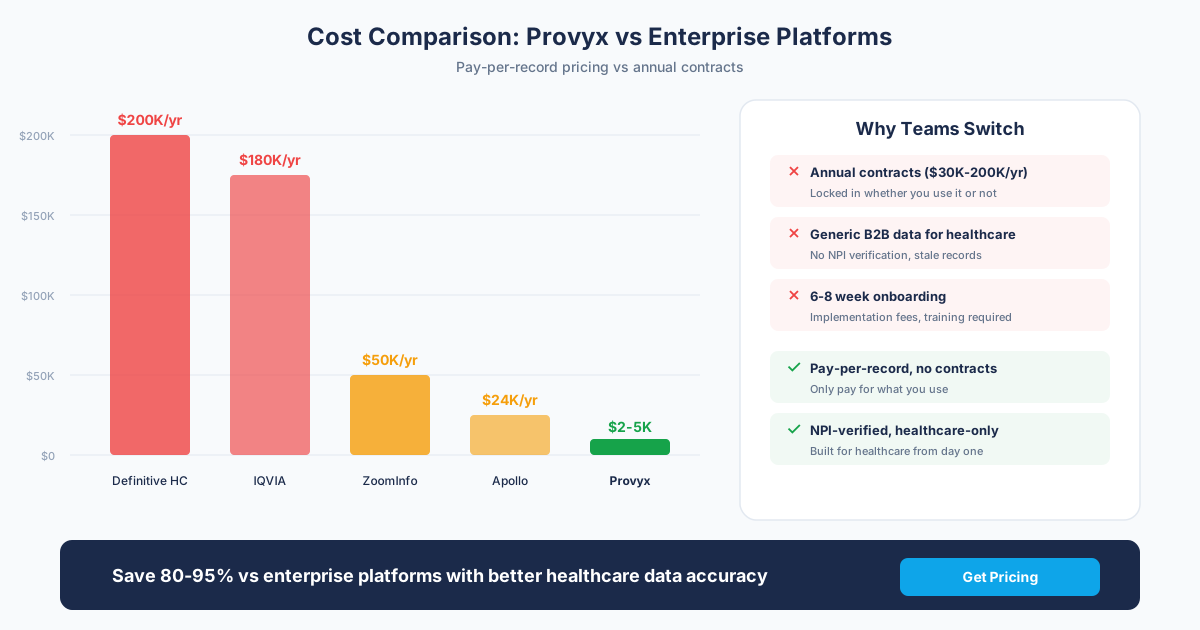
Typical cost: $0.50-$5.00 per enriched record, depending on vendor, volume, enrichment depth, and contract terms. For our custom list building service, pricing depends on scope and specialty.
The advantage: fast time to value. You can have enriched, sales-ready data in days rather than months. No engineering overhead. The vendor absorbs the complexity of maintaining data sources and handling edge cases.
The disadvantage: less control over methodology, potential vendor lock-in, and recurring cost. You're dependent on the vendor's refresh schedule and data quality standards.
The Hybrid Approach
Most of our customers who've thought about this seriously end up with a hybrid. They use a vendor for the initial enrichment and ongoing refresh of their core account list, then supplement with in-house research for high-value target accounts that need deeper intelligence.
This gives you 80% of the coverage at 30% of the build-vs-buy cost, with deeper intelligence where it matters most (your top 100-200 accounts).
Validation: The Step Everyone Skips
Enrichment without validation is a recipe for wasted outreach spend and damaged sender reputation. Validation is the process of confirming that enriched data points are accurate and deliverable before they enter your CRM.
Email Validation
Every email address should be run through a deliverability check before use. Services like ZeroBounce, NeverBounce, and Kickbox verify that an email address exists, accepts mail, and isn't a known spam trap. Cost is negligible ($3-10 per 1,000 verifications), and the ROI is massive.
An email bounce rate above 5% damages your sender reputation. Once your domain gets flagged, deliverability drops across all your email, including to existing customers and inbound leads. A $30 validation run protects thousands of dollars in email infrastructure value.
Phone Validation
Phone validation confirms the number is in service, classifies it (mobile, landline, VoIP), and checks against the national DNC registry. This is especially important for healthcare because many provider listings include fax numbers that look like phone numbers. Your reps shouldn't be dialing fax machines.
Address Standardization
Run all addresses through USPS address standardization. This normalizes formatting, validates deliverability, and catches addresses that don't exist. It also enables accurate territory assignment by standardizing state, county, and ZIP code data.
Identity Resolution
Providers who practice at multiple locations appear as multiple records. A dermatologist working at 3 clinic locations will have 3 NPI address records. Without deduplication, your reps send 3 emails to the same person, which looks sloppy and wastes send volume.
Identity resolution matches records belonging to the same person, designates a primary record, and links secondary records as aliases. This is harder than it sounds because names aren't unique, and the same provider may appear with slightly different name spellings across sources (Robert vs. Rob vs. R., different middle initials, maiden vs. Married names).
The Enrichment Pipeline in Practice
Here's how a provider data enrichment pipeline flows from start to finish:
- Ingest NPI data: Download the NPPES monthly file, parse it, and filter to your target specialties and geographies. This is your base universe.
- Cross-reference state data: Match NPI records against state licensing boards for address validation and ownership information. This catches providers whose NPI address is outdated.
- Web enrichment: Crawl practice websites for contact information, staff names, services offered, and technology indicators. This is the highest-value enrichment layer.
- Professional directory matching: Append data from specialty association directories, hospital affiliation databases, and professional network profiles.
- Contact verification: Validate all email addresses and phone numbers. Remove undeliverable contacts. Flag low-confidence matches for manual review.
- Identity resolution: Deduplicate across all sources. Establish canonical records with primary and secondary contact paths.
- Quality scoring: Assign confidence scores based on source quality, recency, and cross-validation. A contact verified from the practice website and confirmed via state directory gets a higher score than one sourced only from a commercial aggregator.
- CRM formatting: Structure the output for your CRM or outreach tool. Map fields, apply naming conventions, and generate import files.
The whole pipeline, run well, transforms a raw NPI download into a segmented, verified, multi-contact sales database. The difference in campaign performance between enriched and unenriched data is not incremental. Teams using enriched provider data see 3-5x higher connect rates and 2-3x higher meeting rates compared to raw NPI outreach.
When DIY Enrichment Makes Sense
Three scenarios where building your own enrichment pipeline is the right call:
- You need a niche data field that no vendor provides.: If your sales process depends on knowing which medical spas offer a specific device brand, or which primary care practices participate in a specific value-based care program, that's too niche for most vendors. You'll need custom enrichment.
- You process high volumes continuously.: If you need 500,000+ records enriched and refreshed monthly, the per-record economics of in-house enrichment start to beat vendor pricing. The fixed costs (engineer, infrastructure) get amortized across enough records to make sense.
- Provider data is your product, not just an input.: If you're a healthcare analytics company or a data-driven consultancy, your enrichment pipeline is part of your competitive moat. Outsourcing it to a vendor means outsourcing your differentiation.
When Buying Makes Sense
Three scenarios where buying enriched data is the right call:
- You need data fast.: Building a pipeline takes months. Buying takes days. If you have a campaign launching next quarter or a new rep starting next month, buy the data now and evaluate build-vs-buy for the long term.
- Your data needs are episodic, not continuous.: If you need a refreshed list for an annual conference, a quarterly campaign, or a one-time market analysis, the recurring cost of maintaining an in-house pipeline doesn't pencil out.
- You don't have data engineering capacity.: Small and mid-sized sales teams don't have data engineers on staff. Asking a sales ops person to maintain a web scraping pipeline is a bad use of their time and skills.
The right answer for most teams is to start with a vendor, learn what enrichment fields matter most for your sales process, and then decide whether bringing some or all of it in-house makes strategic sense.
What does your enrichment stack look like today? If the answer is "we mostly use the NPI file plus some Google searching," you're leaving pipeline on the table.
Frequently Asked Questions
What is provider data enrichment?
Provider data enrichment is the process of adding contact information, practice intelligence, and quality signals to base provider records (typically from the NPI database). Enrichment fields include verified email addresses, direct phone numbers, practice ownership, facility size, technology stack, and decision-maker names. The goal is to transform a registry record into a sales-ready contact.
What match rates should I expect for healthcare provider email enrichment?
Realistic match rates for verified business email addresses range from 40-60% when enriching NPI records, depending on specialty. Dental and dermatology practices tend to have higher match rates (closer to 60%) because they maintain websites more consistently. Mental health and solo practitioners are lower (closer to 40%). Any vendor claiming 90%+ across all specialties likely includes generic addresses in their counts.
Should I build an in-house provider data enrichment pipeline or buy from a vendor?
For most teams, buying makes sense initially. Building a pipeline takes 3-6 months and costs $80K-$150K annually for 50K records. Buying costs $0.50-$5.00 per record with no engineering overhead. Build in-house if you process 500K+ records continuously, need niche data fields no vendor provides, or treat provider data as a core product. Many teams use a hybrid approach: vendor data for broad coverage, in-house research for top accounts.
How often should enriched provider data be refreshed?
Monthly at minimum. CMS data shows 4-6% of provider records change every month, meaning a quarterly refresh leaves 12-18% of your data degraded. Critical fields like email deliverability and phone connectivity should be validated more frequently, ideally before each outreach campaign.
Sources and References
Related Resources
Get the Provider Data You Need
Tell us what you're looking for. We'll build a custom list matched to your target market.
Trusted by healthcare sales teams, medical device companies, and health IT vendors across the US.