
Healthcare Email List Providers: 2026 Comparison
Most healthcare email list comparisons are written by the vendors themselves. This one isn't.
2026-03-29
The Healthcare Email List Market Is Full of Recycled Data
There are dozens of companies selling healthcare provider email lists. Most of them are reselling the same underlying data from the same handful of aggregators, slapping a different logo on it, and charging anywhere from $0.10 to $5.00 per contact. The differences between vendors are real, but they're not where most buyers think they are.
The meaningful differentiators aren't list size or price per record. They're verification methodology, update frequency, and the gap between what's marketed and what's actually delivered. A vendor claiming 2 million physician emails sounds impressive until you discover 40% of those are generic info@ addresses that never reach a decision-maker.
I've spent the last several years building provider data pipelines and evaluating the output from nearly every major healthcare data vendor. What follows is an honest comparison of the provider categories, their strengths, their weaknesses, and the questions you should be asking before you buy.
Category 1: Healthcare-Specific Data Vendors
These are companies built specifically for healthcare provider data. Their entire business is provider intelligence.
What They Get Right
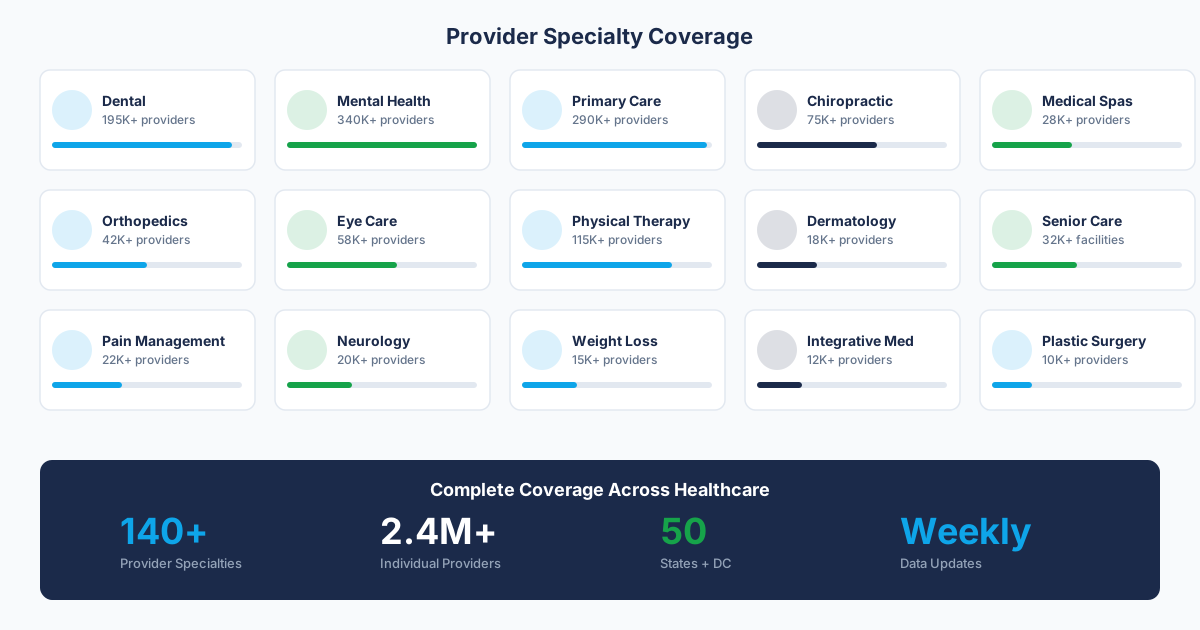
Healthcare-specific vendors understand NPI specialty classifications, specialty classifications, and the organizational complexity of healthcare practices. They typically maintain their own enrichment pipelines that cross-reference NPI data with state licensing boards, practice websites, and professional directories.
The best ones in this category deliver 45-60% email match rates with bounce rates under 5%. They can segment by specialty, sub-specialty, practice size, and geography with reasonable accuracy. They also understand the difference between a provider's NPI-registered address and their actual practice location, which matters more than most buyers realize.
What They Get Wrong
Many healthcare-specific vendors haven't updated their enrichment methodology in years. They're still running the same web scraping pipelines from 2021, which means they miss practices that have redesigned their websites, changed email systems, or moved to new domains. The data decays faster than they refresh it.
Coverage gaps are also real. Most healthcare-specific vendors are strongest in high-volume specialties like primary care, dental, and mental health. If you need integrative medicine providers or pain management specialists, coverage drops significantly. Ask for match rates by specialty, not just overall numbers.
Pricing Range
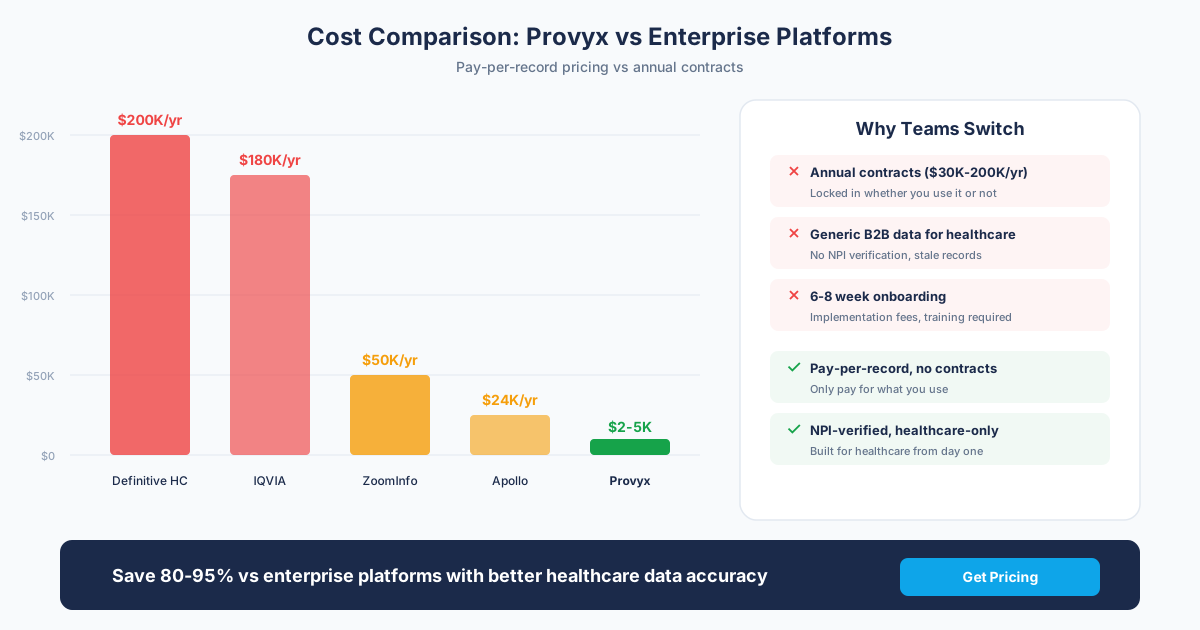
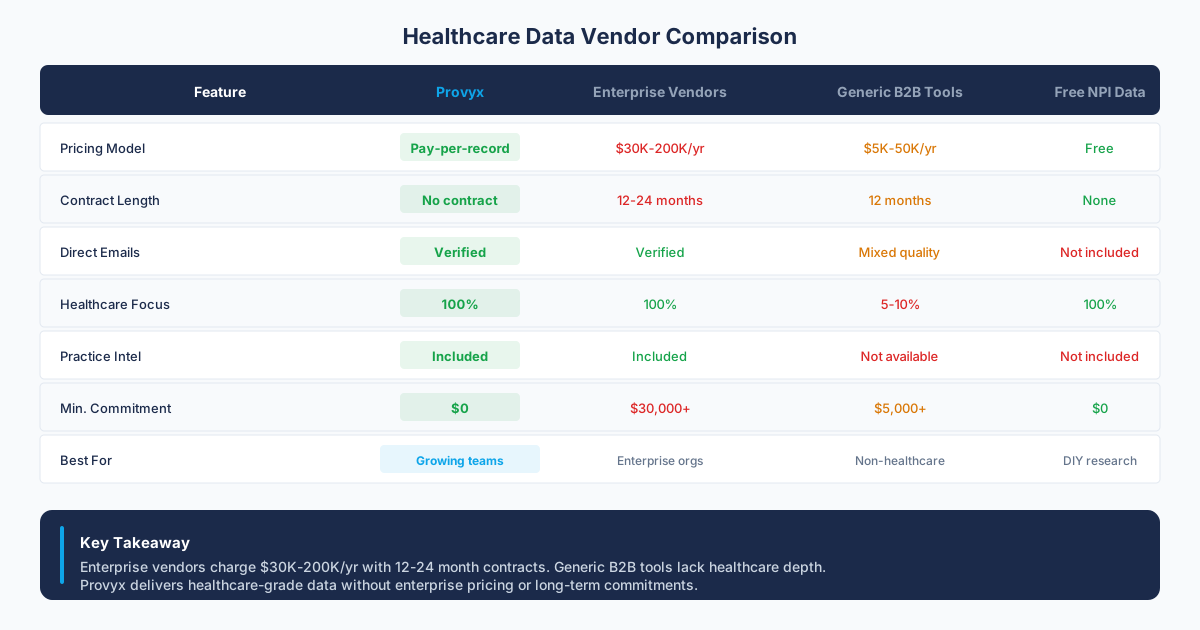
$0.50 to $3.00 per enriched contact, typically with minimum order sizes of 500-5,000 records. Annual subscriptions range from $5,000 to $50,000+ depending on volume and data fields included. Some vendors charge extra for email verification, which should be a red flag. Verification isn't an add-on. It's table stakes.
Category 2: General B2B Data Platforms
These are the ZoomInfos and Apollos of the world. Horizontal data platforms that cover healthcare as one vertical among many.
What They Get Right
Scale and interface. General B2B platforms have massive databases, strong search interfaces, and CRM integrations that make it easy to pull lists directly into your sales workflow. If you need a quick list of 500 cardiologists in Texas with emails, you can generate it in minutes.
They also tend to have better contact-level data for administrative and executive roles. If you're looking for the CFO of a hospital system or the VP of Operations at a DSO, general B2B platforms often outperform healthcare-specific vendors on these non-clinical contacts.
What They Get Wrong
Healthcare provider data is fundamentally different from general B2B data. A solo dermatologist running a 3-person practice doesn't show up the same way as a VP at a software company. General B2B platforms struggle with solo practitioners, small practices, and the organizational complexity of multi-location medical groups. For a detailed comparison, see our Provyx vs ZoomInfo analysis.
The bigger problem is email accuracy. General B2B platforms often report healthcare provider email accuracy rates 10-20 percentage points lower than their overall platform averages. Healthcare providers change practice affiliations frequently, use personal email for some professional activities, and operate across multiple locations. The data models built for corporate employees don't handle this well.
We've tested lists from three major general B2B platforms against our own verified data. Average bounce rates on healthcare provider emails: 12-18%. That's 2-3x higher than what healthcare-specific vendors deliver on the same population.
Pricing Range
$15,000 to $40,000+ annually for platform access. Per-credit models range from $0.30 to $1.50 per contact export. The math often works if healthcare is 20% of your total outreach. If healthcare is your primary market, you're paying for a lot of infrastructure you don't need.
Category 3: List Brokers and Aggregators
These are the companies you find when you search "buy doctor email list." They sell pre-built lists, often by specialty and geography, at relatively low price points.
What They Get Right
Speed and simplicity. You tell them you need 10,000 dentist emails in the Southeast, and they send you a file within 24 hours. No platform login, no complex filtering, no annual contract. For one-time campaigns or market research, the simplicity has value.
What They Get Wrong
Almost everything else. List brokers typically don't maintain their own data. They buy from upstream aggregators, sometimes running it through a basic email verification tool before delivery. The data age is unknown. The verification methodology is opaque. And there's no deduplication across purchases, so buying from the same broker twice often means paying for the same records again.
Bounce rates from list brokers regularly exceed 20%. Some of the worst we've tested hit 35%. At that level, you're not just wasting money on the list. You're actively damaging your email sender reputation, which affects deliverability across all your campaigns.
According to BLS data, the healthcare workforce adds roughly 1.8 million new jobs per decade. Providers move, retire, change affiliations. A static list from a broker ages fast.
Pricing Range
$0.05 to $0.30 per contact. Looks cheap. But factor in 20-35% bounce rates, sender reputation damage, and the cost of cleaning the list after purchase, and the effective cost per usable contact is often higher than buying verified data in the first place.
Category 4: DIY From Public Sources
Some teams skip vendors entirely and build lists from the CMS NPI Registry, state licensing boards, and manual web research.
What This Gets Right
Control and transparency. You know exactly where every data point came from. You can customize your enrichment to include fields that no vendor offers. And for niche specialties or specific geographies, DIY research sometimes produces better results than any vendor.
What This Gets Wrong
Scale and time. The NPI Registry doesn't include email addresses. State licensing boards have inconsistent data formats and varying levels of detail. Manual web research produces excellent results at roughly 5-10 contacts per hour. If you need 500 contacts, that's 50-100 hours of research time. For our detailed breakdown of NPI limitations, read our NPI database vs commercial provider data comparison.
DIY also falls apart on maintenance. Building the initial list is the easy part. Keeping it current requires continuous monitoring of practice websites, email validation, and address verification. Most teams build a great list once, use it for 6 months without updating, and wonder why their campaign metrics are degrading.
The 7 Questions That Actually Matter
Regardless of which vendor category you're evaluating, these questions separate the good providers from the mediocre ones.
1. What's Your Bounce Rate on Healthcare Provider Emails?
Not their overall bounce rate. Their healthcare-specific bounce rate. Any vendor claiming under 3% across all healthcare specialties is either cherry-picking data or using a very generous definition of "deliverable." Realistic benchmark for good data: 3-5% hard bounce rate. Anything above 8% is a problem.
2. How Do You Source Email Addresses?
There are exactly three legitimate sources for provider email addresses: practice websites, professional directories, and direct provider submissions. If a vendor can't explain their sourcing methodology clearly, their data likely comes from a chain of aggregators where the original source is unknown.
3. When Was Each Record Last Verified?
Record-level verification timestamps matter. A vendor saying "we update our database monthly" isn't the same as "this specific email was verified as deliverable 12 days ago." The former means some records were checked recently. The latter means this record was checked recently. Big difference when you're planning an email campaign.
4. What's Your Match Rate by Specialty?
Overall match rates are meaningless if your target specialty is below average. A vendor with a 55% overall email match rate might have 70% for dentists and 30% for functional medicine providers. If you're selling to the latter, the overall number doesn't help you.
5. Do You Differentiate Between Personal and Practice Emails?
Some vendors pad their match rates by including personal Gmail or Yahoo addresses alongside practice emails. A personal email might work for a solo practitioner. It's useless for reaching someone at a multi-location group practice. Know what you're getting.
6. What Happens to Emails That Fail Validation?
Good vendors validate every email before delivery and remove contacts they can't validate, so you never pay for an address that failed validation. Ask how a vendor handles emails it can't validate before you buy.
7. Can You Provide a Test Sample?
Any vendor confident in their data quality will let you validate a sample of 20-50 records independently before committing to a full purchase, either free or as a small pilot fee credited against your first order. If a vendor won't let you test their data before buying at all, that tells you everything you need to know.
Match Rate Benchmarks by Specialty
Based on our experience building and validating provider databases across specialties, here are realistic email match rate benchmarks for verified business email addresses (not personal addresses, not generic info@ addresses):
- Dental:: 55-65%. Dental practices maintain websites consistently and list contact information publicly.
- Dermatology:: 50-60%. Similar to dental. Cosmetic-focused practices are especially well-represented online.
- Primary care:: 40-55%. Highly variable depending on practice size. Health system-employed PCPs are harder to reach directly.
- Orthopedics:: 45-55%. Consolidated groups have standardized email domains. Solo practices vary.
- Mental health:: 35-50%. Solo practitioners often don't publish email on their websites. Group practices are better.
- Integrative medicine:: 30-45%. Smaller practices, less standardized web presence.
- Physical therapy:: 45-55%. Large chains (USPH, ATI) are well-documented. Independent clinics vary.
If a vendor is quoting you match rates 20+ points above these benchmarks, ask them to define what counts as a "match." Including generic addresses, role-based addresses (billing@, frontdesk@), and unverified addresses inflates numbers dramatically.
The Cost of Getting This Wrong
Bad email data doesn't just waste the cost of the list. It creates compounding problems:
- Sender reputation damage.: Email service providers track your bounce rate across campaigns. High bounces from bad list data affect deliverability to your entire database, including existing customers and inbound leads.
- Rep distrust.: When sales reps send 10 emails and 3 bounce, they stop trusting the data. They start doing their own research, which burns selling time and defeats the purpose of buying a list.
- Compliance risk.: Emailing addresses that were scraped without regard to opt-out preferences creates legal exposure, especially under CAN-SPAM and emerging state privacy laws.
- Opportunity cost.: Every email sent to a bad address is an email that could have gone to a real prospect. At scale, this means hundreds of missed opportunities per campaign.
What We'd Recommend
For most healthcare sales teams, the right approach is a healthcare-specific vendor for your core provider data, supplemented with a general B2B platform for administrative and executive contacts at larger organizations. Skip the list brokers entirely. And if you have a niche target segment, consider custom list building for that specific population rather than trying to force a general-purpose list to work.
The cheapest list is never the cheapest list. The one with the lowest bounce rate, the most recent verification, and the best match rate for your specific specialty is the one that costs the least per opportunity generated. Every other calculation is working backward from the wrong number.
Frequently Asked Questions
What's a good bounce rate for a healthcare email list?
Under 5% hard bounce rate is good. Under 3% is excellent. Anything above 8% indicates a data quality problem that will damage your sender reputation. Always run a sample through email verification before sending to the full list.
How much should a healthcare provider email list cost?
Verified healthcare provider email lists typically cost $0.50 to $3.00 per contact from healthcare-specific vendors, or $15,000 to $40,000 annually from general B2B platforms. List brokers charge $0.05 to $0.30 per contact, but high bounce rates (20-35%) make the effective cost per usable contact much higher than it appears.
Should I buy from a healthcare-specific vendor or a general B2B data platform?
If healthcare providers are your primary target market, start with a healthcare-specific vendor. They deliver 10-20 percentage points better email accuracy on provider contacts. Use a general B2B platform as a supplement for administrative and executive contacts at larger healthcare organizations like hospital systems and DSOs.
How often should I refresh my healthcare email list?
Monthly at minimum. CMS data shows 4-6% of provider records change every month, which means a quarterly refresh leaves 12-18% of your list degraded. For active outreach campaigns, validate emails before each send using a real-time verification service.
Sources and References
Related Resources
Get the Provider Data You Need
Tell us what you're looking for. We'll build a custom list matched to your target market.
Trusted by healthcare sales teams, medical device companies, and health IT vendors across the US.