
Cardiology Practice Data for Device and Pharma Sales
Cardiology splits into at least six distinct sub-specialties with completely different buyers. Targeting 'cardiologists' is how you waste a quarter.
2026-04-09
Sub-Specialty Classification Is the Foundation
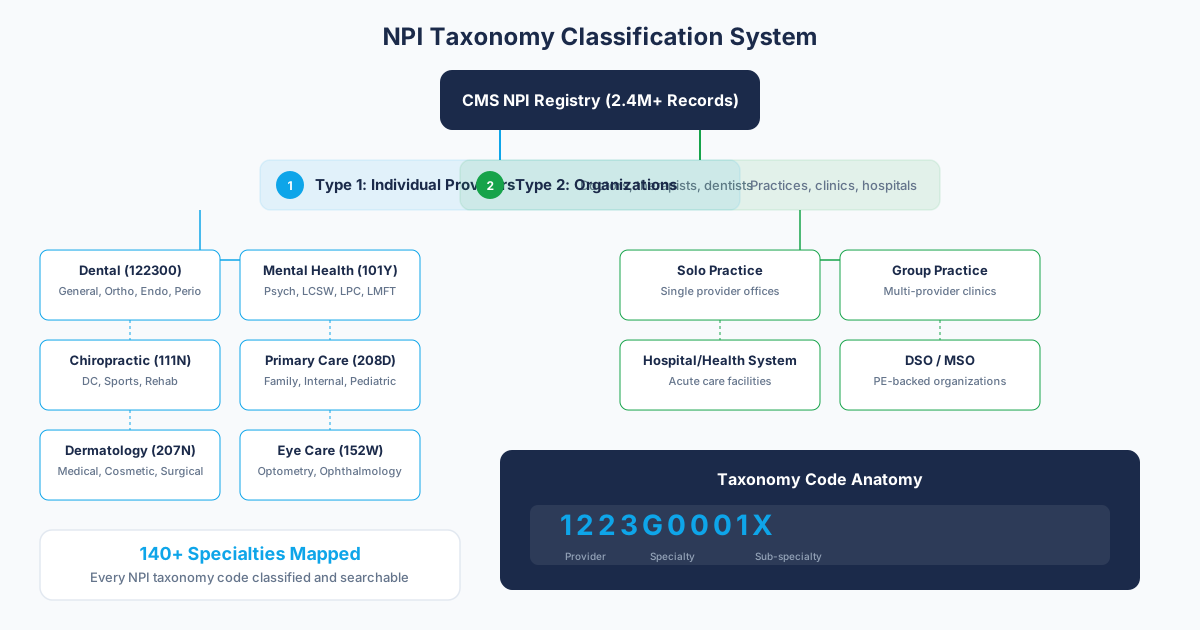
NPI taxonomy gets you to "Cardiovascular Disease" (207RC0000X) and a few sub-codes. That's not enough. The provider's training, current procedures, and institutional role matter more than the taxonomy code.
Interventional Cardiology
Interventional cardiologists perform cath lab procedures: PCI, stenting, balloon angioplasty, and increasingly, structural heart interventions. They are the primary buyers for drug-eluting stents, guide catheters, intravascular imaging (IVUS, OCT), and peripheral vascular devices. Roughly 5,000 board-certified interventionalists practice in the US.
Data fields you need: cath lab volume (annual PCI count), academic vs community practice, structural heart program participation, peripheral vascular procedures performed, current stent brand preference, and TAVR program involvement.
Electrophysiology (EP)
EP specialists implant pacemakers, ICDs, CRT devices, leadless pacemakers, and perform ablation procedures for atrial fibrillation and ventricular arrhythmias. Around 2,500 EPs are board-certified. The EP lab is one of the highest-revenue cost centers in any cardiology program, and the buying committee usually includes the EP medical director, the lab manager, and the hospital's value analysis committee.
Data fields: ablation volume (AFib, VT), CIED implant volume, current device manufacturer (Medtronic, Abbott, Boston Scientific, Biotronik), pulsed-field ablation adoption, leadless pacemaker volume, and academic affiliations for clinical trial recruiting.
Structural Heart
Structural heart cardiologists perform TAVR, MitraClip, Watchman, and increasingly tricuspid interventions. The procedure list is exploding as new devices get FDA-cleared. These programs require multidisciplinary heart teams (interventionalist + cardiac surgeon + imaging cardiologist + anesthesiologist + coordinator), so your contact map needs all five roles for each program.
Data fields: TAVR volume, MitraClip volume, structural heart program designation, current valve brand preference (Edwards vs Medtronic for TAVR, Abbott for MitraClip), and heart team composition.
Advanced Heart Failure
HF specialists manage advanced heart failure patients, including LVAD candidates, transplant candidates, and CardioMEMS implant patients. Roughly 1,000 board-certified advanced heart failure specialists practice in the US. They concentrate at academic medical centers and large regional referral programs.
Data fields: LVAD program designation, transplant program designation, CardioMEMS implant volume, current LVAD device (HeartMate 3 vs alternatives), heart failure clinic patient volume, and remote monitoring program participation.
Cardiac Imaging
Imaging cardiologists run echo labs, nuclear cardiology programs, cardiac CT, and cardiac MRI. They are buyers for ultrasound systems, contrast agents, AI imaging analysis software, and PACS integration tools. Many academic programs have dedicated imaging cardiologists; community practices often have generalists who read echos.
Data fields: echo lab accreditation (IAC), nuclear cardiology accreditation (ICANL), cardiac CT volume, cardiac MRI capability, AI imaging tool adoption, and current ultrasound vendor.
General Cardiology
General cardiologists see clinic patients, manage chronic conditions, prescribe cardiovascular medications, and refer to sub-specialists for procedures. They're the largest sub-specialty group and the primary buyers for outpatient diagnostic equipment, EHR-integrated workflow tools, and prescription medications.
Data fields: practice setting (academic, employed, independent group, solo), patient panel size, hypertension and lipid clinic participation, anticoagulation clinic participation, and primary referral relationships to interventional/EP/structural heart programs.
The Decision-Maker Map for Cardiology Sales
For any cardiology vendor selling into a hospital-employed cardiology program, the contact map should include:
- Cardiology service line director - manages the entire cardiovascular service line P&L
- Cath lab director - operational leader of the cath lab, often a senior interventionalist
- EP lab director - operational leader of the EP lab
- Echo lab director - imaging cardiologist running the echo program
- Cardiology department chair - academic leadership role
- Cardiothoracic surgery chief - relevant for structural heart programs
- Hospital value analysis committee chair - approves new vendor relationships
- Supply chain director - executes contracts and manages vendor relationships
- Biomedical engineering manager - approves capital equipment installations
- Cardiology nursing leadership - involved in workflow tool decisions
For independent cardiology groups, the buying committee is smaller but still multi-stakeholder: the managing partner, the practice administrator, the office manager, and the relevant clinical lead for the product. Independent groups are increasingly rare but they buy faster than hospitals, which is why they're high-value targets even if the volume is lower.
Mistakes Cardiology Vendors Keep Making
Mistake 1: Targeting Sub-Specialty Without Procedure Volume
An interventionalist doing 50 PCIs per year is not the same buyer as one doing 500. Your data needs procedure volume estimates. Without them, you're treating high-volume operators and low-volume operators identically, and your ROI on outreach falls in half.
Mistake 2: Ignoring the Heart Team
Structural heart is a team sport. If your TAVR pitch only includes the interventionalist and not the cardiac surgeon, the imaging cardiologist, and the program coordinator, you're talking to one person on a five-person committee. Map all five.
Mistake 3: Missing the Service Line Director
The cardiology service line director is the single highest-leverage contact at any hospital cardiology program. They manage the P&L, they sit on value analysis committees, they have direct relationships with supply chain, and they decide which vendors get pilots. If your data doesn't include service line directors at every target hospital, you're missing the most important contact in the building.
Mistake 4: Treating EP and Interventional As Interchangeable
They share a fellowship root and they both work in cath labs, but they buy completely different products. EPs buy ablation catheters, mapping systems, leadless pacemakers, and ICDs. Interventionalists buy stents, guide catheters, IVUS, and TAVR valves. Cross-pitching these products to the wrong sub-specialty wastes outreach and signals you don't understand the market.
Frequently Asked Questions
How many cardiologists practice in the United States?
Approximately 33,000 cardiologists practice in the US, according to the American College of Cardiology. The specialty splits into at least six sub-specialties: general cardiology, interventional cardiology (~5,000), electrophysiology (~2,500), advanced heart failure (~1,000), structural heart, and cardiac imaging. Each sub-specialty buys different products and has different decision authority.
Why does sub-specialty classification matter for cardiology sales?
Cardiology sub-specialties have completely different procedure mixes and buying committees. Electrophysiologists buy ablation catheters and CIEDs. Interventionalists buy stents and IVUS. Structural heart specialists buy TAVR valves and MitraClips. Heart failure specialists work with LVADs and CardioMEMS. Pitching the wrong product to the wrong sub-specialty wastes outreach and damages credibility.
Who actually buys cardiology equipment at a hospital?
The cardiology service line director, the relevant lab director (cath lab, EP lab, echo lab), the hospital value analysis committee, supply chain, and biomedical engineering. The cardiologist is an influencer but rarely the buyer for capital equipment. Disposables flow through GPO contracts. Pharmaceuticals face formulary committee review. Your data needs all of these contacts, not just the prescribing physician.
How do I identify high-volume cardiology operators?
Public signals include: STS National Database participation, NCDR (National Cardiovascular Data Registry) participation, accredited program designations (chest pain center, AFib center, structural heart program), clinical trial principal investigator records, and published case volume in research papers. Commercial data vendors layer claims-derived procedure counts on top of these public signals.
What does a cardiology heart team look like?
For structural heart programs, the heart team typically includes: an interventional cardiologist, a cardiothoracic surgeon, an imaging cardiologist, an anesthesiologist, and a program coordinator. All five roles weigh in on patient selection and product preference. Selling structural heart products without contact data for all five roles means you're talking to a fraction of the buying committee.
How is cardiology employment shifting?
More than 70% of cardiologists now work in hospital-owned practices or are employed by hospital systems, according to AMA practice benchmark data. This has shifted purchasing authority from individual cardiologists and small groups to hospital service line directors, value analysis committees, and supply chain teams. Sales motions built for the old independent-group landscape don't work in the consolidated environment.
Sources and References
Related Resources
Get the Provider Data You Need
Tell us what you're looking for. We'll build a custom list matched to your target market.
Trusted by healthcare sales teams, medical device companies, and health IT vendors across the US.