
ASC Decision Makers: Who to Target and How
Ambulatory surgery centers are growing faster than almost any other healthcare facility type. Here's who makes buying decisions inside them.
2026-03-29
The ASC Market Is Booming
Ambulatory surgery centers are one of the fastest-growing segments in US healthcare. There are now over 6,100 Medicare-certified ASCs according to CMS provider data, and the count is increasing as procedures continue shifting from hospital outpatient departments to lower-cost freestanding facilities.
The economics are driving the shift. Medicare payment rates for ASC procedures have been increasing, while hospital outpatient costs have been growing faster. Payers want procedures done in ASCs when clinically appropriate because it costs them less. Physicians want to operate in ASCs because they can own equity and control their surgical environment. And patients prefer them because the experience is typically faster and more comfortable than a hospital.
For anyone selling medical devices, surgical supplies, practice management software, revenue cycle services, or clinical staffing into this market, ASCs represent a large and growing addressable market. But selling to ASCs requires understanding their unique organizational structure and knowing exactly who makes purchasing decisions.
ASC Ownership Models
Not all ASCs are structured the same way, and the ownership model determines who controls vendor relationships.
Physician-Owned ASCs
Roughly 55-60% of ASCs are owned wholly or partly by the physicians who operate there. Ownership might be a single surgeon, a group of surgeons, or a partnership where physicians hold majority equity. In physician-owned ASCs, the physicians collectively make capital purchasing decisions, often through a governing board composed of the physician-partners.
The key contact at a physician-owned ASC is typically the managing partner (the physician who takes the lead on business operations) and the administrator or center director (the non-physician who runs day-to-day operations). Both need to be in your outreach sequence.
Hospital-Affiliated ASCs
About 25-30% of ASCs are joint ventures between physicians and hospital systems. The hospital provides capital and administrative support. The physicians provide cases and clinical expertise. Decision-making is shared, with capital expenditures above a certain threshold requiring approval from both the physician board and the hospital system's leadership.
Selling into hospital-affiliated ASCs is harder because you need buy-in from two separate organizations. The physician-partners may love your product, but the hospital system's supply chain department wants to standardize on a different vendor. Navigating this dual authority requires contacts on both sides.
Corporate-Owned ASCs
The remaining 10-15% of ASCs are owned by national management companies like USPI (Tenet), AmSurg (Envision), and SCA Health (UnitedHealth Group). These organizations manage hundreds of centers and make purchasing decisions centrally for most vendor categories. Individual center administrators have limited authority.
Selling to corporate ASC chains is an enterprise sale. You need to reach the corporate VP of Supply Chain or VP of Clinical Services, not the local administrator. The local team can champion your product, but the buying decision happens at corporate headquarters.
The ASC Org Chart
ASC organizational structures are flatter than hospital org charts, which is an advantage for sales. There are fewer layers between you and the decision-maker. Here are the roles that matter.
Medical Director
Usually a physician-owner who provides clinical oversight. The medical director sets clinical protocols, approves new procedures, and often has significant input on equipment and device purchasing. They're the clinical voice in purchasing discussions.
Reaching them: NPI data identifies physicians who list the ASC as their practice location. Cross-reference with the ASC's website to identify who holds the Medical Director title. Many ASCs list their medical director on their "About" page or in their state licensing filings.
Administrator / Center Director
The operational leader who manages staffing, scheduling, budgeting, vendor relationships, and regulatory compliance. At most ASCs with 2-6 operating rooms, this is the single most important contact for non-clinical purchases. They control the budget, negotiate contracts, and manage vendor performance.
Reaching them: ASC administrators rarely appear in NPI databases because they're not healthcare providers. They're business professionals. LinkedIn is the best source for identifying administrators by name. Search for titles like "Administrator," "Center Director," "Director of Operations," or "Business Manager" combined with the ASC's name or parent organization.
Director of Nursing / Clinical Director
Oversees nursing staff, OR processes, and clinical quality. For surgical supplies, instrument trays, and clinical workflow products, the DON or Clinical Director is often the primary evaluator and sometimes the decision-maker for purchases under $10K-25K.
Materials Manager / Purchasing Coordinator
At larger ASCs (4+ ORs), a dedicated materials manager handles supply ordering, inventory, and vendor coordination. They don't make strategic purchasing decisions, but they influence reordering and can block or facilitate vendor trials. At smaller ASCs, the administrator handles this role.
Governing Board
Physician-owned and joint-venture ASCs have a governing board (the physician-partners) that approves major capital expenditures. For purchases above $25K-50K, you need board approval. This means your champion (administrator or medical director) needs to present your solution at a board meeting and get a vote. Board meetings are typically monthly or quarterly, which adds time to the sales cycle.
Data Sources for ASC Decision-Maker Identification
Finding the right people at ASCs requires merging data from several sources because no single database covers both the clinical and administrative contacts you need.
CMS Provider Enrollment Data
CMS maintains a list of all Medicare-certified ASCs including facility name, address, and CMS Certification Number (CCN). This is your base universe for ASC targeting. It's updated monthly and is the most complete list of operating ASCs in the country. Download it from CMS Provider Data.
State Licensing Records
Most states require ASCs to be licensed separately from the physicians who operate there. State licensing records often include the facility's administrator name, medical director, and ownership entity. Quality varies by state, but this is one of the few public sources that names non-physician contacts at ASCs.
NPI Registry
ASCs with organizational NPIs (Type 2) appear in the NPPES registry with an authorized official listed. The authorized official is often the administrator or a physician-owner. Individual physicians who practice at the ASC have Type 1 NPIs that may list the ASC as their practice address, allowing you to identify which surgeons operate there.
ASC Association Directories
The Ambulatory Surgery Center Association (ASCA) maintains a member directory. Not all ASCs are members, but ASCA membership indicates an engaged facility that's likely receptive to vendor conversations. Member listings sometimes include administrator names and contact information.
For administrators and operational staff, LinkedIn is often the best source. Search for "ASC Administrator," "Surgery Center Director," or "Ambulatory Surgery Center" combined with geography. Build a list of named contacts and match them to your CMS facility list. Our social profiles data automates this matching at scale.
Practice Websites
Many ASCs maintain their own websites with staff directories, physician directories, and contact information. Web scraping at scale can extract administrator names, medical director names, and direct phone numbers that don't appear in any database.
ASC Segmentation for Sales Targeting
Not all ASCs are equal as prospects. Here's how to segment them.
By Specialty Mix
ASCs specialize. Some focus on a single surgical specialty (orthopedic-only, ophthalmology-only). Others are multispecialty. Your product's relevance depends on the specialty mix. CMS claims data can help identify what procedures an ASC performs, but it's not publicly available. Proxy indicators include the specialties of the physicians who list the ASC as their practice location (available from NPI data) and the ASC's website content.
By Size (Operating Rooms)
ASC size ranges from single-OR facilities to 10+ OR centers. Size correlates with purchasing authority, deal size, and organizational complexity. Larger ASCs have dedicated purchasing staff. Smaller ASCs have one administrator handling everything. Size data comes from state licensing records and CMS survey data.
By Ownership Model
As discussed above, physician-owned, hospital-affiliated, and corporate-owned ASCs have different decision-making structures. Segment by ownership to match your outreach strategy to the right contacts and the right sales cycle.
By Geography
ASC density varies significantly by state. Florida, Texas, California, and Maryland have the highest concentrations. States with favorable ASC licensing laws and certificate-of-need (CON) exemptions have more ASCs per capita. Focus your territory efforts on high-density markets where you can build rep expertise and referral networks.
Outreach Strategies for ASCs
Lead With the Administrator
For non-clinical products (RCM software, scheduling systems, billing services, facility supplies), start with the administrator. They manage vendor relationships and can evaluate your solution without needing physician approval for initial conversations. The administrator is also the person who's most responsive to email outreach because managing vendor inquiries is part of their job.
Lead With the Surgeon for Clinical Products
For devices, implants, and clinical technology, start with the surgeon. Specifically, the surgeon who would use the product and who has equity in the ASC. An owner-surgeon who wants a particular device has both the clinical authority and the financial incentive to push the purchase through the governing board.
Multi-Thread From Day One
Contact the administrator and the medical director simultaneously. Different message, same week. The administrator gets an operational pitch. The physician gets a clinical outcomes pitch. When they compare notes at their next meeting and both know your name, you've created internal momentum without either person feeling pressured.
Use Case-Level Data
If you can identify what procedures an ASC performs, you can tailor your pitch to their surgical specialty mix. An orthopedic ASC doing 40% total joints has different needs than one focused on sports medicine arthroscopy. Procedure-level targeting is where generic outreach becomes relevant outreach.
The ASC Opportunity for Data-Driven Sales
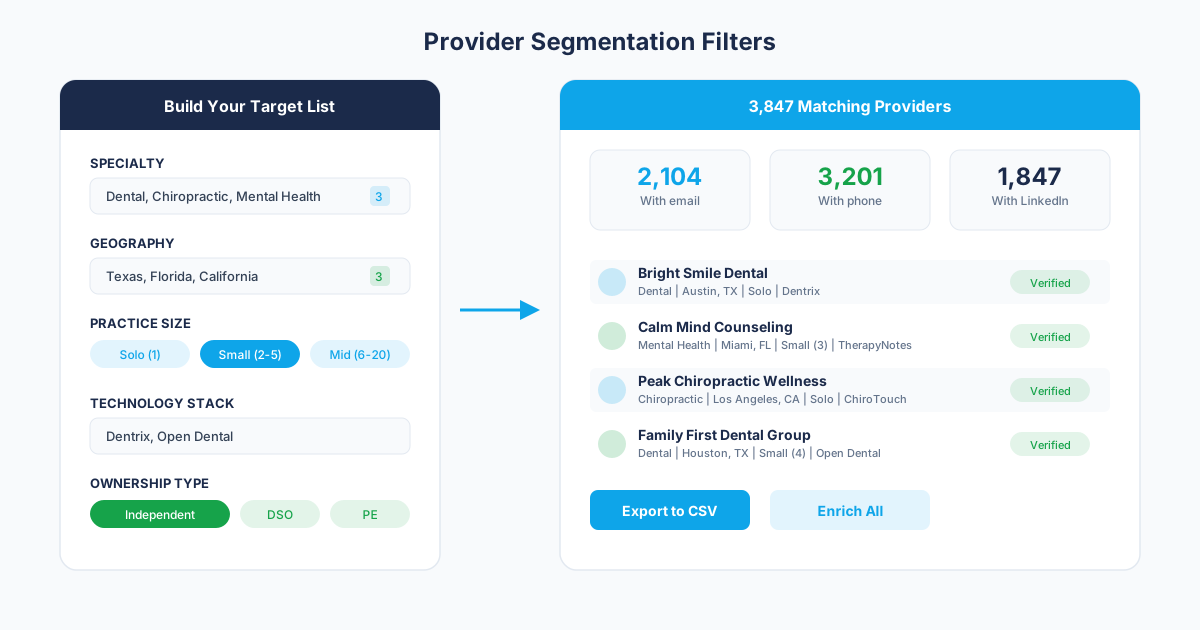
ASCs are underserved by most provider data vendors. The databases are optimized for hospitals and physician practices. ASC-specific data, especially administrator contacts and ownership structures, is sparse in the platforms that most sales teams use.
That gap is your opportunity. If you invest in building or buying an ASC-enriched database that includes facility-level contacts (not just the physicians who operate there), ownership classification, specialty mix indicators, and OR count data, you'll be reaching decision-makers that your competitors can't even identify.
The ASC market is growing, fragmented, and poorly covered by existing data infrastructure. Those are exactly the conditions where better data produces disproportionate results. For a deeper look at building ASC-specific prospect data, see our ASC data use case.
Frequently Asked Questions
Who makes purchasing decisions at ambulatory surgery centers?
It depends on the ownership model and purchase size. For day-to-day vendor decisions, the administrator or center director is the primary contact. For capital expenditures above $25K-50K, the governing board (physician-owners) must approve. At hospital-affiliated ASCs, the hospital system's supply chain also has approval authority. At corporate-owned ASCs (USPI, SCA Health), purchasing decisions are centralized at the corporate level.
How many ambulatory surgery centers are there in the US?
Over 6,100 Medicare-certified ASCs, according to CMS provider data. The actual number including non-Medicare-certified facilities is higher. The count is growing as procedures shift from hospital outpatient departments to freestanding ASCs driven by lower costs and payer preferences.
How do I find the administrator of an ASC?
Three best sources: state licensing records (many states require naming the facility administrator), LinkedIn searches for 'ASC Administrator' or 'Surgery Center Director' in your target geography, and the ASC's own website staff page. The NPI registry lists an authorized official for organizational NPIs, which is sometimes the administrator. No single source is reliable alone; cross-reference for best results.
What's the difference between physician-owned and hospital-affiliated ASCs?
Physician-owned ASCs (55-60% of ASCs) are owned entirely by the surgeons who operate there. Purchasing decisions are made by the physician governing board with the administrator managing vendor relationships. Hospital-affiliated ASCs (25-30%) are joint ventures requiring approval from both the physician board and the hospital system. Capital purchases need sign-off from both sides, making the sales cycle longer and more complex.
Sources and References
Related Resources
Get the Provider Data You Need
Tell us what you're looking for. We'll build a custom list matched to your target market.
Trusted by healthcare sales teams, medical device companies, and health IT vendors across the US.