
NPPES Data Accuracy vs Commercial Provider Databases
The NPPES file is free and contains every NPI in the country. Commercial provider data costs money. Understanding exactly what each gives you prevents both overspending and underinvesting.
Updated April 2026
What You Get in the NPPES Weekly Download
The NPPES Data Dissemination file is a free weekly export of the National Plan and Provider Enumeration System. It contains every active and deactivated NPI record in the United States, currently over 8 million records. The file is available as a full replacement download or as weekly incremental updates. It is published by CMS and serves as the authoritative source for provider identity in the US healthcare system.
Each record includes a defined set of fields. The NPI number itself is a unique 10-digit identifier assigned to every healthcare provider. The file contains provider name (first, last, middle, credential for Type 1 individuals; organization name for Type 2 organizations), provider specialty classifications (primary and secondary specialties using the standard provider classification system), practice location address, mailing address, enumeration date, last update date, NPI deactivation date and reason if applicable, and authorized official information for organizational NPIs.
specialty classifications are one of the most useful fields for segmentation. The standard provider classification system classifies providers into granular specialty categories. A Type 1 NPI record might have a primary classification of 207Q00000X (Family Medicine) and a secondary classification for a subspecialty. These codes let you filter the file down to specific provider types, which is essential for building targeted lists. However, specialty classifications are self-reported and not always current.
The file format requires technical handling. The full NPPES download is a large CSV file (multiple gigabytes) with over 300 columns, most of which are empty for any given record due to the flat-file structure accommodating multiple specialty classifications, addresses, and identifiers. Parsing it requires scripting or database tools. It is not something you open in Excel. Most teams use Python, SQL, or a data pipeline tool to extract the subset of records and fields they need.
Update frequency is a genuine advantage. Weekly updates mean you can track new NPI enumerations, deactivations, and address changes on an ongoing basis. For market sizing, identity resolution, and provider universe tracking, this cadence is more than sufficient. Few commercial vendors update their full databases weekly.
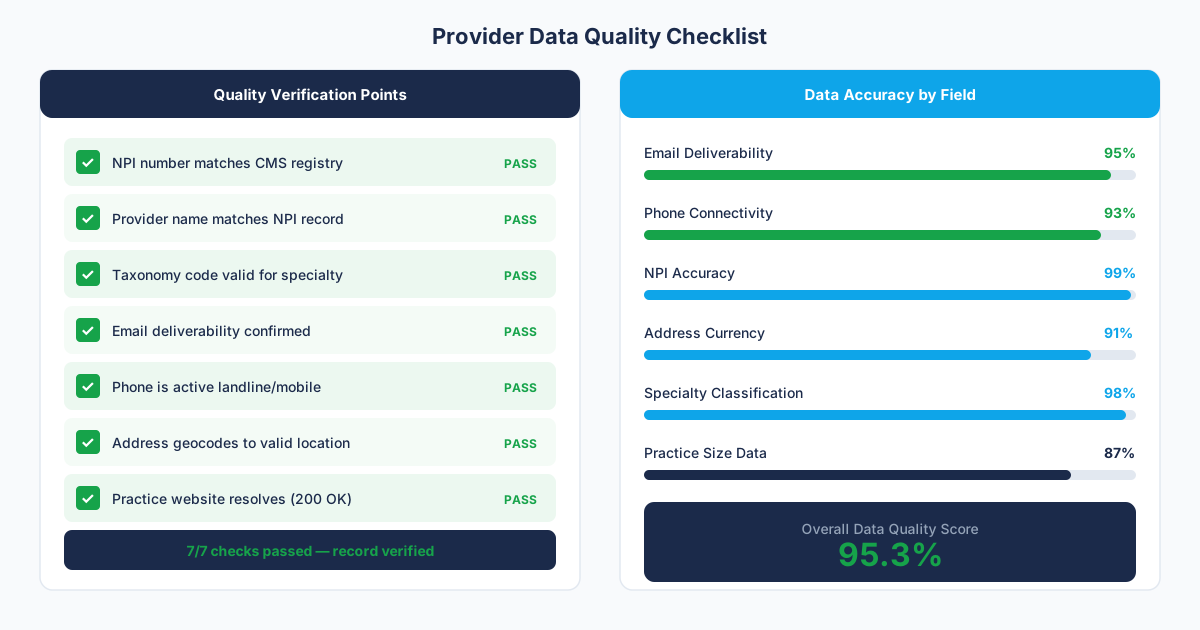
The NPI deactivation field is valuable for data hygiene. When a provider retires, loses their license, or dies, their NPI is eventually deactivated. The NPPES file includes the deactivation date and reason code. Cross-referencing your CRM or outreach lists against the deactivation file removes records for providers who are no longer practicing, which prevents wasted outreach and keeps your database current. This is a maintenance step that many teams overlook until bounce rates or wrong-number rates spike.
What Is Missing from NPPES Data
There are no email addresses in the NPPES file. This is the single biggest gap for any team that wants to use the data for outreach. CMS does not collect or publish provider email addresses. If your use case involves email campaigns, email verification, or CRM enrichment with email contacts, NPPES gives you nothing to work with.
Phone numbers are present but unreliable. The file includes a phone number field, but it is the number the provider submitted during enumeration, which may have been years ago. Many numbers are outdated main practice lines, fax numbers, or billing department numbers. Direct dial numbers and mobile numbers are not in the file. For cold calling campaigns, these phone numbers produce low connect rates and high wrong-number rates.
Addresses are self-reported and decay over time. Providers are supposed to update their NPI record when they change practice locations, but compliance is inconsistent. CMS does not independently verify addresses. Studies and industry experience suggest that 15-20% of NPPES addresses are stale at any given time, meaning the provider no longer practices at that location. For direct mail or territory mapping, this creates meaningful waste and inaccuracy.
There are no practice-level firmographics. NPPES tells you a provider's name, specialty, and address. It does not tell you the practice size, number of providers, ownership structure, revenue range, technology stack, payer mix, or any other firmographic attribute. You cannot distinguish a solo practitioner from a physician in a 200-provider group practice using NPPES data alone. For account-based targeting or ICP filtering, this is a critical gap.
Decision-maker identification is absent. The file does not indicate who makes purchasing decisions at a practice. There is no role field, no title field beyond medical credentials, and no way to determine whether a given NPI holder is a practice owner, managing partner, employed physician, or locum tenens. Selling into a practice requires knowing who to contact, and NPPES does not answer that question.
Non-physician staff are invisible in NPPES data. Practice administrators, office managers, billing managers, IT directors, and other non-clinical staff who frequently influence or control purchasing decisions do not have NPIs and therefore do not appear in the NPPES file at all. If your product is sold to administrative buyers rather than clinical buyers, NPPES does not contain your target contact. You need a data source that maps practices to their full staff, not just their licensed providers.
How Accurate Is the NPPES Database, Field by Field
NPPES accuracy is not a single number. It depends entirely on which field you look at. Identity fields like the NPI itself and the provider name are close to authoritative, because CMS assigns and controls them. Self-reported fields like address, phone, and classification decay because providers update them late or not at all, and CMS does not independently verify what they submit. The table below breaks down typical accuracy by field so you know which parts of the file to trust and which to validate before you use them.
| Field | Source | Typical Accuracy | What Breaks It |
|---|---|---|---|
| NPI number | CMS-assigned | Authoritative | Nothing; it is the primary key |
| Provider / org name | Self-reported, CMS-controlled | High | Name changes, mergers |
| Deactivation status | CMS-maintained | High | Lag between event and flag |
| classification / specialty | Self-reported | Moderate | Outdated or overly broad self-selection |
| Practice address | Self-reported | 80-85% current | Moves, acquisitions, late updates |
| Phone number | Self-reported | Low for direct contact | Main lines, fax, billing departments |
| Email address | Not collected | Not present | CMS does not collect it |
The headline figure most buyers ask about is address accuracy. Roughly 15-20% of NPPES practice addresses are stale at any given time, which puts current accuracy in the 80-85% range. That decay is not evenly distributed. Early-career physicians who move between training and first jobs, providers in markets going through practice acquisitions, and locum tenens clinicians all drift faster than the average. A list pulled straight from NPPES without an address-validation pass carries that 15-20% waste into every direct mail drop and territory map you build from it.
classification accuracy is a subtler problem. The code is present and the format is valid, but providers self-select it and rarely revisit it. A physician who shifted from general practice into a focused subspecialty may still carry the broad code they picked at enumeration. For segmentation, that means a classification pull catches most of the right providers but also drags in some who no longer fit, and misses some who do. Cross-referencing classification against credentialing or board-certification data is the fix, and it is the kind of validation our provider contact data service runs before a record reaches a customer.
Phone accuracy is where NPPES is weakest for outreach. The number is whatever the provider submitted at enumeration, which could be years old, and it is often a main practice line, a fax, or a billing department rather than a direct dial. For market sizing none of this matters. For a cold-calling campaign it is the difference between connecting and burning a list.
What Commercial Provider Data Adds
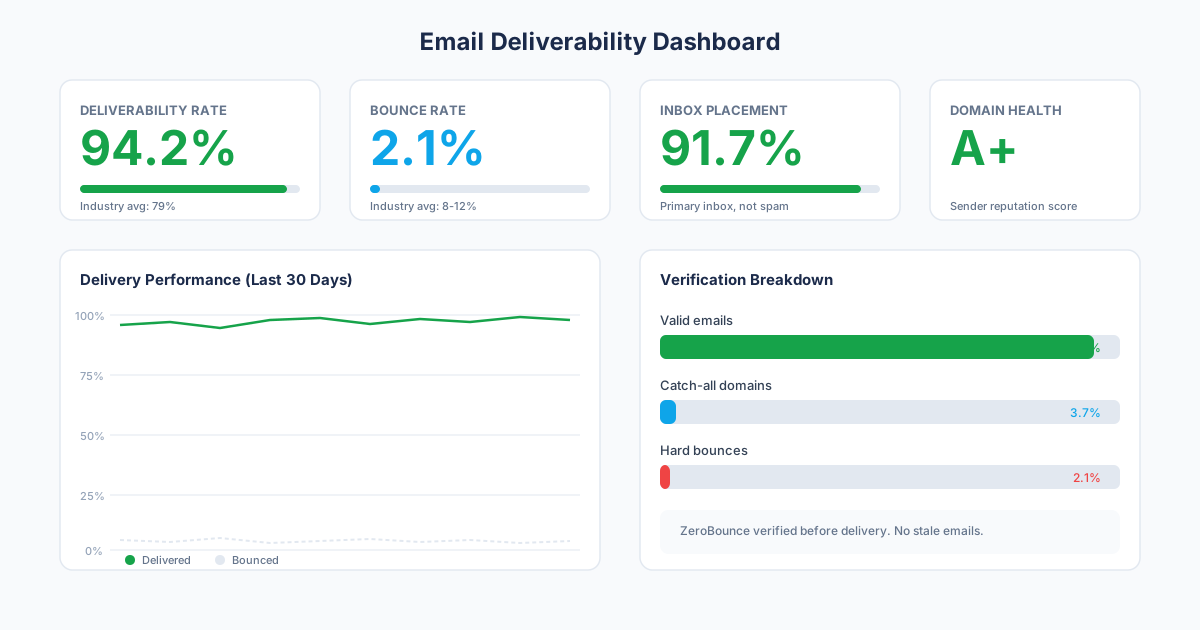
Contact enrichment is the primary value layer. Commercial provider data vendors match NPI records to verified email addresses, direct phone numbers, and in some cases mobile numbers. The verification process typically includes SMTP validation for emails, carrier lookup for phones, and periodic re-verification to maintain accuracy. Match rates vary by vendor and specialty, but a good vendor delivers verified email addresses for 60-80% of active practicing physicians.
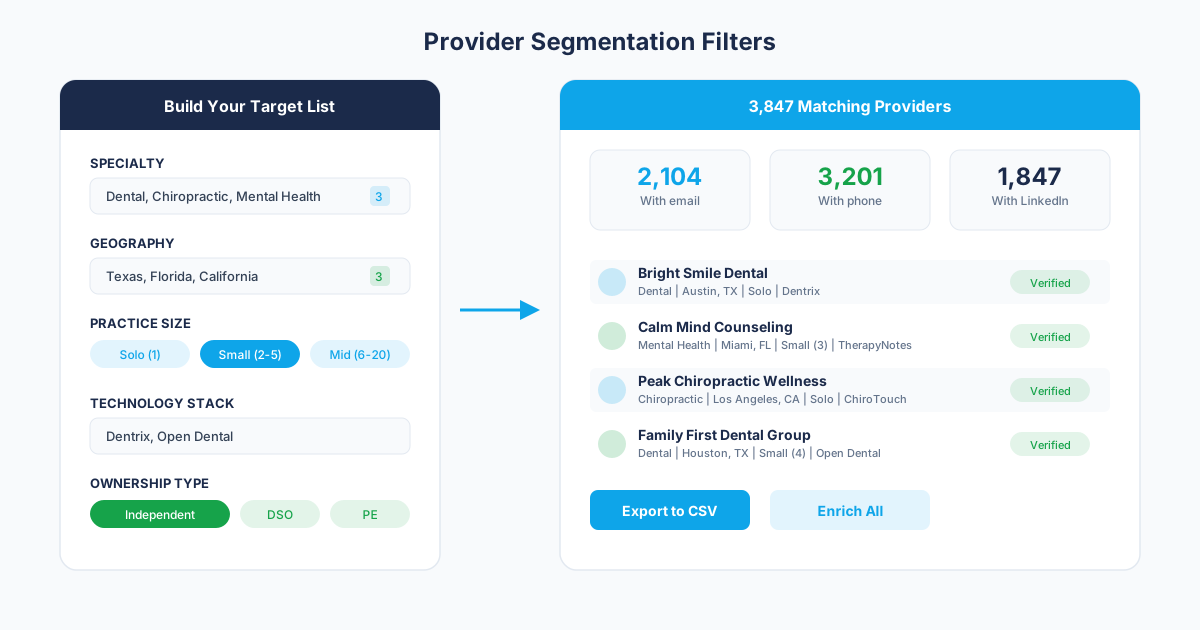
Practice aggregation connects individual providers to their practice entity. Commercial databases link individual NPI records to practice-level records, grouping all providers at a single location or under a single organization. This enables account-level analysis: how many providers are at this practice, what specialties are represented, is this a single-location practice or a multi-site group. NPPES contains both Type 1 (individual) and Type 2 (organization) NPIs, but the linkage between them is incomplete and unreliable.
Firmographic enrichment adds the fields that power targeting. Practice size, estimated revenue, ownership type (independent, group, DSO, health system-affiliated), years in operation, and technology detection (EHR system, practice management software, billing platform) are all fields that commercial vendors compile from multiple sources. These fields enable ICP filtering that goes far beyond specialty and geography.
Decision-maker identification connects you to the person who can say yes. For group practices, commercial datasets often include practice administrator names, office manager contacts, and managing partner identification. For health systems, they may include department heads, IT directors, and procurement contacts. This layer transforms a provider directory into a prospecting tool by mapping the buying committee, not just the clinical staff.
LinkedIn profile matching adds professional context. Some vendors match provider records to LinkedIn profiles, giving sales teams access to professional background, education, group memberships, and content engagement signals. This is particularly useful for personalized outreach and for identifying physicians who are active on LinkedIn and responsive to social selling approaches.
When to Use NPPES Directly vs When to Buy Commercial Data
Use NPPES directly for market sizing and universe definition. If you need to know how many cardiologists practice in Texas, or how many new NPIs were enumerated last quarter, the NPPES file answers those questions for free. Market sizing does not require contact information or firmographics. It requires accurate counts by specialty, geography, and provider type, which is exactly what NPPES provides.
Use NPPES for identity resolution and master data management. The NPI is the standard provider identifier across claims data, EHR systems, credentialing platforms, and health plan directories. If you are building a provider master data management system or matching records across multiple internal databases, the NPI from NPPES is your primary key. Commercial data is not needed for identity matching; it is needed for enrichment after the match.
Buy commercial data when you need to contact providers directly. Any use case involving email outreach, phone outreach, direct mail campaigns, or CRM enrichment requires contact information and verification that NPPES does not provide. The cost of commercial data is justified by the time savings over manual research and the deliverability improvements over unverified contact information.
Buy commercial data when you need to filter by attributes NPPES does not carry. If your ICP includes practice size, ownership type, technology stack, or decision-maker role, you need enriched data. Attempting to infer these attributes from NPPES data (e.g., counting NPIs at an address to estimate practice size) produces unreliable results and takes significant engineering effort to build and maintain.
Many teams use both. NPPES serves as the identity backbone and universe reference. Commercial data provides the enrichment and contact layers needed for outreach. The two are complementary, not competitive. The question is not which one to use but which combination of the two matches your use case and budget.
A hybrid approach also gives you a data quality audit layer. When you receive commercial data, you can validate provider identity against the NPPES file: confirm the NPI is active, verify the specialty classifications matches the specialty the vendor claims, and check the address against the NPPES address for consistency. Discrepancies between NPPES and your vendor data flag records that need investigation. Using NPPES as a reference layer makes you a more informed buyer of commercial data, not a less dependent one.
Cost Comparison: Free Download Plus Engineering vs Per-Record Pricing
NPPES is free to download, but free data is not free to use. Parsing the multi-gigabyte file, filtering to relevant records, cleaning specialty classifications, deduplicating, standardizing addresses, and loading the data into a usable format requires engineering time. For a team with existing data engineering resources, this might be a few days of work for the initial build and a few hours per week for ongoing maintenance. For a team without those resources, it could mean weeks of work or hiring a contractor.
The hidden cost of NPPES is the enrichment you have to do yourself. Once you have the base NPI records, you still need email addresses, phone numbers, firmographics, and verification. Building those capabilities internally means purchasing email-finding tools, phone validation APIs, address verification services, and web scraping infrastructure. Each of these has its own cost, learning curve, and maintenance burden. The total cost of a DIY enrichment pipeline often exceeds the cost of buying commercial data, especially at moderate volumes.
Commercial provider data pricing varies widely. Enterprise platforms charge $25,000-$100,000+ annually for platform access with seat-based licensing and annual commitments. Mid-market vendors charge $5,000-$25,000 per year. Provyx uses project-based pricing with a $2,500 minimum, so you can buy a scoped dataset without carrying an expensive annual platform license. A standard 5,000-record project is approximately $3,800 before optional enrichment, typically a fraction of an enterprise subscription.
Calculate your actual cost per usable record. Take your total spend (vendor fees, engineering time, tool subscriptions) and divide by the number of verified, outreach-ready records you produce. A $50,000 annual platform subscription that gives you 100,000 records sounds like $0.50 per record, but if only 40,000 pass verification and match your ICP, the effective cost is $1.25 per usable record. Compare that to a per-record vendor that charges a fixed price for verified, ICP-filtered records with no waste.
Delivery speed is an underappreciated cost factor. Building a list from NPPES with DIY enrichment might take 2-4 weeks. A commercial vendor with pre-built databases can deliver in days. If your sales team is idle or a campaign is delayed waiting for data, the opportunity cost of slow delivery can exceed the dollar cost of buying commercial data. Factor time-to-value into your comparison, not just unit economics.
The right comparison is total cost of ownership over 12 months, not just the initial purchase. Include data acquisition costs, engineering or analyst time for processing and cleaning, tool subscriptions for verification, storage and infrastructure, and the ongoing maintenance needed to keep the data current. A vendor that charges $X per record but delivers verified, CRM-ready data with no engineering overhead often costs less than a free NPPES download that requires 20 hours per month of engineering maintenance. Run the honest calculation for your specific team before deciding.
Frequently Asked Questions
How large is the NPPES data download file and what format does it come in?
The full NPPES replacement file is a CSV that exceeds 8 GB uncompressed and contains over 8 million records. It has more than 300 columns due to its flat-file structure accommodating multiple specialty classifications, addresses, and other identifiers per record. The file is also available as a compressed archive. Weekly update files are much smaller, containing only records that changed since the prior week. Most teams use Python, SQL, or ETL tools to process it rather than attempting to open it in spreadsheet software.
What percentage of NPPES addresses are typically inaccurate?
Industry estimates and practical experience suggest that 15-20% of NPPES practice location addresses are stale at any given time. Providers are required to update their NPI records within 30 days of a change, but compliance is inconsistent. Address decay is higher among early-career physicians, providers in markets with frequent practice acquisitions, and locum tenens providers. Running NPPES addresses through USPS address validation before using them for territory mapping or direct mail is a necessary step.
Can I use NPPES data for email outreach to physicians?
Not directly. The NPPES file does not contain email addresses. You would need to enrich NPPES records with email addresses from another source, then verify those addresses before sending. Some teams use email-finding tools that guess email patterns based on the provider name and practice domain, but accuracy varies and unverified emails risk bounces that damage sender reputation. For email outreach at any meaningful volume, purchasing verified email addresses from a commercial provider data vendor is more reliable and faster than DIY enrichment.
How often is the NPPES file updated by CMS?
CMS publishes NPPES updates weekly. A full replacement file is available for download alongside incremental weekly update files that contain only new or modified records. This weekly cadence means you can track new NPI enumerations, deactivations, address changes, and classification updates on an ongoing basis. For most use cases, processing the weekly incremental file is sufficient and far more efficient than re-processing the full file each week.
Is the NPPES database accurate enough to use as-is?
It depends on the field and the use case. NPI numbers, provider names, and deactivation flags are close to authoritative because CMS controls them, so NPPES is reliable for market sizing, identity matching, and CRM hygiene. Self-reported fields are weaker: practice addresses run about 80-85% current, specialty classifications are valid but often outdated or overly broad, and phone numbers are frequently main lines or fax numbers rather than direct dials. Emails are not in the file at all. For outreach, the contact fields need validation or replacement before you send.
How can I check the accuracy of NPPES records?
Validate field by field. Confirm the NPI is active against the current weekly file, run practice addresses through USPS address validation to catch the 15-20% that are stale, and cross-reference specialty classifications against credentialing or board-certification data to catch self-reported codes that no longer match the provider's actual focus. Phone numbers should be re-verified through a carrier or live check before any calling campaign, and emails have to be sourced and verified separately because NPPES does not carry them.
Sources and References
Related Resources
Get the Provider Data You Need
Tell us what you're looking for. We'll build a custom list matched to your target market.
Trusted by healthcare sales teams, medical device companies, and health IT vendors across the US.