
How a Neurodiagnostics Company Found the Clinics That Say Yes
A brain-health and neurodiagnostics company needed to know which TMS, neurology and diagnostic imaging clinics were worth a sales email. Provyx verified 1,570 locations in 20 U.S. metros, ranked each on its clinical activity and named the people who decide. Contacts from that list said yes at four times the cold-email benchmark. Provyx then analyzed the company's outreach and pipeline, showed where the yeses came from, and the company expanded into a new segment across 55 metros.
Published November 2026
The Results at a Glance
“Thanks for the analysis... I appreciate the clear recommendations. We will move ahead with the plan...”
Chief Business Officer, neurodiagnostics company, November 9, 2026
The Problem: Every Clinic Is Its Own Sale
The client is a brain-health and neurodiagnostics company. Clinics run its brain-function assessment on their own patients, and the company earns on each test. So the account that matters is a single physical location that sees the right patients, not a parent group or a legal entity.
The lists the team had grouped practices by legal name with one address each, and most of the rows tagged for TMS were general psychiatry organizations that might adopt TMS one day. The team was emailing thousands of contacts with no way to tell a busy TMS clinic from a mailing address.
The company needed the clinics that actually do the work, a way to rank them, and the person at each one who decides.
The Use Case: A Ranked List of Clinics to Sell To
The customer named three clinic segments in 15 states, and Provyx took the 20 largest metropolitan statistical areas in them, from New York and Los Angeles to St. Louis.
- TMS: psychiatry and mental health practices that deliver transcranial magnetic stimulation.
- Neurology: including memory, cognitive and concussion care.
- Diagnostic imaging: centers doing brain MRI or brain PET.
A fourth list covered companies that provide on-site neurology, psychiatry or dementia care in skilled nursing facilities, sized at the company level.
- Confirm each location. Each practice was checked on its own website, or for TMS in the provider directory of NeuroStar, an FDA-cleared TMS system, as open and doing the segment's work.
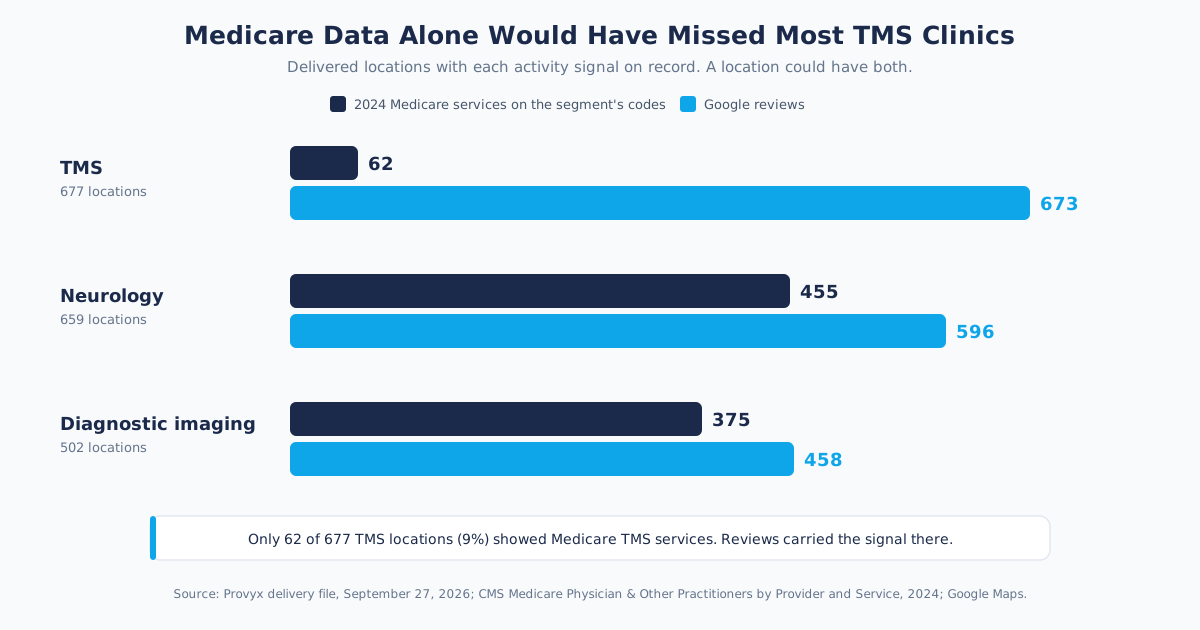
- Rank on activity. Each location carries its Medicare services on the billing codes the customer chose, from the public CMS Medicare Physician & Other Practitioners file, plus its Google rating and review count. Reviews mattered most for TMS, where Medicare data found only 62 of 677 clinics.
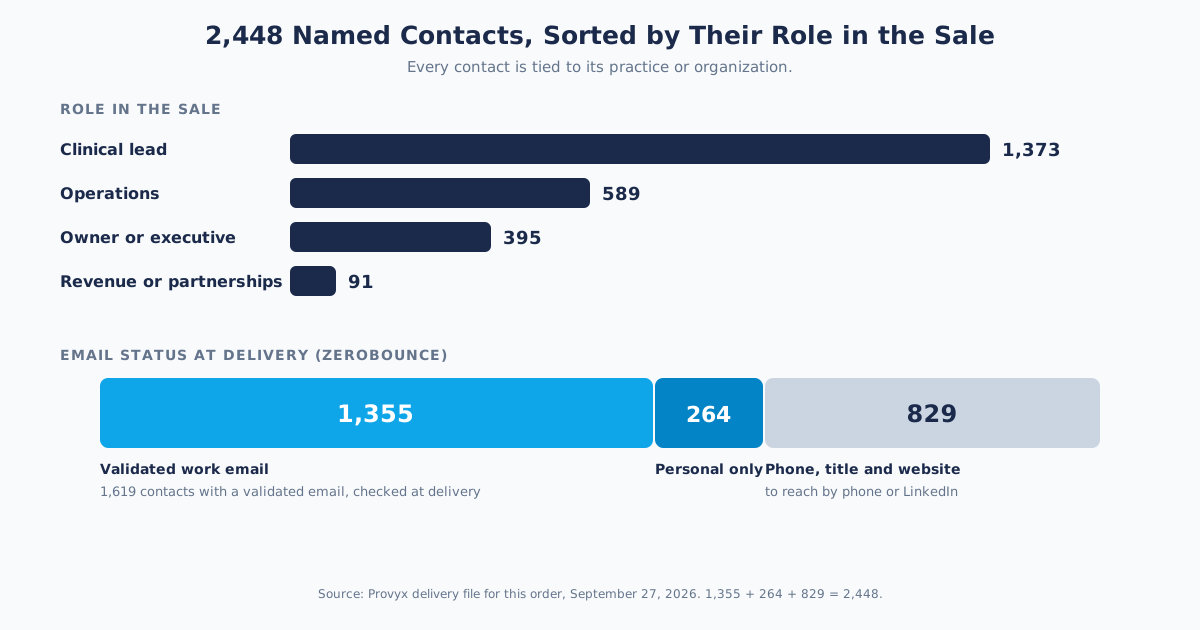
- Name the buyers. Clinical leads, owners, operators and partnership leaders at each account, each labeled by role, with emails validated with ZeroBounce at delivery.
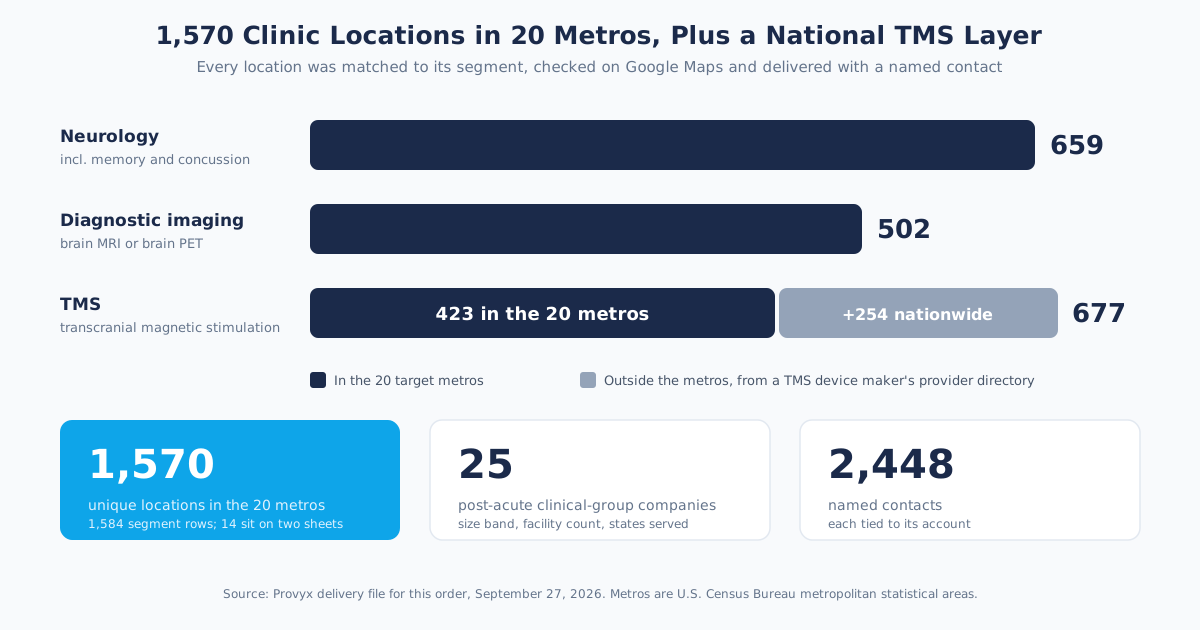
Doing this by hand, at 10 minutes to confirm a location and 5 to find and validate a contact, would have taken about 508 hours, roughly 13 work weeks for one researcher.
The Value: Growth Operations Showed What Was Working
A list only proves itself in the campaign. As part of our growth operations work, Provyx analyzed the company's cold-email workspace from August 24 to October 29 and its CRM pipeline through November 2: 22,083 emails, 10,281 contacts and 66 deals. We looked at who says yes, to what message, and what happens after.
The Targeting Worked
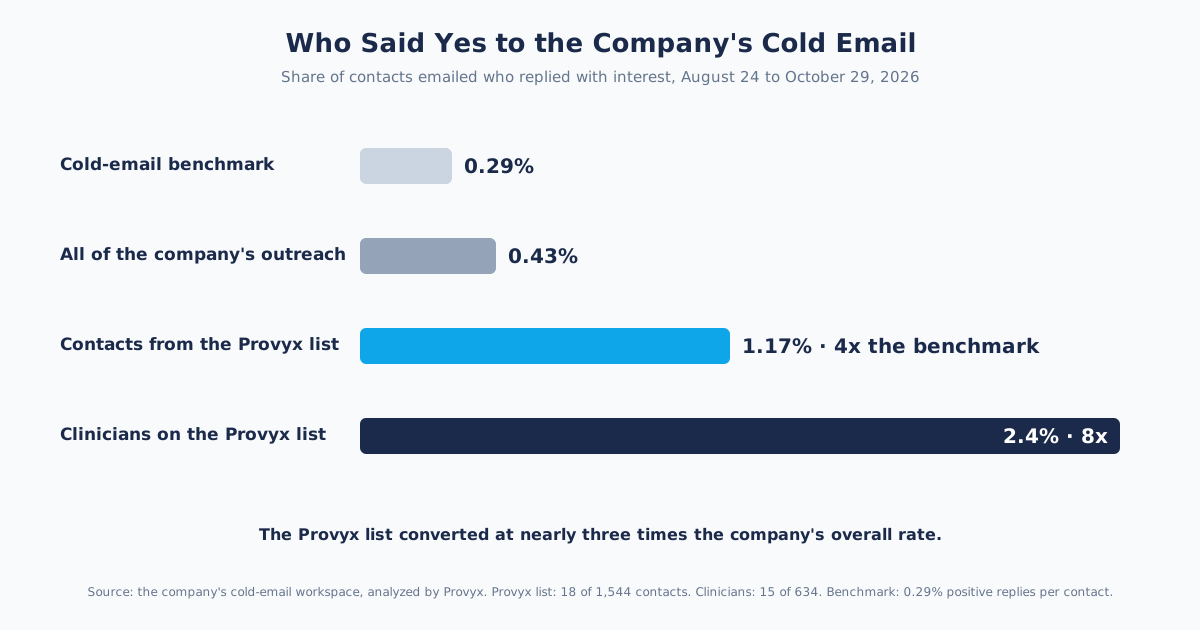
Contacts from the Provyx list said yes at 1.17%, four times the 0.29% cold-email benchmark and nearly three times the 0.43% the company saw across all of its outreach. Clinicians on the list said yes at 2.4%, eight times the benchmark. Within the list, the best segments were clear:
| Segment on the Provyx list | Said yes |
|---|---|
| Clinicians | 6.19% |
| Practices rated 4.5 stars and up | 4.53% |
| Practices with no Medicare billing on record | 3.96% |
| Practices with over 50 Google reviews | 3.80% |
| Average for the list | 3.2% |
Rates in the table count Provyx-list contacts on Google-hosted mailboxes, so the mail host does not skew the comparison. The list-wide rates above (1.17%, 2.4%) count every mailbox. Operations staff, by contrast, produced no yeses from 406 contacts. The lesson for the next list: owners, medical directors and treating clinicians first, operations last.
A Deliverability Problem Hiding in Plain Sight
Contacts on Microsoft-hosted mailboxes produced 1 yes in 1,618. Google-hosted contacts produced 36 in 1,714. The emails to Microsoft inboxes were almost certainly not being seen. Provyx recommended pausing those leads and setting up new sending accounts to test them properly, and the company moved ahead with the plan.
The Message and the Timing
- Lead with reimbursement. Emails that opened on reimbursement and revenue drew 5.3 yeses per 1,000 sent. "Your cognition evaluations" drew 0.5.
- Keep all three emails. 65% of the yeses came on the second or third email.
- Answer fast. 88% of replies arrived within 24 hours, and two thirds between 9am and 1pm Eastern.
- Answer the real questions. Interested clinics asked about reimbursement and billing codes, a demo, and who can run and read the test. Provyx recommended answering those three on the website and in the second email.
What the Pipeline Said About the Next Segment
The CRM showed that 5 of 5 deals that reached the contract stage closed, with a 30-day median from deal to win. It also showed where demand was coming from that no list had targeted: four deals touched the personal injury world, from a lien funder to a practice that tests every priority case to support settlements. Provyx recommended a personal injury segment, sized it metro by metro, and the company ordered it across 55 metros.
A Faster Website for the Prospects the Emails Send There
Interested prospects land on the company's website, so Provyx rebuilt it as part of the same growth operations work, with more ways to get in touch and a much lighter page. Measured with Google's PageSpeed Insights on mobile, the homepage went from 63 to 97 on performance.
| Homepage, mobile | Before | After |
|---|---|---|
| Performance score | 63 | 97 |
| Accessibility score | 77 | 93 |
| Total blocking time | 32,150 ms | 100 ms |
| Speed index | 7.0 s | 1.7 s |
Total blocking time is how long the page stays frozen while it loads. The old homepage locked up for more than 30 seconds on a phone. The new one is ready to use almost at once.
When This Approach Fits
Location-level targeting fits when you sell something whose value depends on volume at a single site: a device, a test, a service billed per use. It works best where Medicare data is thin, as with TMS, because reviews and the practice's own website fill the gap. If you sell into the same specialties, see our TMS practice data and neurology practice data.
The outreach analysis fits any team already sending email to a list. It tells you which segments, roles and messages produce meetings, so the next list is built on results rather than guesses. For territory design on top of a list like this, see medical device territory planning.
Related Resources
Selling Into Clinics One Location at a Time?
Tell us the specialties, the metros and the activity that marks a good account. We’ll confirm every location, rank it on that activity, name the people who decide, and show you which of them say yes.