
How to Evaluate Healthcare Data Vendors: A Buyer's Framework
Stop buying provider data blind. Here's how to test vendors before you sign.
2026-02-15
The Healthcare Data Vendor Landscape Is a Mess
There are over 50 companies selling healthcare provider data right now. Some are excellent. Some are reselling the same NPI Registry data you could download for free. And a disturbing number will lock you into an annual contract before you've had a chance to test a single record.
If you're buying provider data for sales prospecting, market analysis, or practice outreach, the vendor you pick will directly determine your team's hit rate. Bad data means wasted dials, bounced emails, and reps who stop trusting the CRM. Good data means your team spends time selling instead of researching.
This guide gives you a repeatable framework for evaluating healthcare data vendors. It covers what to measure, what questions to ask, how to run your own quality test, and how to compare pricing models so you don't overpay.
The 6 Criteria That Matter Most
Every vendor will tell you their data is "the best." That's meaningless. Here are the six things you should measure, ranked by impact on your sales outcomes.
1. Contact Accuracy Rate
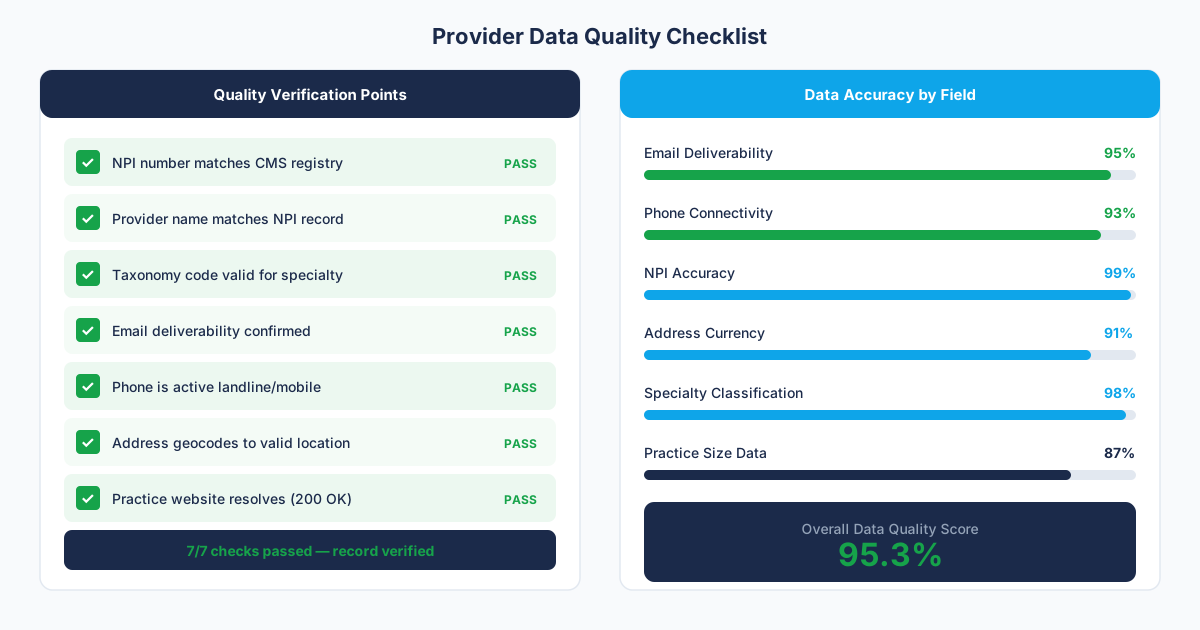
This is the single most important metric. What percentage of phone numbers connect to the right person? What percentage of emails are deliverable?
Industry benchmarks for healthcare provider data:
- Phone accuracy:: 70-85% is good. Below 65% is unacceptable. Above 85% is excellent.
- Email accuracy:: 80-92% is good. Below 75% means the vendor isn't verifying addresses.
- Physical address accuracy:: 90%+ is the baseline. Anything less means they're pulling from stale sources.
Don't accept a vendor's self-reported accuracy number. Test it yourself. More on that below.
2. Coverage Depth
Coverage has two dimensions: breadth (how many providers) and depth (how many data points per provider).
Breadth is easy to compare. The NPI Registry has roughly 2.3 million active individual providers and 900K organizational NPIs. A good vendor should cover the vast majority of these, plus add data points the NPI Registry doesn't include.
Depth is where vendors differ dramatically. The NPI Registry gives you name, classification, and mailing address. That's it. A strong vendor adds:
- Direct phone numbers (not the front desk line from Google)
- Verified email addresses
- Practice affiliations and group practice membership
- Technology stack (EHR, practice management, imaging systems)
- Insurance panel participation
- Provider headcount per location
- Decision-maker identification (office manager, practice owner, billing contact)
Ask specifically: "For my target specialty and geography, what percentage of records include a direct phone number? A verified email?" Don't let them quote overall averages. Different specialties have wildly different coverage rates.
3. Data Freshness
Healthcare practices change constantly. Providers move, retire, join new groups, change phone systems. A dataset that was 90% accurate six months ago might be 70% accurate today.
Questions to ask:
- How often do you reverify contact information? (Monthly is good. Quarterly is acceptable. Annually is a red flag.)
- What's your process for detecting practice closures and provider moves?
- Do you track when each record was last verified? Can I see that timestamp?
- What percentage of your database was verified in the last 90 days?
The best vendors continuously verify records rather than doing periodic batch refreshes. Continuous verification means records are checked on a rolling basis, so the database is never more than a few weeks stale for any given record.
4. Compliance and Data Sourcing
Healthcare data carries regulatory risk. You need to understand where your vendor's data comes from and how they handle compliance.
Key questions:
- What are your primary data sources? (Good answers: NPI Registry, state licensing boards, direct verification, public filings. Concerning answers: "proprietary" with no further detail.)
- Do you scrape data from provider websites or directories? If so, how do you handle terms of service?
- Is your data CAN-SPAM compliant for email outreach?
- Do you provide opt-out mechanisms?
- How do you handle HIPAA considerations? (Provider contact data isn't PHI, but some vendors conflate business data with patient data in confusing ways.)
A vendor who can't clearly explain their data sourcing methodology is either hiding something or doesn't have a methodology. Neither is good.
5. Delivery Format and Integration
How you receive the data matters more than most buyers realize. Consider:
- API access:: Essential if you want to enrich records in real time or integrate with your CRM. Ask about rate limits, documentation quality, and uptime SLAs.
- Bulk downloads:: CSV/Excel exports for one-time list builds or CRM imports. Ask about file size limits and custom field mapping.
- CRM integrations:: Native connectors for Salesforce, HubSpot, etc. Ask if they push updates automatically or if it's a manual sync.
- Custom formatting:: Can they match your internal schema? Or do you need to build transformation scripts?
If a vendor only offers bulk CSV downloads with no API, that's a sign they're operating with older infrastructure. It also means you'll spend engineering time on data pipeline work that should be the vendor's responsibility.
6. Support and Account Management
This sounds soft, but it matters. When you find data quality issues (and you will), how fast does the vendor respond?
Ask during the sales process:
- What's your average response time for data quality issues?
- Do I get a dedicated account manager or a shared support queue?
- Can you do custom research for niche specialties or geographies where your standard data is thin?
- What's your process for handling bulk data corrections?
Red Flags That Should Kill the Deal
After evaluating dozens of data vendors across my career, here are the warning signs that should make you walk away.
No Free Test Data
Any vendor confident in their data quality will give you a sample to test. If they won't provide 50-100 records from your target segment for validation, they know what you'll find.
Annual Contracts with No Out Clause
A 12-month commitment with no termination clause means the vendor knows churn is high. Good vendors offer monthly billing or at minimum a 90-day out clause. The data should earn your renewal, not a contract.
Accuracy Claims Above 95% with No Methodology
If a vendor claims 97% accuracy across all data points, ask exactly how they measure that. Most vendors who quote numbers that high are measuring something narrow (like "percentage of records with a phone number present") rather than something useful (like "percentage of phone numbers that connect to the right person").
They Can't Segment by Specialty or Geography
If you ask "how many dermatologists do you have in Texas with verified emails?" and the vendor can't answer within 24 hours, their data infrastructure isn't built for the queries you need. You'll be buying a big, undifferentiated dump.
The Data Looks Identical to the NPI Registry
Pull up the NPPES NPI Registry and compare it to the vendor's sample. If the addresses, phone numbers, and names match exactly, they haven't added any value. You're paying for a prettier interface on free government data.
No Transparency on Data Age
If the vendor can't tell you when individual records were last verified, they probably don't track it. That means some records could be years old and you'd never know.
How to Run Your Own Data Quality Test
Don't rely on vendor demos. Run your own test. Here's a step-by-step process that takes about 2-3 hours and will tell you everything you need to know.
Step 1: Define Your Test Segment
Pick a specific specialty and geography that matches your actual sales target. Don't let the vendor choose the sample. They'll cherry-pick their cleanest data.
Request 100 records. That's enough to calculate meaningful accuracy rates without spending days on validation.
Step 2: Validate Phone Numbers (30 minutes)
Have a rep call 25-30 numbers from the sample. Track:
- Connected to the right practice: yes/no
- Reached the named contact or their direct line: yes/no
- Disconnected/wrong number: yes/no
If fewer than 70% connect to the right practice, the data isn't worth buying. If fewer than 40% reach the named contact's direct line, the vendor is giving you front desk numbers, not direct contacts.
Step 3: Validate Email Addresses (15 minutes)
Run the email addresses through a verification tool like ZeroBounce, NeverBounce, or Kickbox. These cost $5-10 per 1,000 addresses. Track the percentage that come back as valid, invalid, or catch-all.
Valid rates below 80% are a problem. Catch-all rates above 30% mean the vendor is guessing at email formats rather than verifying them.
Step 4: Validate Practice Details (30 minutes)
Spot-check 20 records against the practice's actual website and Google Business Profile. Verify:
- Is the practice still open at that address?
- Does the named provider still work there?
- Is the specialty classification correct?
- Is the practice size estimate reasonable?
Step 5: Calculate Your Numbers
Build a simple scorecard:
- Phone accuracy: X%
- Email deliverability: X%
- Address accuracy: X%
- Provider-practice match rate: X%
- Overall usable record rate: X%
The "usable record rate" is the percentage of records where you have at least one working contact method and the practice/provider details are correct. This is the number that determines your ROI.
Comparing Vendor Pricing Models
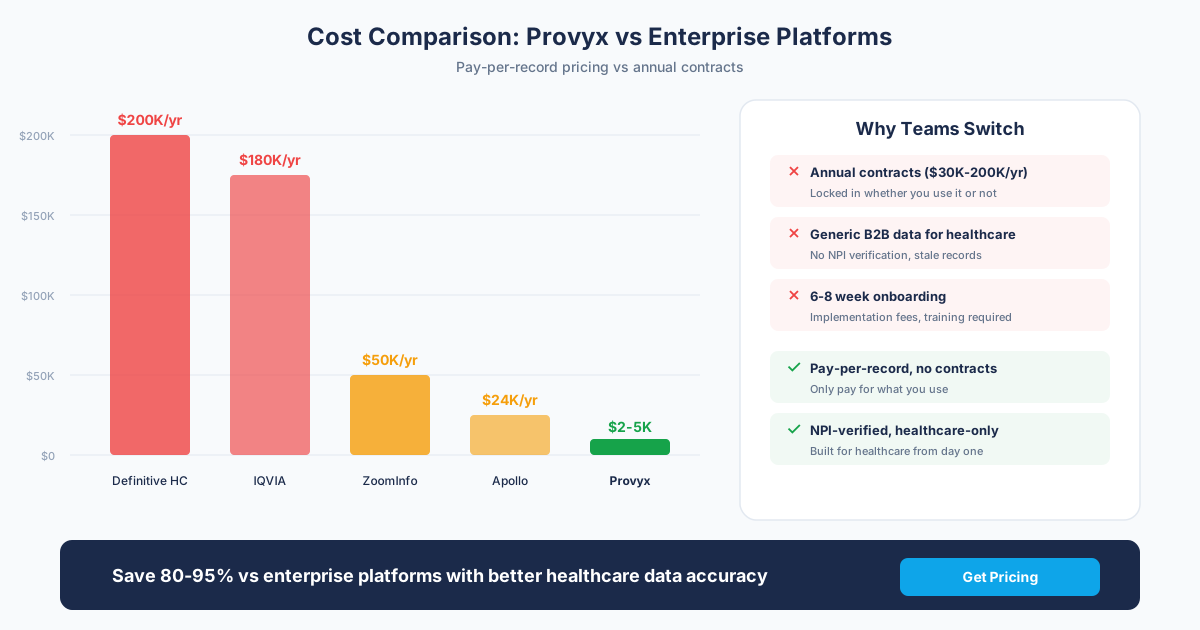
Healthcare data vendors use four main pricing models. Each has trade-offs, and the right one depends on how you use the data.
Per-Record Pricing
You pay for each record you pull. Typical range: $0.10 to $0.75 per record depending on data richness and specialty.
Best for: Teams that need small, targeted lists for specific campaigns. You only pay for what you use.
Watch out for: Costs that balloon when reps start pulling large lists. A 10,000-record pull at $0.50/record is $5,000.
Subscription/Platform Access
Monthly or annual fee for unlimited (or high-cap) access to the database. Typical range: $500 to $5,000+ per month depending on features and seat count.
Best for: Teams that do frequent prospecting across multiple specialties and geographies. The per-record cost drops quickly with volume.
Watch out for: Seat-based pricing that punishes you for adding reps. Also, "unlimited" often has practical limits buried in the terms.
Custom List Building
You specify criteria and the vendor builds a one-time deliverable. Pricing varies widely: $1,000 to $25,000+ depending on list size, research depth, and turnaround time.
Best for: One-time projects, market sizing, or highly specialized segments where off-the-shelf data is thin. Custom list builds often include manual research and verification that automated databases skip.
Watch out for: Vendors who charge custom pricing but deliver the same automated pull you could get from their platform.
Hybrid Models
A base subscription plus per-record charges for premium data points (like technology detection or enrichment). This is increasingly common and often the best value for mid-size teams.
Best for: Teams that need regular access to basic data but only occasionally need enriched records.
Watch out for: Complexity. Make sure you understand exactly what's included in the base fee and what triggers additional charges.
Questions to Ask During the Demo
Vendor demos are designed to show the product at its best. These questions cut through the polish and reveal what working with the vendor will be like.
Data Quality Questions
- "Can you show me the record count for [my target specialty] in [my target geography] with verified email addresses?" This tests real coverage, not total database size.
- "What's the average age of a record in your database? What percentage was verified in the last 90 days?"
- "How do you handle providers who practice at multiple locations? Do I get all locations or just the primary?"
- "What's your false positive rate for technology detection?" If they offer technology stack data, this question separates real detection from guessing.
Commercial Questions
- "Can I do a paid pilot before committing to an annual contract?" A 30-day paid trial at a slight premium is worth it.
- "What happens to my data if I cancel? Do I keep the records I've already downloaded?"
- "Is there a minimum commitment? What's the penalty for early termination?"
- "Do you offer volume discounts? At what thresholds?"
Technical Questions
- "Can I see your API documentation before I sign?" If the answer is no, expect integration headaches.
- "How do you handle deduplication? If I pull the same provider twice, am I charged twice?"
- "What CRM integrations do you support natively? What does the setup process look like?"
Building Your Evaluation Scorecard
After testing 2-3 vendors (don't test more than that, or you'll never make a decision), score them on this framework:
- Data quality (40% weight):: Phone accuracy, email deliverability, address accuracy, provider-practice match rate
- Coverage (20% weight):: Record count for your target segments, depth of data points per record
- Freshness (15% weight):: Verification frequency, age of records, process for detecting changes
- Pricing (15% weight):: Total cost of ownership for your expected usage, contract flexibility
- Support and integration (10% weight):: API quality, CRM connectors, response time, account management
Weight data quality highest because it's the hardest thing to fix after purchase. You can work around limited coverage by supplementing with other sources. You can work around clunky integrations with engineering effort. But if the core data is wrong, nothing downstream works.
When to Switch Vendors
Even after a thorough evaluation, you might need to switch. Here are the triggers:
- Accuracy degradation:: If your bounce rates or wrong-number rates increase by more than 10 percentage points over a quarter, the vendor's data quality is slipping.
- Price increases without value adds:: Annual price hikes of 10-15% are common in the data industry. If the data isn't getting measurably better, push back or shop around.
- Coverage gaps in new segments:: If your company expands into new specialties or geographies and the vendor can't keep up, you'll need a provider with broader reach.
- Integration blockers:: If your tech stack changes and the vendor can't integrate, the switching cost is worth it to avoid manual data work.
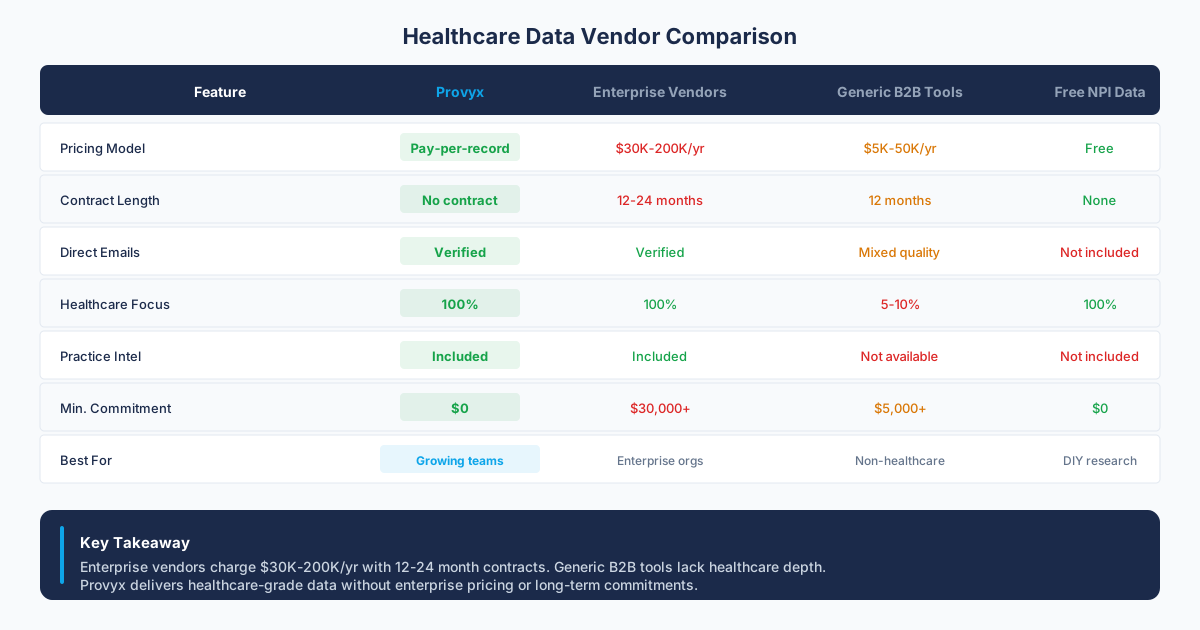
For a side-by-side look at how different vendors stack up, check our vendor comparison page and alternatives directory.
Make the Right Vendor Decision
Choosing a healthcare data vendor isn't a procurement exercise. It's a sales enablement decision that will affect your team's productivity every single day. Spend the time upfront to test properly, ask hard questions, and negotiate contract terms that protect you if the data doesn't perform.
The vendors who welcome scrutiny are the ones worth buying from. The ones who hide behind NDAs, refuse test data, and push for quick annual commitments are telling you everything you need to know.
If you want to see how Provyx's data performs against your current vendor, scope a list matched to your target segment.
Frequently Asked Questions
How many healthcare data vendors should I evaluate before choosing one?
Test 2-3 vendors maximum. More than that creates analysis paralysis without improving your decision. Pick your top candidates based on initial research, run your data quality test on each, and score them on the framework in this guide. The differences will be clear enough with 3 vendors to make a confident choice.
What's a good accuracy rate for healthcare provider contact data?
For phone numbers, 70-85% accuracy is good and above 85% is excellent. For email addresses, 80-92% deliverability is the target. Physical address accuracy should be 90% or higher. The most important metric is the 'usable record rate,' which is the percentage of records where at least one contact method works and the practice details are correct.
Should I choose per-record pricing or a subscription model for provider data?
It depends on your volume. If you pull fewer than 1,000 records per month, per-record pricing (typically $0.10-$0.75/record) is usually cheaper. If you pull more than 2,000 records per month across multiple specialties, a subscription ($500-$5,000+/month) gives you better per-record economics. Calculate your expected monthly usage and compare total costs.
How often should healthcare provider data be reverified?
Monthly reverification is the gold standard. Quarterly is acceptable for stable fields like specialty and NPI number, but contact information (phone, email) should be checked at least monthly. Ask your vendor what percentage of their database was verified in the last 90 days. If they can't answer that question, they probably don't track it.
Sources and References
Related Resources
Get the Provider Data You Need
Tell us what you're looking for. We'll build a custom list matched to your target market.
Trusted by healthcare sales teams, medical device companies, and health IT vendors across the US.